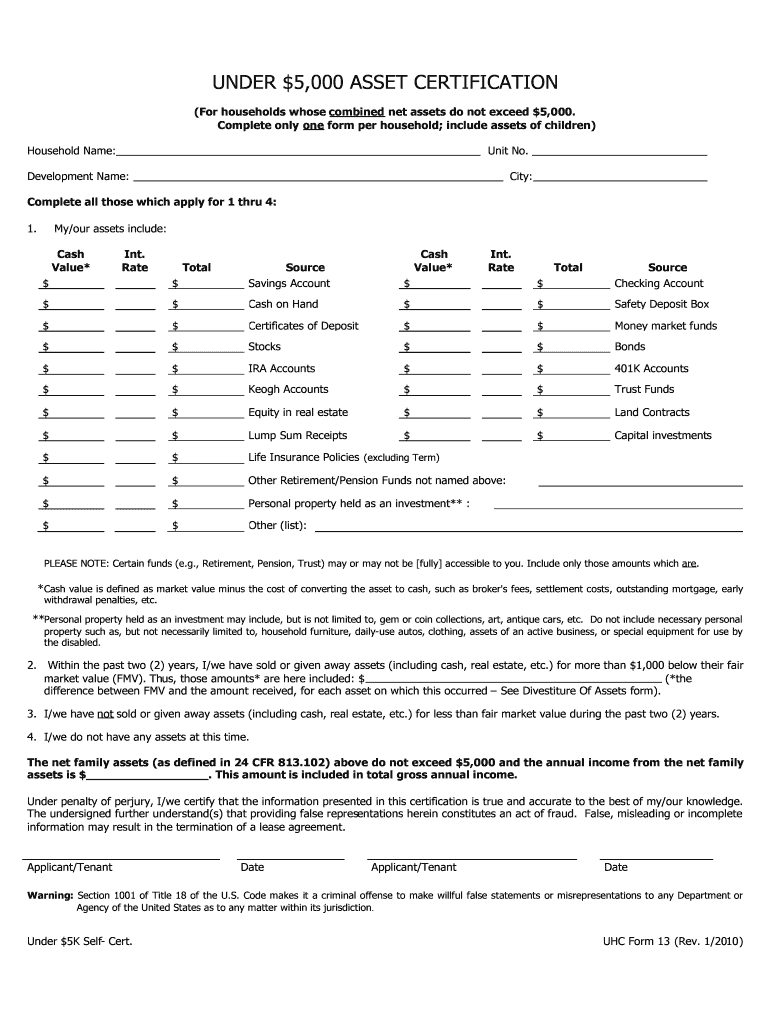







Definition and Meaning of the Under $5,000 Asset Certification
The Under $5,000 Asset Certification form is designed to document and verify a household's net assets that total less than $5,000. This form requires individuals or families to accurately list all assets, including cash, savings accounts, and investments. It serves as a binding declaration that the applicant's total combined net assets do not surpass the specified threshold. The emphasis on accuracy underscores the form's legal implications, warning that providing false information can result in severe legal consequences.
Steps to Complete the Under $5,000 Asset Certification
Completing the Under $5,000 Asset Certification involves several critical steps:
-
Gather Financial Documents: Collect detailed information about various assets, including bank statements, property deeds, and investment records.
-
List All Assets: Enumerate each asset accurately, providing current valuations. This includes cash in hand, savings accounts, certificates of deposit, and mutual funds.
-
Disclose Previous Transactions: Account for any assets sold or gifted below fair market value within the past two years.
-
Review for Accuracy: Double-check entries to ensure all information is precise and complete before submission.
-
Sign the Form: Acknowledge the information's accuracy through a signature, affirming legal responsibility for its honesty.
Key Elements of the Under $5,000 Asset Certification
-
Household Description: Information regarding household composition, ensuring clarity about who is included under the certification.
-
Asset Listings: Detailed records of all owned assets, emphasizing the need for precision in valuations.
-
Recent Transactions: Documentation of any asset sales or gifts conducted below market value in the past two years.
-
Certification Statement: A declaration confirming the truthfulness of the provided information, including potential legal consequences for discrepancies.
Who Typically Uses the Under $5,000 Asset Certification
This certification is commonly utilized by individuals or households applying for specific government programs or benefits contingent on income and asset eligibility. It is particularly relevant for those seeking housing assistance or benefits where assets significantly impact eligibility determination. Primarily, low-income households aiming to verify their financial situation to qualify for assistance use this form.


Important Terms Related to Under $5,000 Asset Certification
-
Net Assets: Total assets minus any liabilities.
-
Fair Market Value: The price an asset would sell for on the open market.
-
In-Kind Transfers: Non-cash asset transfers for which the fair market value must be declared.
-
Asset Cap: The maximum allowable asset limit for the form, which is currently $5,000.
Legal Use of the Under $5,000 Asset Certification
The certification's legal purposes include verifying financial eligibility for federally regulated housing assistance or other support programs. It acts as a formal record confirming an individual’s or family’s financial status, serving as evidence of eligibility based on assets. Legal compliance is critical, as false reporting can lead to penalties, disqualification from benefits, or legal action.
Examples of Using the Under $5,000 Asset Certification
-
Scenario A: A retired individual applies for subsidized housing; they need to confirm that their savings and pension accounts total under $5,000.
-
Scenario B: A single parent applies for food assistance and must prove their net worth does not exceed the asset limit by detailing bank and retirement accounts.
-
Scenario C: A recently unemployed household applies for temporary rental assistance, using the form to document their cash reserves and investment accounts.
Penalties for Non-Compliance
Failure to accurately complete the Under $5,000 Asset Certification can lead to serious repercussions:
-
Rescission of Benefits: Any benefits granted based on inaccurate information may be revoked.
-
Legal Action: Applicants may face prosecution, fines, or imprisonment if found guilty of providing false information.
-
Reputational Damage: Credibility loss, affecting future applications for assistance programs.
Ensuring precise and honest declarations is crucial to avoid these consequences.
Eligibility Criteria for the Under $5,000 Asset Certification
To use this certification form, applicants typically must:
-
Demonstrate Need: Prove that household assets are below $5,000, influencing eligibility for state or federal programs.
-
Declare All Assets: Fully disclose all types of assets and their values.
-
Meet Program-Specific Criteria: Each assistance program may have additional qualifying conditions that need to be met beyond asset assessment.