Plant Diagnostic Center 2025

Get Form
Plant Diagnostic Center Preview on Page 1

Here's how it works

01. Edit your form online
Type text, add images, blackout confidential details, add comments, highlights and more.
02. Sign it in a few clicks
Draw your signature, type it, upload its image, or use your mobile device as a signature pad.
03. Share your form with others
Send it via email, link, or fax. You can also download it, export it or print it out.

How to use or fill out Plant Diagnostic Center with our platform

Form edit decoration
9.5
Ease of Setup
DocHub User Ratings on G2
9.0
Ease of Use
DocHub User Ratings on G2
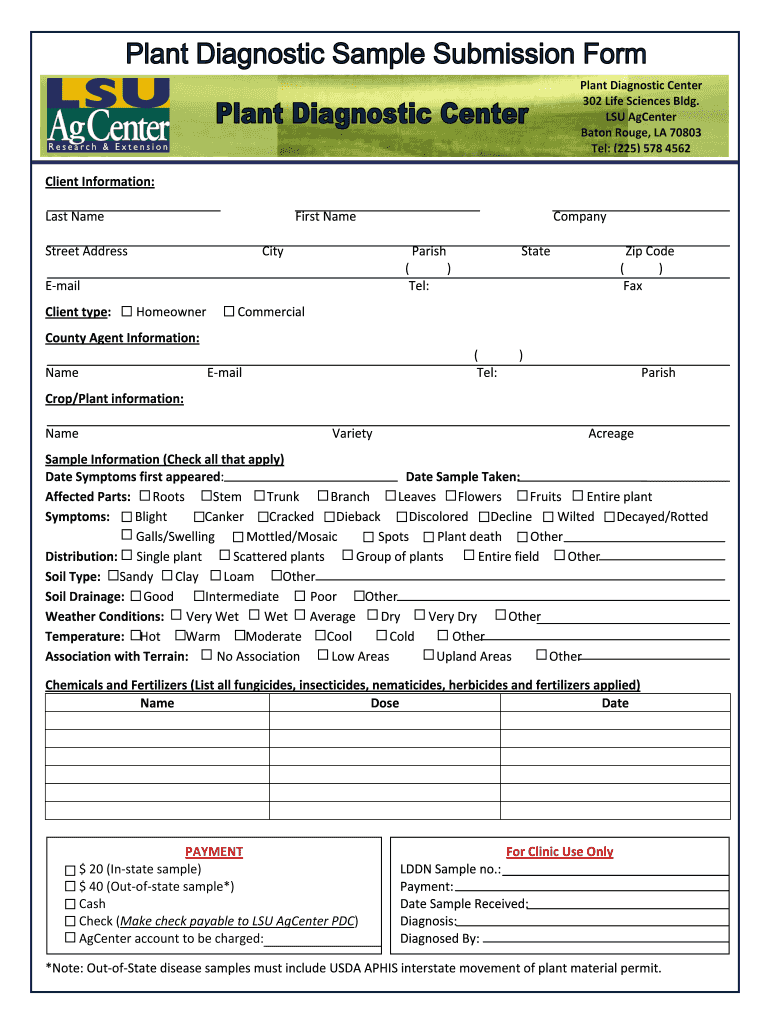
  1. Click ‘Get Form’ to open the Plant Diagnostic Center document in the editor.
  2. Begin by filling out the Client Information section. Enter your Last Name, First Name, Street Address, City, State, Zip Code, and contact details including Telephone and E-mail. Select your Client type as either Homeowner or Company.
  3. Next, provide County Agent Information if applicable. Fill in the Name, Telephone, E-mail, and Parish of your County Agent.
  4. In the Crop/Plant Information section, specify the Name and Variety of the plant along with Acreage. Check all relevant Sample Information fields such as Date Symptoms first appeared and Date Sample Taken.
  5. Indicate affected parts of the plant by checking options like Roots, Stem, Leaves etc., and describe symptoms experienced. Additionally, provide information on Distribution and Soil Type.
  6. Complete Weather Conditions and Temperature sections by selecting appropriate options. Lastly, list any Chemicals and Fertilizers applied along with their respective doses and dates.
  7. For payment details, select your payment method for processing the sample fee before submitting your form.

Start using our platform today to streamline your Plant Diagnostic Center submissions for free!

be ready to get more

Complete this form in 5 minutes or less

Get form

Got questions?

We have answers to the most popular questions from our customers. If you can't find an answer to your question, please contact us.
Contact us
Examples include such symptoms as stunting of plants, shortened internodes, inadequate development of roots, malformation of leaves, inadequate production of chlorophyll and other pigments, and failure of fruits and flowers to develop.
Start by examining affected parts with a dissecting scope and move to a compound light microscope, if necessary. Look for fruiting structures (signs of the disease agent) or evidence of insects or insect activity. Leaves/Stems: IF leaf spots, lesions or cankers, look for fungal growth.
How can you tell if a plant is diseased? There are several signs that can indicate a plant is diseased, including changes in leaf color, shape, or texture; wilting or yellowing of leaves; and the presence of spots, blotches, or lesions on the plant.
Dont just focus on first symptom seen. Examine leaves (young and old; both surfaces), stems, flowers, fruit, and growing points. Note shape and appearance of leaf spots. If affected plants are stunted or wilted, look at roots and cut open stems (including below ground portion) to see if there is discoloration anywhere.
Here are some of the major signs and what to do about them: Wilted plant plant is dehydrated. Brown tips plant is likely suffering from lack of humidity. Leaf drop plant is shocked. Yellowing leaves, brown spots plant is sunburned.
be ready to get more

Complete this form in 5 minutes or less

Get form

People also ask

Many apps work as plant scanners, but PlantIn is the only one that takes plant health so seriously it stores detailed information on every plant disease possible!
A plant diagnostician examines plants to understand issues of concern such as diseases and growing problems.

Related links