






Definition and Meaning
The Statewide Central Register encompasses a database used for conducting background checks on individuals involved in child care services within the United States. It is designed to ensure that the personnel involved do not have a history that could compromise child safety. The primary purpose of this database is to maintain a record of individuals who have been reported for abuse or neglect, providing a resource for agencies to verify the background of applicants.
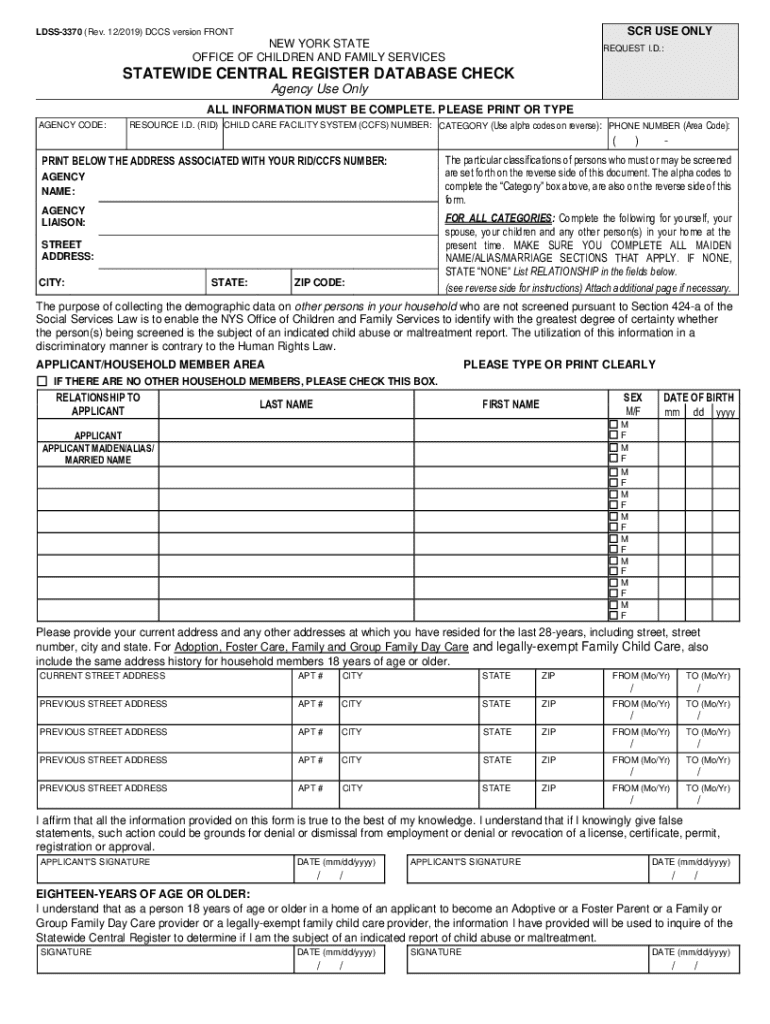
The Statewide Central Register Database Check Form, officially known as LDSS-3370, is essential for agencies and individuals involved in child care services to access background information. This form is administered by state-level authorities and involves both manual and electronic checks. It plays a critical role in ensuring compliance with child safety legislation and supports agencies in making informed decisions when screening potential caregivers.
Steps to Complete the Form
-
Gather Personal Information: Begin by collecting necessary personal details required by the form. This includes your full name, date of birth, and social security number. Additionally, if applicable, you need to provide details about other adult household members living with you.
-
Provide Agency Information: The form requires the name and number of the agency requesting the background check. This ensures that the issuing authority can track who requested the information and why it is being requested.
-
List Address History: Applicants must provide an address history for the past 28 years. This extensive record helps the reviewing agency trace any historical reports or incidents.
-
Sign the Document: The signature is necessary to authorize the background check. It serves as consent for the agency to access your information within the database.
-
Submit the Form: Send the completed form as per instructions. Some states may allow online submission, while others require a mailed or in-person delivery. Ensure you check the specific guidelines for your state to complete the submission successfully.
Key Elements of the Form
- Applicant Details: These include name, contact information, social security number, and any additional ID numbers that may be relevant.
- Agency Codes: Specific codes assigned to the agencies are often required. These codes help in identifying and verifying the requesting agency's legitimacy and purpose.
- Household Members: Personal details of any adult household members. This ensures a comprehensive background check of the environment in which child care services will be provided.
- Address History: A chronological list of residences ensures thorough background vetting against the central database over an extended period.
- Signatures: The applicant’s signature is a confirmation of consent, validating the use of personal data for the background check.
Legal Use and Compliance
Utilizing the Statewide Central Register in compliance with legal guidelines is crucial for both the requesting agency and the applicant. The information accessed through this form must only be used for its intended purpose—to evaluate the suitability of individuals in child care roles. Breaching this use, such as sharing information without consent or using it for discriminatory practices, can lead to severe penalties.
State and federal legislation protect the confidentiality and proper use of the data within the Register. Agencies must adhere to these regulations, ensuring that any decision made based on the background checks aligns with legal standards and maintains individual privacy. Applicants concerned about privacy must verify that the agencies involved follow these protocols.
Required Documents for Submission
- Identification Proof: A government-issued ID, such as a driver’s license or passport, supports the identity verification process.
- Proof of Residence: Documents like utility bills or rental agreements are needed to corroborate address history.
- Consent Form: Some states may require an additional consent form, especially if submitting electronically, to ensure the applicant is fully aware and consents to the background check process.
Ensuring all these documents are complete and accurately match the information on the Statewide Central Register Database Check Form is critical for a smooth and error-free submission process.
Software Compatibility
While there is no formal requirement for software compatibility, platforms such as DocHub can simplify the process of filling out, verifying, and submitting the form digitally. Such platforms allow for:
- Digital Annotations: Tools to fill out forms electronically with added security features for document integrity.
- E-Signature Capability: Ensures that executed signatures are legally binding and valid under the ESIGN Act.
- File Management: Supports exporting and sharing completed forms securely and efficiently.
Using these digital tools can streamline the process, reduce errors, and speed up submission times compared to traditional paper-based methods.
Examples of Using the Form
Consider a daycare center in New York needing to hire new staff. They utilize the Statewide Central Register Form LDSS-3370 to vet potential employees for any history of child abuse. This proactive step is not just a regulatory requirement but a safeguard to ensure child safety within their care.
Similarly, a family choosing a private nanny might request consent from their chosen candidate to complete this background check, adding an additional layer of reassurance to their hiring decision. This practice highlights the form’s utility beyond institutional use to private citizens looking to ensure safety.
Penalties for Non-Compliance
Non-compliance with the proper use of the Statewide Central Register or failure to submit the form as required can result in several penalties:
- Fines: Agencies or individuals using the data unlawfully may face substantial fines.
- Revocation of Licenses: For service providers, failure to comply may result in a suspension or revocation of licenses.
- Legal Action: Depending on the extent and impact of misuse, civil or criminal actions might be pursued against involved parties.
Understanding these implications helps both agencies and applicants approach the Statewide Central Register with the seriousness and diligence it demands.