






Definition and Meaning of Utah Quit Claim Deed Form
The Utah Quit Claim Deed Form is a legal document used to facilitate the transfer of property ownership rights from a grantor to a grantee. Unlike a warranty deed, this form does not guarantee the title's clarity or the absence of encumbrances, making it a critical instrument for transferring property between familiar parties, such as family members or as part of a divorce settlement. In Utah, this deed serves to expedite the simple exchange of ownership without extensive assurance, focusing on the conveyance rather than title guarantees.
How to Use the Utah Quit Claim Deed Form
Utilizing a Utah Quit Claim Deed Form correctly ensures that property transfer is legally effective and recognized. To engage this form:
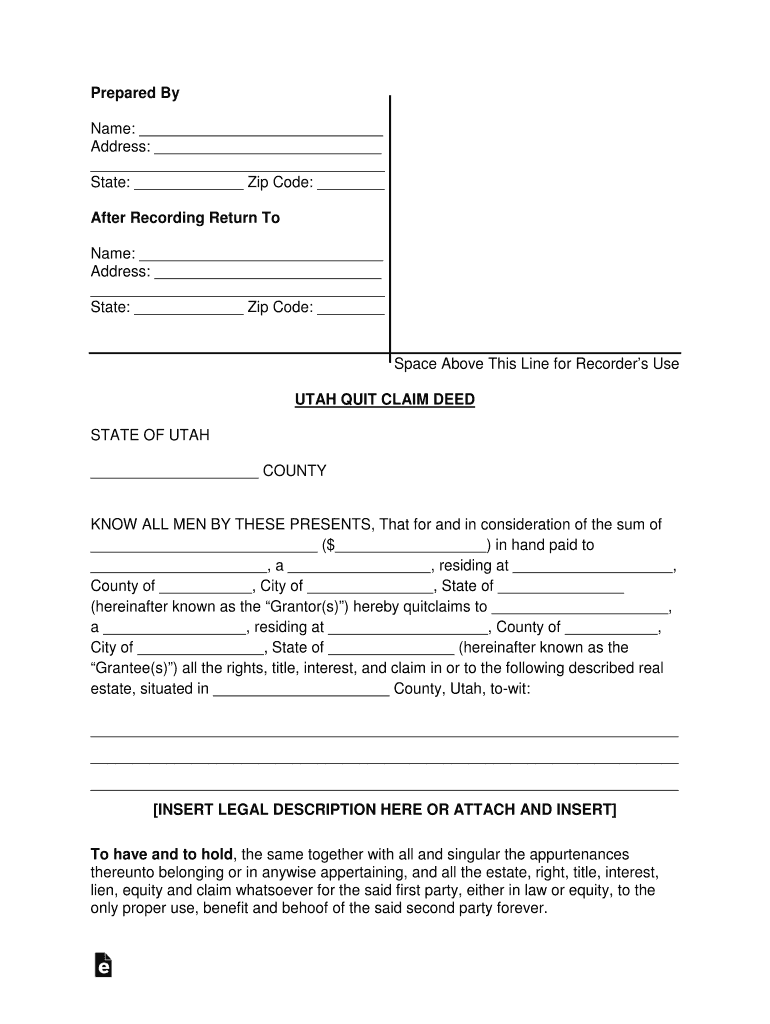
- Complete Grantor and Grantee Information: Include detailed names, addresses, and any relevant identifiers.
- Describe Property Details: Clearly outline the property's legal description, ensuring accuracy to avoid future disputes.
- Signature and Date: Both parties, the grantor and grantee, must sign and date the form in the presence of a notary public to validate the transaction.
- Notary Public Acknowledgment: A certified notary must witness the signing to provide authentication, ensuring the deed's legal enforceability.
Practical Example
For instance, if Jane Doe is transferring her Salt Lake City property to her son, the quit claim deed allows this transfer without promising a clear title, providing a straightforward solution for intra-family transactions.
Steps to Complete the Utah Quit Claim Deed Form
Filling out the Utah Quit Claim Deed Form involves several precise steps to ensure legal soundness:
- Begin with Grantor Information: The grantor must list their full name and current address.
- Detail the Grantee’s Identity: Provide the full legal identity and address of the grantee who will receive ownership.
- Include the Legal Description of Property: Attach a complete property description found in the property's recorded documents.
- Execution Date and Signatures: All parties must sign the form in the presence of a notary public.
- Notary's Confirmation: Obtain the notary's signature and seal to confirm the deed's authenticity for public record.
Completing these steps with precision ensures the legal transfer of ownership without extensive title guarantees.
Legal Use of the Utah Quit Claim Deed Form
This form is legally binding when transferring property rights, recognized by Utah authorities. It's critical in legal familial transactions, settling disputes, or redistributing assets during probate without the need for comprehensive title warranties. It is essential, however, to understand that using this deed form does not resolve potential title issues or encumbrances; it merely transfers the interest the grantor holds.
Key Elements of the Utah Quit Claim Deed Form
The Utah Quit Claim Deed consists of essential components to complete the legal process accurately:
- Identification of Parties: Full names and addresses of the grantor and grantee.
- Property Description: A formal legal description that precisely identifies the property.
- Conveyance Language: Legal verbiage that clearly expresses the intent to transfer property interest.
- Execution Section: Spaces for signatures of both the grantor and grantee, with a date.
- Notarial Acknowledgment: Section for notary public certification which ensures the form's legality.
These elements must be completed accurately to ensure the deed's validity and fulfillment of legal requirements.
State-Specific Rules for the Utah Quit Claim Deed Form
Utah has specific regulations governing the use of quit claim deeds:
- Notary Requirement: A notary must authenticate the signing process, underscoring the legal documentation.
- Recording in County Clerk’s Office: The executed form must be filed with the office where the property is situated for public notice.
- Consideration Statement: Utah law requires stating any consideration exchanged, even if it's nominal (like $10).
Strict adherence to these rules ensures the deed accomplishes its intended legal function within the state.
Examples of Using the Utah Quit Claim Deed Form
Quit claim deeds are commonly used in scenarios involving:
- Family Property Transfers: Facilitating easy ownership shifts between family members.
- Divorce Settlements: Allowing a spouse to relinquish property rights without title complications.
- Business Reorganization: Transferring property as part of an asset redistribution within a company.
Each example emphasizes efficient and uncomplicated ownership changes, which this deed type enables.
Filing Methods and Requirements for the Utah Quit Claim Deed Form
To complete the Utah Quit Claim Deed process:
- In-Person Submission: Deliver the deed to the county clerk’s office where the property is located.
- Mail-In Filing: Mail the completed and notarized form to the respective county office with any required fees.
- Recording Fees: Be aware of requisite filing fees specific to each Utah county, paying any necessary amounts to finalize the recording.
Compliance with these filing procedures guarantees that the deed is officially recorded, effectively transferring ownership as intended.