





Definition and Meaning
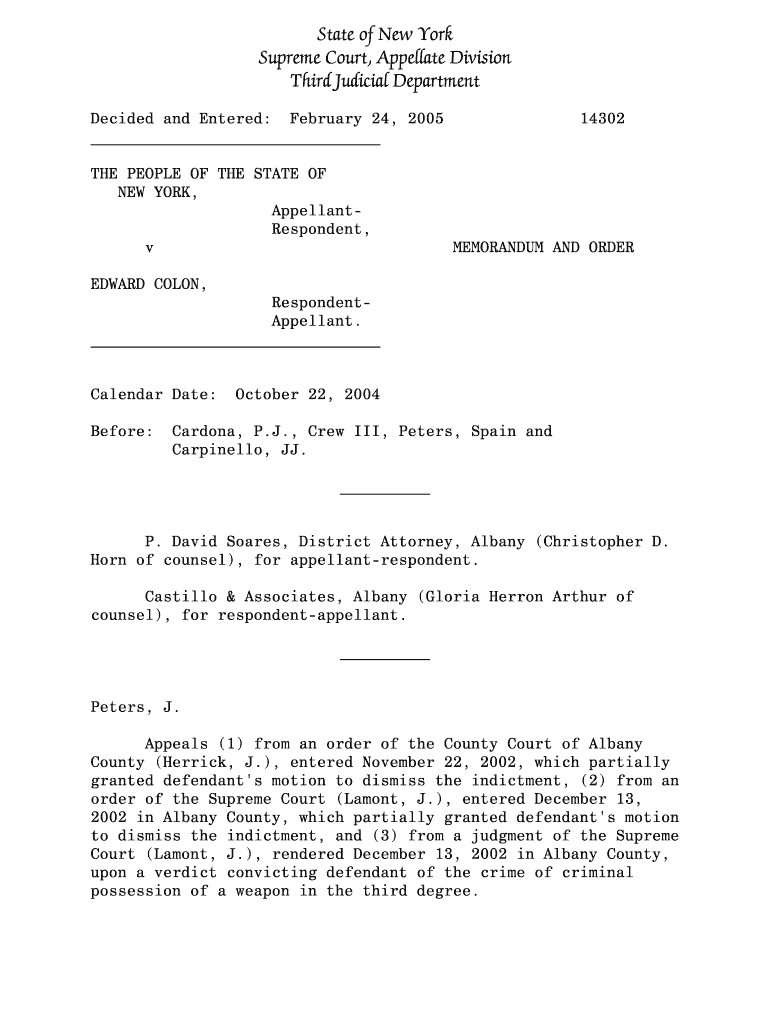
The term "EDWARD COLON, - decisions courts state ny" refers primarily to legal decisions made by the courts of the State of New York concerning the case of Edward Colon. In this case, Edward Colon was involved in legal proceedings connected to charges of criminal possession of a weapon, following a traffic stop that revealed illegal drugs and a firearm. Understanding the context and implications of such legal decisions is crucial for legal professionals and individuals interested in how state courts handle firearm-related cases.
How to Use the EDWARD COLON, - Decisions Courts State NY
To effectively utilize the information from the court decisions surrounding the Edward Colon case, legal professionals or interested parties can analyze the rulings to understand precedents set in weapon possession and traffic-related law enforcement. These decisions might influence how similar cases are approached in the future, offering insights into evidence admissibility, procedural requirements, and jurisprudential interpretations specific to New York State.
Obtaining EDWARD COLON, - Decisions Courts State NY
Accessing the court decisions for Edward Colon's case requires utilizing legal databases or public records from the New York State court system. Interested parties can search for case files on the New York State Unified Court System's website or use legal research databases like Westlaw or LexisNexis. These platforms provide comprehensive access to legal documents, case summaries, and detailed opinions rendered by the courts.
Steps to Complete Analysis of EDWARD COLON, - Decisions
-
Collect Case Documents: Identify and obtain all relevant legal documents and decisions related to Edward Colon's case from court databases.
-
Review Legal References: Analyze the court's discussion on evidence sufficiency, procedural execution, and legal definitions like that of a 'loaded firearm.'
-
Evaluate Legal Impact: Determine how these decisions might affect future cases and understand their role in legal precedents regarding weapon possession and procedural adherence in New York.
-
Summarize Findings: Consolidate the analysis into a detailed report or presentation, highlighting significant legal interpretations and implications.
Important Terms Related to EDWARD COLON, - Decisions
- Indictment: A formal charge or accusation of a serious crime.
- Grand Jury: A jury, typically of twenty-three people, that examines the validity of an accusation before trial.
- Loaded Firearm: A legally specific term needing clear evidence and definition in cases involving firearm possession.
Legal Use of EDWARD COLON, - Decisions
These decisions hold significant importance for legal research, as they contribute to the body of case law in New York State. Lawyers might cite these decisions to argue for or against the sufficiency of evidence or procedural correctness in similar, future cases. They also serve as educational examples in understanding judicial reasoning and the application of legal standards.
State-Specific Rules and Implications
The decisions in Edward Colon's case are governed by New York State laws and procedural rules, illustrating the unique aspects of conducting legal proceedings within this jurisdiction. Such cases highlight the singularities of state laws compared to federal standards, which is crucial for legal practitioners who must navigate these differences proficiently.
Key Elements of the EDWARD COLON, - Decisions
- Evidence Sufficiency: The court addressed whether the evidence presented met the necessary legal standards to support an indictment for weapon possession.
- Procedural Concerns: Examined the handling and documentation of pretrial motions, which can critically impact the outcome of legal challenges.
- Legal Definitions: Clarified the interpretation of certain terms like 'loaded firearm,' which affect the overall charges and potential penalties.
Examples of Using EDWARD COLON, - Decisions
Legal professionals and scholars may reference these decisions when debating evidence admissibility in cases involving weapon possession or when assessing procedural adherence. For instance, if facing a similar firearm-related charge, an attorney might present these decisions as relevant legal precedent to bolster their arguments regarding the sufficiency of evidence or other trial processes.