Board of Prosthetics, Orthotics and Pedorthics - Kentucky.gov - pop ky 2026

Get Form
sherri schuenemeyer Preview on Page 1

Here's how it works

01. Edit your sherri schuenemeyer online
Type text, add images, blackout confidential details, add comments, highlights and more.
02. Sign it in a few clicks
Draw your signature, type it, upload its image, or use your mobile device as a signature pad.
03. Share your form with others
Send it via email, link, or fax. You can also download it, export it or print it out.

How to use or fill out Board of Prosthetics, Orthotics and Pedorthics - Kentucky.gov - pop ky with our platform

Form edit decoration
9.5
Ease of Setup
DocHub User Ratings on G2
9.0
Ease of Use
DocHub User Ratings on G2
  1. Click ‘Get Form’ to open it in the editor.
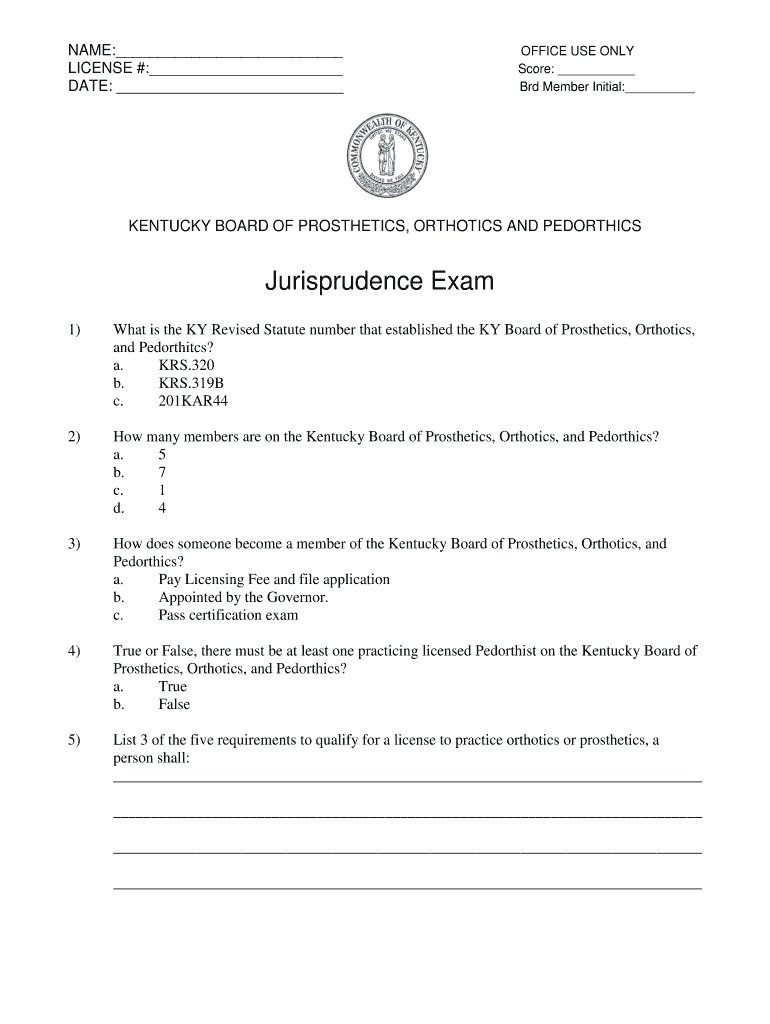
  2. Begin by entering your NAME and LICENSE # at the top of the form. This personal information is essential for identification purposes.
  3. Fill in the DATE field to indicate when you are completing the exam.
  4. Proceed to answer each question carefully. For multiple-choice questions, select the correct option by clicking on it.
  5. For open-ended questions, such as listing requirements, type your responses directly into the provided spaces. Ensure clarity and completeness in your answers.
  6. Once all sections are completed, review your answers for accuracy before finalizing the document.
  7. Sign the Licensee Acknowledgment section at the end of the form to confirm that you have completed the examination without assistance.

Start using our platform today to streamline your form completion process for free!

See more Board of Prosthetics, Orthotics and Pedorthics - Kentucky.gov - pop ky versions

We've got more versions of the Board of Prosthetics, Orthotics and Pedorthics - Kentucky.gov - pop ky form. Select the right Board of Prosthetics, Orthotics and Pedorthics - Kentucky.gov - pop ky version from the list and start editing it straight away!
Versions Form popularity Fillable & printable
2016 4.3 Satisfied (28 Votes)
be ready to get more

Complete this form in 5 minutes or less

Get form

Got questions?

We have answers to the most popular questions from our customers. If you can't find an answer to your question, please contact us.
Contact us
No, they dont go to medical school. Theyre both a type of healthcare provider called allied health professionals.
A prosthetist is a healthcare provider who makes and fits artificial limbs (prostheses) for people with disabilities. This includes artificial legs and arms for people who have had amputations due to diseases, disorders, or injury.
Orthotists and prosthetists evaluate patients and design custom or off-the-shelf orthoses (braces) or prostheses (artificial limbs). Once created and fitted, these devices support the body and assist with physical activities such as walking, running, grasping, and balancing.
As of Sep 9, 2025, the average annual pay for a Prosthetist in California is $80,072 a year. Just in case you need a simple salary calculator, that works out to be approximately $38.50 an hour. This is the equivalent of $1,539/week or $6,672/month.
Education. To enter the occupation, orthotists and prosthetists typically need a masters degree in orthotics and prosthetics from a program accredited by a professional organization. Masters degree programs, which typically require a bachelors degree to enter, take about 2 years to complete.

Security and compliance

At DocHub, your data security is our priority. We follow HIPAA, SOC2, GDPR, and other standards, so you can work on your documents with confidence.

Learn more
ccpa2
pci-dss
gdpr-compliance
hipaa
soc-compliance
be ready to get more

Complete this form in 5 minutes or less

Get form

People also ask

Most often, students must complete a 4-year undergraduate degree in a related field (such as kinesiology and engineering), followed by a 2-year paid residency program in prosthetics and orthotics. They must then pass a national certification exam.
Prosthetists provide artificial limbs to assist people who have part of or a whole a limb missing. Orthotists provide braces and splints to support, correct, or aid the function of people with various conditions of the neurological, muscular and skeletal systems.
No, they dont go to medical school. Theyre both a type of healthcare provider called allied health professionals. They offer a special service that works alongside other types of care. Orthotists and prosthetists have their own education and residency requirements.

Related links