01. Edit your form online
Type text, add images, blackout confidential details, add comments, highlights and more.

Type text, add images, blackout confidential details, add comments, highlights and more.

Draw your signature, type it, upload its image, or use your mobile device as a signature pad.

Send it via email, link, or fax. You can also download it, export it or print it out.
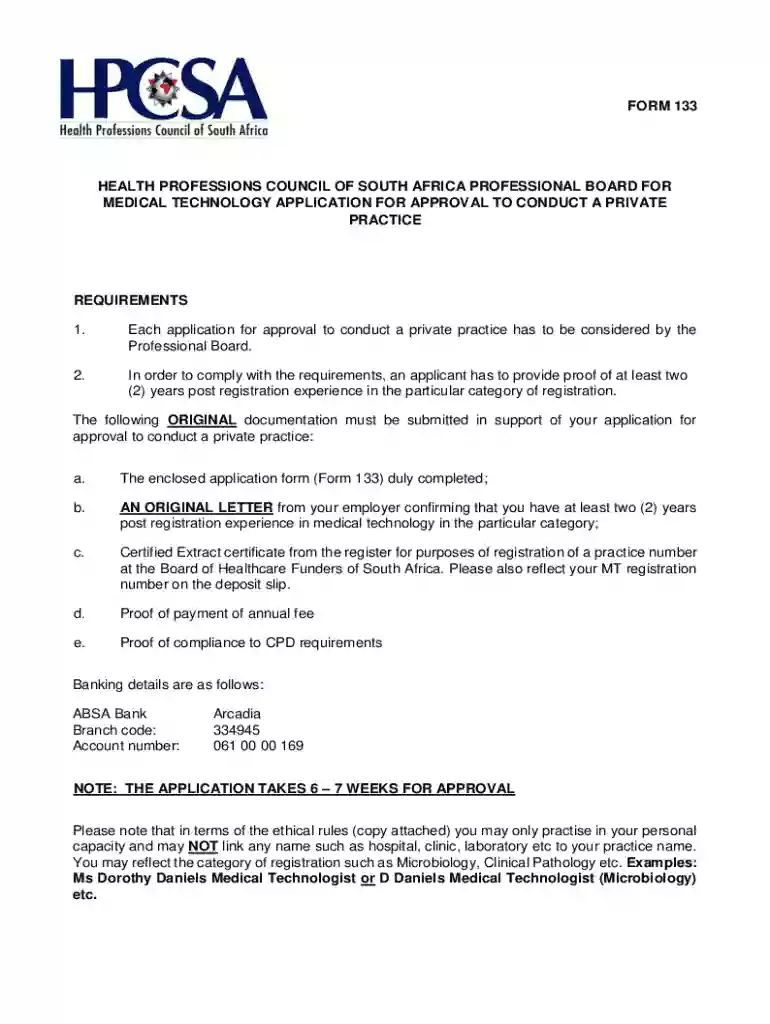
Form 133 is an application form provided by the Health Professions Council of South Africa's Professional Board for Medical Technology. It serves as an official document to request authorization for conducting a private practice. The primary objective of the form is to ensure that medical technologists meet the necessary qualifications and ethical standards required for approving and overseeing private practices. By submitting Form 133, applicants affirm their compliance with the board's requirements, including having adequate post-registration experience and fulfilling continuing professional development (CPD) requirements.
Completing Form 133 involves several crucial steps to ensure a successful application. Missing details or incomplete sections can result in a delay or rejection of the application. The process is as follows:
Personal Information: Begin by filling out basic personal details, such as name, address, and contact information. Ensure accuracy to avoid processing delays.
Professional Experience: Provide evidence of at least two years of post-registration experience in medical technology. This includes details of past employment roles and durations.
Supporting Documentation: Attach original documentation, such as proof of experience, current registration details, and proof of compliance with CPD requirements.
Ethical Compliance: Confirm adherence to ethical guidelines regarding practice naming and operational standards.
Payment Proof: Include payment proof for the application fee, ensuring that it corresponds with the form submission.
Form 133 requires several critical components to be effectively completed. Understanding these elements is essential for applicants to prepare and submit their applications accurately:
Accurate and complete documentation is vital when submitting Form 133. Collecting the necessary supporting materials beforehand can streamline the application process:
Form 133 is primarily used by medical technologists in South Africa who aspire to establish private practices. The applicants often include professionals who:
Applicants can submit Form 133 through various channels, each requiring attention to different procedural details:
The application process for Form 133 is structured yet comprehensive, focusing on ensuring practitioners meet standards. The typical timeline and process are as follows:
Form Completion and Document Collection: Careful attention to detail during the form completion phase is crucial for preventing delays.
Submission and Initial Review: Initial application evaluation checks for completeness and compliance before further processing.
Approval Time Estimate: The average approval time for Form 133 is between six to seven weeks, contingent on the complexity of the applicant's qualifications and legal adherence.
Notification of Results: Applicants will be informed of the outcome via their preferred communication method, often email or post.
Form 133 must be used within the legal framework established by the Health Professions Council of South Africa. Comprehending these legal aspects ensures that practices remain within the law:
By following the guidelines and faithfully adhering to each step and requirement outlined in Form 133 and its associated processes, prospective private practitioners can align their ventures with regulatory requirements, ultimately providing quality healthcare services within the community.
We've got more versions of the Form 133 form. Select the right Form 133 version from the list and start editing it straight away!
At DocHub, your data security is our priority. We follow HIPAA, SOC2, GDPR, and other standards, so you can work on your documents with confidence.