






Definition and Meaning
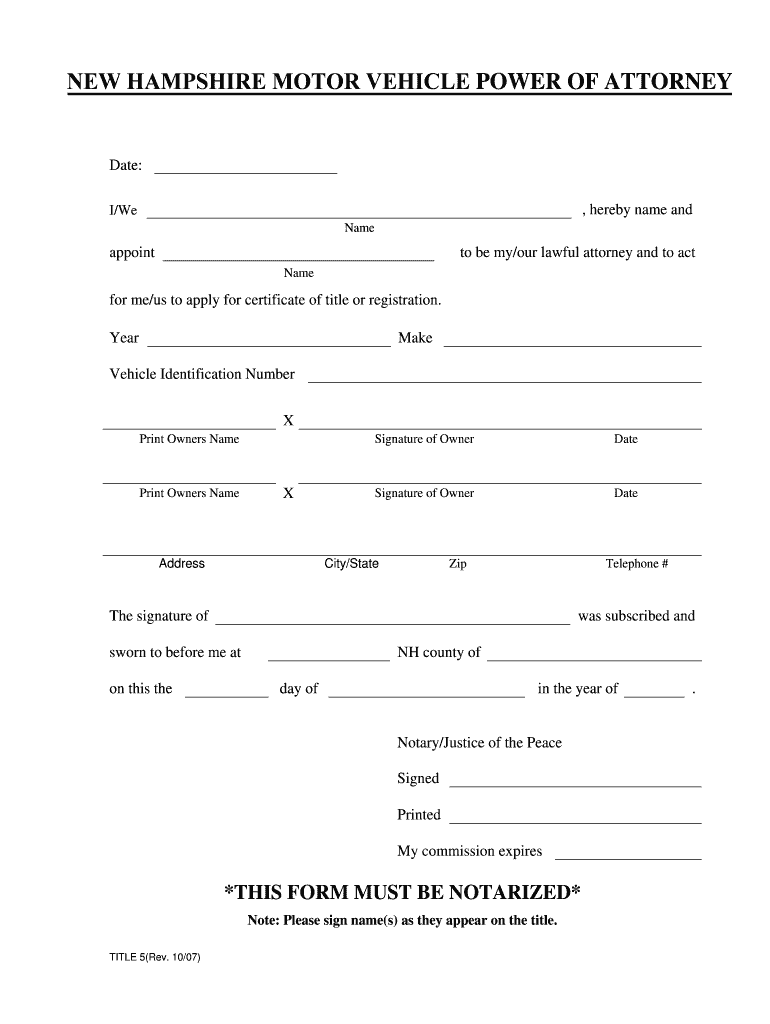
The Free New Hampshire Motor Vehicle Power of Attorney Form is a legal document that allows an individual, designated as the "agent" or "attorney-in-fact," to act on behalf of a vehicle owner for specific motor vehicle-related transactions. This form is commonly used to grant authority for tasks such as registering a vehicle, applying for a certificate of title, or handling other DMV-related activities in the state of New Hampshire. It is essential to understand that the power granted through this form is limited to motor vehicle matters only and does not extend to other personal legal affairs.
Real-World Applications
- An individual purchasing a car on behalf of a family member can use this form to manage the title transfer.
- A business owner can authorize an employee to handle the registration of a company vehicle.
- A vehicle owner who is out of state or incapacitated can empower a trusted person to renew their car's registration.
How to Use the Free New Hampshire Motor Vehicle Power of Attorney Form
To utilize the Free New Hampshire Motor Vehicle Power of Attorney Form, several steps must be followed to ensure it is filled out and executed correctly:
- Identify the Principal and Agent: Clearly indicate the names and contact information of the vehicle owner (principal) and the person being granted power (agent).
- Detail the Vehicle Information: Include specifics about the vehicle, such as the make, model, year, and Vehicle Identification Number (VIN).
- Define the Scope of Authority: Explicitly outline what the agent can do, such as apply for registration or obtain a title.
- Signatures and Notarization: The form must be signed by the principal and, in some cases, notarized to be legally binding.
Important Considerations
- Ensure the agent is trustworthy, as they will make decisions on the vehicle owner's behalf.
- Review the completed form for accuracy to avoid processing delays.
Steps to Complete the Free New Hampshire Motor Vehicle Power of Attorney Form
Completing the New Hampshire Motor Vehicle Power of Attorney Form involves a series of steps to ensure it is legally effective:
- Gather Necessary Information:
- Principal and agent full names and addresses
- Detailed vehicle information (make, model, VIN)
- Complete the Form Fields:
- Enter all required information in the specified fields
- Clarify the specific powers being granted
- Signature and Notarization:
- Sign the document in the presence of a notary public, if required
- Collect the agent's acknowledgment of their responsibilities
Verification and Submission
- Double-check all information for completeness and accuracy before submission.
- Submit the form to the New Hampshire DMV or other relevant authorities, depending on the task to be performed.
Key Elements of the Free New Hampshire Motor Vehicle Power of Attorney Form
Several critical components must be included in this form for it to function properly:
- Identification of Parties: Includes the principal's and agent's details.
- Vehicle Information: Specifies the car's details for which the power is granted.
- Powers Granted: Clearly delineates the specific powers the agent is allowed to exercise.
- Signature Section: Requires the principal's signature and date, typically with a notary's seal.
Legal Requirements
- The form must comply with New Hampshire state laws regarding power of attorney.
- The principal must be of sound mind when executing the form to ensure validity.
State-Specific Rules for the Free New Hampshire Motor Vehicle Power of Attorney Form
In New Hampshire, certain state-specific rules govern how this form can be used:
- Notarization Requirement: Although not always required, notarization can add a layer of authenticity that might be needed for certain transactions.
- Scope Limitations: The document strictly applies to motor vehicle-related tasks and cannot be used for other types of powers.
- Documentation: Supporting documents, like proof of vehicle ownership or identification, may be required alongside the form during submission.
Compliance Importance
- Adhering to state guidelines helps avoid legal complications.
- Ensures that the principal's intentions are honored by third parties like the DMV.
Legal Use of the Free New Hampshire Motor Vehicle Power of Attorney Form
Using this power of attorney form legally involves understanding its constraints and responsibilities:
- Limited to Motor Vehicle Transactions: Cannot be used for unrelated financial or personal matters.
- Revocation Conditions: The principal can revoke the power granted at any time by providing written notice.
- Fiduciary Duty: The agent is legally obligated to act in the principal's best interest and adhere to specified powers.
Enforcement and Disputes
- Misuse of the form can result in legal action against the agent.
- Disputes are resolved based on the documented authority and intentions outlined in the form.
Who Typically Uses the Free New Hampshire Motor Vehicle Power of Attorney Form
This form is utilized by various individuals and entities, including:
- Private Vehicle Owners: For convenience in managing their vehicles when unavailable.
- Business Entities: Authorizing employees to handle company vehicle registrations.
- Legal Guardians: Acting on behalf of minors or incapacitated individuals for vehicle transactions.


Common Use Cases
- A parent assigning a child to sell or transfer their car.
- A company granting fleet management powers to its logistics officer.
- Someone temporarily out of state needing assistance with their vehicle registration.
Examples of Using the Free New Hampshire Motor Vehicle Power of Attorney Form
Practical scenarios where this form would be essential include:
- Assigning authority to a trusted friend to renew a vehicle's registration while the owner is abroad.
- Empowering a dealership representative to handle paperwork for a new car purchase.
- Facilitating a title transfer between family members by authorizing one party to act on behalf of both.
Scenario Detailing
- Consider a college student moving out of state who uses the form to let parents manage their car’s DMV affairs.
- A real estate agent handling an estate sale that includes transferring vehicle titles to new owners.