Definition & Meaning
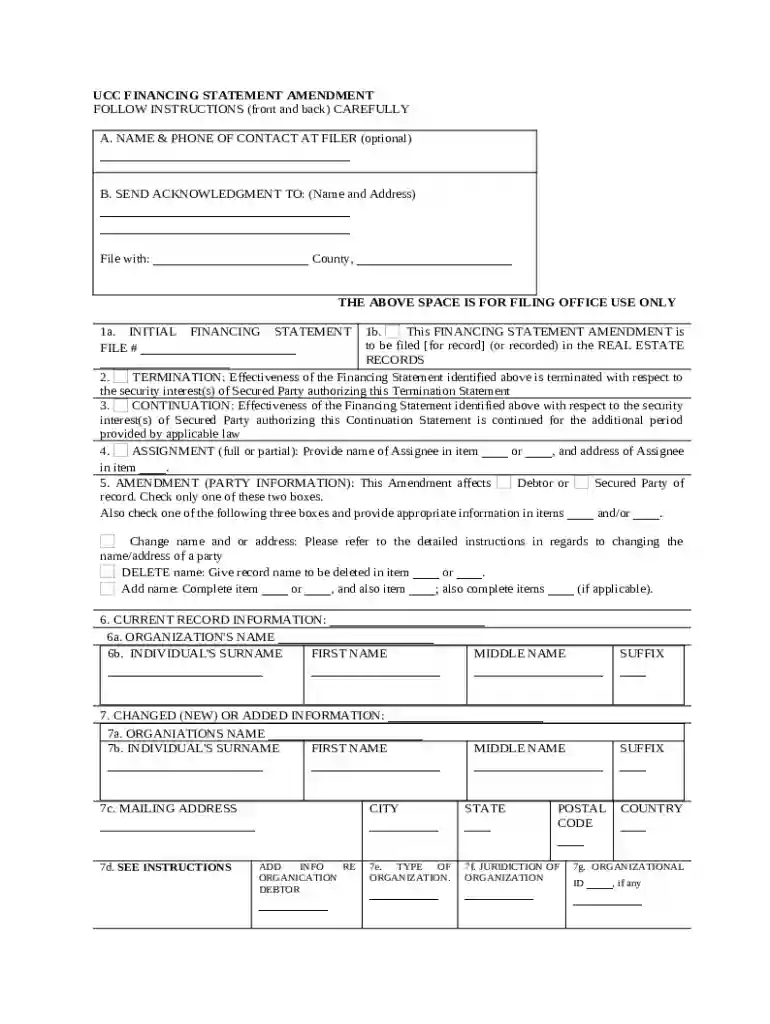
The "UCC Financing Statement Amendment" is a legal form used to modify a previously filed Uniform Commercial Code (UCC) financing statement. This amendment adjusts the initial terms of the financial agreement outlined in the original financing statement. It is used to update, correct, or refine details such as debtor information, secured party data, or the status of the collateral involved.
Key Elements of the UCC Financing Statement Amendment
Understanding the components of the UCC Financing Statement Amendment is essential for accurate modification. The form includes sections for:
- Debtor Information: This section must list the name and address of the original debtor. Any changes to debtor info should be clearly documented.
- Secured Party Information: Changes to the name or address of the secured party are recorded in this segment.
- Collateral Changes: This part of the form addresses alterations to the description or details of the collateral.
- Filing Actions: Specify the type of amendment—whether it is an assignment, continuation, termination, or a transfer of collateral rights.
Steps to Complete the UCC Financing Statement Amendment
- Gather Necessary Information: Compile details of the existing financing statement, including filing numbers and date.
- Identify Amendment Type: Determine whether you will be updating debtor/secured party information, modifying collateral, or taking another action.
- Complete the Form: Fill in all necessary sections accurately. Ensure each modification is clear and unmistakable.
- Submit to the Appropriate Authority: Once completed, the form must be sent to the appropriate state authority for filing.
How to Use the UCC Financing Statement Amendment
To use the UCC Financing Statement Amendment effectively:
- Identify Required Modifications: Evaluate which parts of the original statement need changes.
- Prepare Supporting Documents: Have documentation ready that supports your proposed amendments.
- Review Legal Advice: Consulting with a legal professional can provide assurance that the amendments comply with state regulations.
Important Terms Related to UCC Financing Statement Amendment
- Debtor: The individual or business entity that owes payment or performance under the terms of the original financing statement.
- Secured Party: The entity that holds interest in the collateral, typically a lender or creditor.
- Continuation: An extension of the original financing statement's effectiveness, typically required after five years.
- Termination Statement: Used to release the secured party's interest in the collateral once obligations are satisfied.
State-Specific Rules for the UCC Financing Statement Amendment
Each state may have its own specific rules governing UCC filings:
- Filing Fees: Most states charge a fee to process amendments, which can vary significantly.
- Filing Location: Depending on the collateral type, the filing office can be either the state capital or the county where the debtor resides.
- Forms and Format: States may have their own forms or specific formats that differ from the national standard. Ensure to follow local requirements.
Legal Use of the UCC Financing Statement Amendment
Filing a UCC Financing Statement Amendment carries legal implications:
- Accuracy Requirement: Incorrect or misleading information can result in legal disputes or diminished priority of security interest.
- Priority of Interest: Amendments can affect the priority of secured interests, particularly if changes to collateral descriptions are involved.
- Dispute Resolution: Any disputes arising from amendments may require intervention from legal authorities or arbitration for resolution.
Examples of Using the UCC Financing Statement Amendment
- Updating Debtor's Name: A business changes its structure from an LLC to a corporation and must update the debtor's name on the financing statement.
- Collateral Reassignment: A company reassigns part of its collateral to another creditor, requiring an update in the financial statement.
- Continuation Filing: Before the five-year expiration of the original statement, a creditor files a continuation to maintain their secured interest.