01. Edit your form online
Type text, add images, blackout confidential details, add comments, highlights and more.

Type text, add images, blackout confidential details, add comments, highlights and more.

Draw your signature, type it, upload its image, or use your mobile device as a signature pad.

Send it via email, link, or fax. You can also download it, export it or print it out.
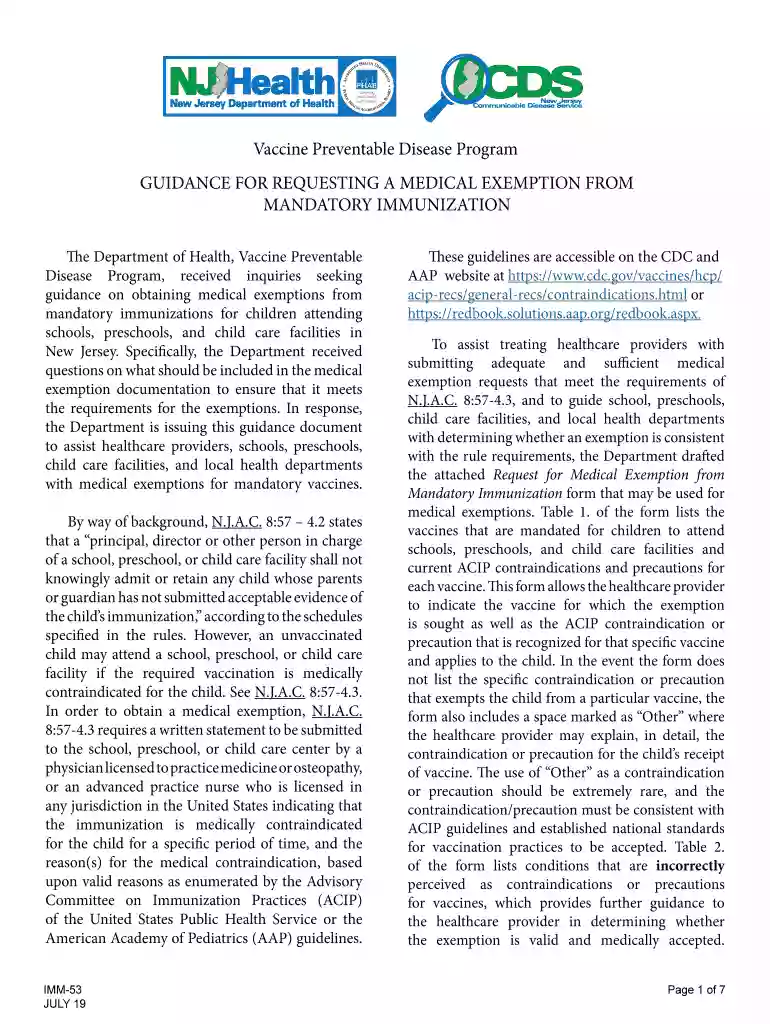
The "Guidance for Requesting a Medical Exemption From" primarily refers to the procedures and protocols for formally seeking an exemption from mandatory medical requirements, such as vaccinations. This guidance is crucial for individuals or guardians looking to exempt a child from standard medical procedures based on specific health conditions. It outlines the criteria needed to justify an exemption, ensuring that it aligns with medical standards and legal requirements. A medical exemption typically must be substantiated with documentation from a licensed healthcare provider who recognizes the contraindication based on established medical guidelines.
Understand the Requirements: Familiarize yourself with the documentation and medical criteria that justify an exemption. This often involves guidelines specified by entities like the Centers for Disease Control and Prevention (CDC) or the Advisory Committee on Immunization Practices (ACIP).
Consult a Healthcare Provider: Work with a licensed healthcare provider to discuss potential medical contraindications. The provider must evaluate medical history and any conditions that could warrant an exemption.
Prepare the Necessary Documentation: Collect and prepare all required forms and statements. This includes obtaining a written statement from the healthcare provider detailing the medical contraindication.
Submit the Exemption Request: Follow the submission procedures as outlined in the guidance. This could involve submitting forms through various channels, such as online, by mail, or in-person, depending on the specific requirements of your institution or state.
Collect Necessary Information: Begin by gathering all essential personal and medical information needed to fill out the exemption request. This includes medical records pertinent to the condition prompting the exemption request.
Fill Out the Exemption Form: Carefully complete the form provided, ensuring that all sections are accurately filled out. Any applicable medical documentation should be attached as required.
Review and Sign: Once filled, review the entire form for errors. Both the applicant and the healthcare provider (when necessary) should sign the form to confirm its accuracy and validity.
Submission and Follow-Up: Send the completed form via the preferred method (online submission, mail, or in-person drop-off) and keep copies for your records. Be sure to track the submission to confirm receipt and acceptance.
For a successful medical exemption request, certain documents are typically required:
Licensed Healthcare Provider Statement: A signed document from a healthcare practitioner that details the medical reasons for exemption.
Medical Records: Relevant medical history and records that support the exemption claim.
Exemption Form: The official form provided by the institution or state regulatory agency that must be completed and submitted.
Having these documents prepared and correctly filled out ensures that the processing of the exemption request can proceed without unnecessary delays.
To qualify for a medical exemption, the requesting individual must typically meet specific eligibility requirements:
Valid Medical Contraindication: The condition for exemption must be recognized and justified based on medical guidelines such as those from the CDC or ACIP.
Professional Medical Evaluation: The request must be supported by an evaluation and statement from a qualified healthcare provider.
Detailed Medical Documentation: Well-documented medical history and records that substantiate the condition claimed as a contraindication are required.


Initiate the Request: Start by obtaining the necessary forms and guidelines specific to your state or institution.
Timeline for Submission: Forms should be submitted within the required timeframe, often prior to the implementation of the medical requirement (such as the start of a new school term).
Review Process: Once submitted, the exemption request is reviewed by the appropriate health department or institutional body, a process that can take several weeks depending on the complexity and volume of requests.
Notification: After review, notification of approval or denial is provided. If denied, the notice typically includes reasons for the decision, and an appeal process may be available.
Different states in the U.S. may have varying rules for requesting a medical exemption. These differences can include:
Specific Forms: States may issue their own exemption forms and guidelines that must be used.
Review and Approval Bodies: The authority responsible for reviewing exemption requests can differ, ranging from state health departments to individual school districts.
Deadlines and Submission Routes: States may have varied submission timelines and required channels for submission.
Understanding the specific rules for your locality is essential to ensure compliance and successful exemption requests.
Contraindication: A medical reason why a particular treatment or procedure is not advisable.
ACIP: Advisory Committee on Immunization Practices, which provides guidance on immunization policies and procedures.
Medical Exemption: An official allowance to forego a medical procedure due to recognized medical reasons.
Familiarity with these terms enhances comprehension and facilitates smoother navigation of the exemption process.
When seeking a medical exemption, it is crucial to adhere to the legal standards governing exemptions:
Compliance with Laws: Ensure that all actions taken follow federal and state laws regarding medical exemptions and mandatory procedures.
Accuracy and Honesty: All information submitted must be accurate and truthful to avoid legal repercussions such as denial of the exemption or penalties for falsification.
By understanding these legal frameworks and adhering to the guidance provided, individuals can ensure they are legitimately pursuing their medical exemption requests.
We've got more versions of the GUIDANCE FOR REQUESTING A MEDICAL EXEMPTION FROM form. Select the right GUIDANCE FOR REQUESTING A MEDICAL EXEMPTION FROM version from the list and start editing it straight away!
| Versions | Form popularity | Fillable & printable |
|---|---|---|
| 2019 | 4.8 Satisfied (121 Votes) |
At DocHub, your data security is our priority. We follow HIPAA, SOC2, GDPR, and other standards, so you can work on your documents with confidence.