01. Edit your form online
Type text, add images, blackout confidential details, add comments, highlights and more.

Type text, add images, blackout confidential details, add comments, highlights and more.

Draw your signature, type it, upload its image, or use your mobile device as a signature pad.

Send it via email, link, or fax. You can also download it, export it or print it out.
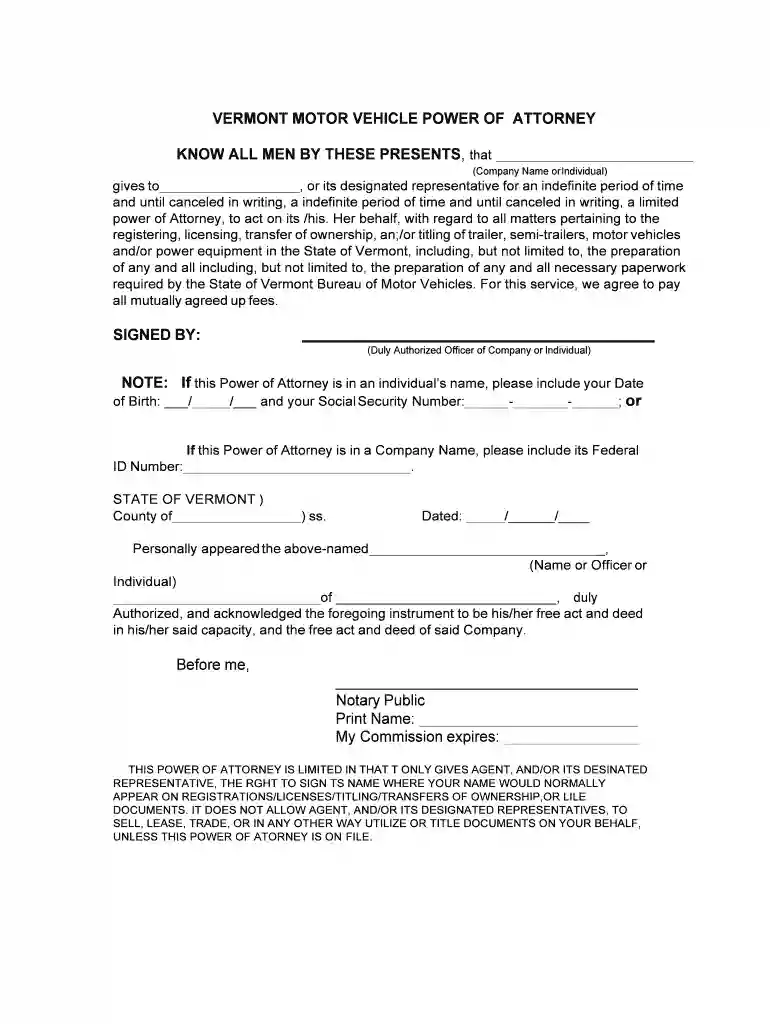
The Vermont Vehicle Power of Attorney Form is a legal document that authorizes an individual or entity to act on another person's behalf concerning specific vehicle-related affairs. This form is pivotal for managing the registration, licensing, transfer of ownership, and titling of vehicles and equipment within the state of Vermont. The authority granted through this document is limited and does not extend to selling or leasing vehicles without further explicit authorization. These restrictions ensure that the designated representative focuses solely on the processes necessary for maintaining lawful and proper documentation of vehicle ownership.
To utilize this form effectively, the principal—who is the vehicle owner—must complete it by providing essential personal and vehicle information. Once the form is filled out, it must be signed and dated by both the principal and the appointed attorney-in-fact, who is the representative. The form permits the attorney-in-fact to sign documents related to vehicle transactions on behalf of the principal. The principal should carefully consider and expressly state the scope of authority granted, ensuring it aligns with their intentions. This form becomes particularly important when the vehicle owner is unable to be present during the administrative processes for their vehicle.
Gather Required Information: Before filling out the form, collect all necessary details, such as the principal's personal information and the vehicle's identification number.
Fill Out the Form: Enter the principal and the appointed representative's details carefully. Double-check all entries for accuracy to avoid delays.
Specify Limitations: Clearly outline the scope of authority intentionally, limiting it to necessary administrative tasks.
Sign the Form: Both the principal and the attorney-in-fact must sign and date the form in the presence of a notary public, if required, to validate it.
Notarization: Although Vermont may not always require notarization, having a notary public verify the signatures can provide additional assurance of the document's authenticity.
The legal significance of this form lies in its ability to simplify and expedite vehicle-related tasks when the principal cannot be present. By granting specific authorization, it reduces the bureaucratic burden on vehicle administrators and ensures uninterrupted management of vehicular matters. The document is strategically limited, emphasizing its use for lawful administration tasks without extending power unnecessarily. This specification protects the principal from unauthorized transactions and maintains oversight over the use of their vehicle.
In Vermont, certain state-specific rules govern the use of the power of attorney forms. These documents must comply with Vermont statutes that oversee the delegation of administrative tasks related to vehicle ownership and management. Understanding these rules is crucial for ensuring the form's acceptance by the Vermont Department of Motor Vehicles. It is advisable to consult with a legal expert familiar with Vermont laws to ensure complete compliance and adequacy of the documentation.
Administrative Streamlining: A car dealership assisting customers in completing vehicle registration processes could use this form to handle necessary documentation without the customer's physical presence.
Remote Transactions: A Vermont resident temporarily living abroad might use this form to allow a family member in Vermont to manage their vehicle's registration and titling.
Estate Management: An executor of an estate might use this form to transfer vehicle ownership to heirs following the decedent's instructions.
To submit a Vermont Vehicle Power of Attorney Form, the following items may be needed:
The Vermont Department of Motor Vehicles typically oversees the issuance and regulation of vehicle-related documents, including this power of attorney form. They provide guidelines and templates to ensure compliance with state laws and facilitate the vehicle management and ownership processes. Potential users should refer directly to the DMV or their official resources for the most up-to-date forms and supplementary requirements.
At DocHub, your data security is our priority. We follow HIPAA, SOC2, GDPR, and other standards, so you can work on your documents with confidence.