






Definition & Meaning
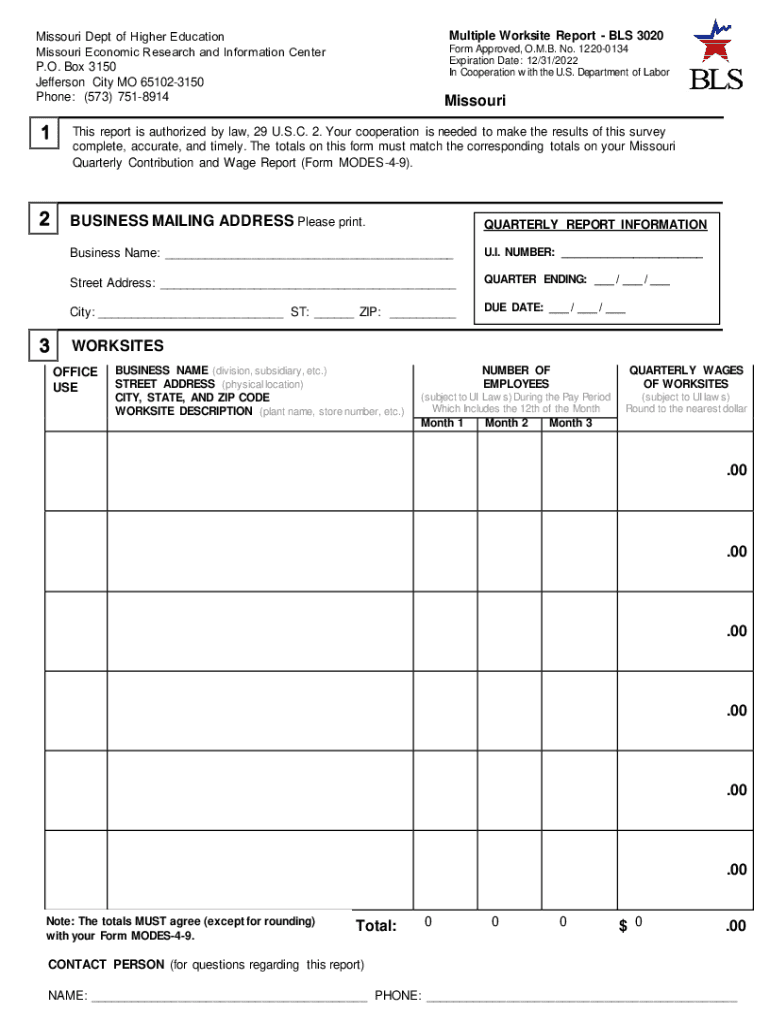
The "Missouri 3020" refers to the Multiple Worksite Report, also known as BLS 3020. This form is issued by the Missouri Department of Higher Education in collaboration with the U.S. Department of Labor. Its primary purpose is to collect employment and wage data from businesses operating at multiple locations under a single Unemployment Insurance Account Number. This data collection ensures accurate reporting for statistical and unemployment insurance purposes. Businesses must provide detailed information about each worksite, including employee counts and wages, contributing to a comprehensive understanding of multi-location business operations in Missouri.
How to Obtain the Missouri 3020
To acquire the Missouri 3020 form, businesses typically receive it directly from the Missouri Department of Higher Education if they meet certain criteria, such as having multiple worksites under a single unemployment insurance account. If it is not received, businesses can contact the department to request the form. Alternatively, the form may be available for download on the department's website, where it can be accessed and printed for completion. It's important that businesses ensure they are using the most recent version of the form, which will be explicitly indicated on the department’s website or included in the mailing.
Steps to Complete the Missouri 3020
-
Gather Required Information:
- Collect information on employee counts and gross wages for each worksite.
- Ensure that you have the correct Unemployment Insurance Account Number.
-
Fill Out Business Information:
- Provide the company's name, address, and other identifying details at the top of the form.
-
Detail Each Worksite:
- List each worksite separately, detailing the employee count and wages for that location.
-
Verify and Double-check Entries:
- Carefully review all entries for accuracy and ensure all sites are included.
-
Submit the Completed Form:
- Send the form either via mail or through an online submission platform, if available.
Businesses might choose to keep copies of the completed form for their records and possible future audits.
Who Typically Uses the Missouri 3020
The Missouri 3020 is primarily used by larger businesses and organizations that operate multiple locations under one Unemployment Insurance Account Number. This includes corporations with branches or divisions, franchises, and other multi-location enterprises. It is particularly relevant to human resources managers, payroll departments, and accountants within these entities, as they are responsible for compiling and reporting the necessary wage and employment data.


Key Elements of the Missouri 3020
- Unemployment Insurance Account Number: Identifies the overarching business entity.
- Location Details: Each worksite must be individually detailed with its specific location identifiers.
- Employee Count: The average number of employees at each site during the reporting period.
- Total Wages Paid: The aggregate wage amount dispensed to employees at each location over the reporting period.
These elements are crucial for assessing compliance and ensuring accurate labor statistics.
Required Documents
To complete the Missouri 3020 form effectively, businesses will need several supporting documents akin to:
- Payroll records for the reporting period.
- Internal employee databases for headcounts.
- Wage summaries or financial statements relevant to each worksite.
Having these documents on hand can facilitate an accurate and efficient completion process.
Form Submission Methods
- Online Submission: If supported, businesses should utilize an online portal for efficient submission.
- Mail: The completed form can be mailed to the address specified by the Missouri Department of Higher Education.
- In-Person: In some cases, physical submission may be required or preferred.
It's essential to confirm and utilize the submission method designated by the issuing authority.
Penalties for Non-Compliance
Failure to complete and submit the Missouri 3020 accurately and on time can result in penalties, which may include fines or additional scrutiny from labor and employment authorities. Businesses should carefully adhere to submission deadlines and ensure all reporting is thorough and accurate to avoid such consequences. Each non-compliance incident may impact the business's standing and could result in increased future audits.