







Definition & Meaning
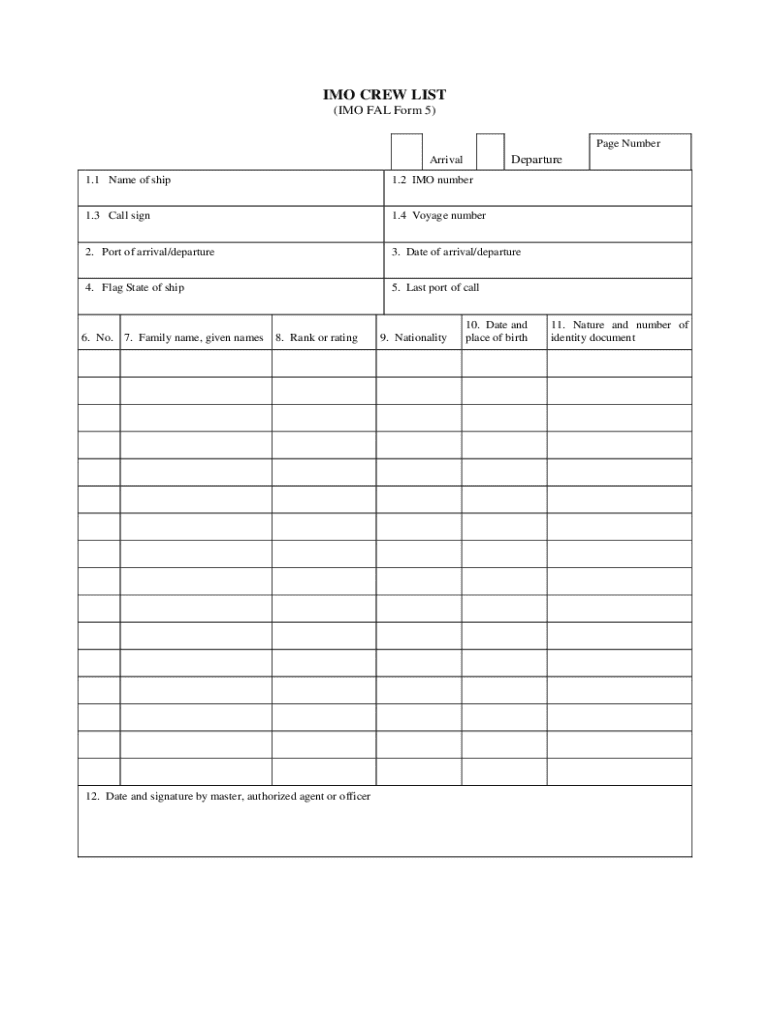
The IMO Crew List, officially known as IMO FAL Form 5, is an essential maritime document used to record detailed information about the crew members on board a ship. This document includes critical data such as the ship's name, IMO number, call sign, voyage number, and comprehensive details of each crew member like names, ranks, nationalities, birth dates, and identity documents. The form plays a vital role in ensuring compliance with international regulations and enhancing the efficiency of maritime operations by standardizing crew data across vessels globally.
How to Use the IMO CREW LIST - Vistikhetmaar
The IMO Crew List - Vistikhetmaar is used primarily to provide port authorities with necessary crew information upon a vessel's arrival or departure. It helps streamline the assessment processes required by customs and immigration when ships enter or exit ports. Shipping companies must ensure that all details on the list are accurate and up-to-date to avoid any legal complications or delays in port clearance. When completing the form, it's important to follow the prescribed format and include all necessary details for each crew member to facilitate seamless port operations.
Steps to Complete the IMO CREW LIST - Vistikhetmaar
- Gather Crew Information: Collect all necessary details about each crew member, including their full name, rank, nationality, date of birth, and ID information.
- Fill In Ship Details: Accurately input the vessel's name, voyage number, IMO number, and call sign.
- Organize Data Chronologically: Arrange the crew names and other details in an organized manner, usually by rank or department, for clarity.
- Required Signatures: Ensure the form is signed by the master or an authorized officer of the ship, verifying the authenticity of the provided information.
- Review for Accuracy: Double-check all entered details for correctness and completeness to prevent issues during submission.
Key Elements of the IMO CREW LIST - Vistikhetmaar
- Ship Details: Includes the ship’s name, IMO number, call sign, and voyage number.
- Port Details: Information about the departure and arrival ports, ensuring correct route identification.
- Crew Information: Comprehensive data about each crew member, including name, nationality, birth date, and identity document details.
- Officer’s Signature: Verification by the ship’s master or a designated official confirming the accuracy of the listed information.
Who Typically Uses the IMO CREW LIST - Vistikhetmaar
This form is primarily used by shipping companies, maritime agencies, and port authorities. Captains or staff responsible for documenting crew details on board a ship are typically tasked with maintaining the IMO Crew List. Regulatory bodies and customs officials at ports also rely on this document to facilitate the legal entry and exit of vessels, making it crucial for international maritime operations.


Legal Use of the IMO CREW LIST - Vistikhetmaar
The IMO Crew List is mandated by international maritime law, serving as a standardized record that ensures compliance with safety and security regulations worldwide. It is required documentation during inspections and can be audited by maritime authorities to verify a vessel's adherence to crew management standards. Non-compliance or inaccuracies can lead to significant penalties, highlighting the importance of accurate documentation.
Examples of Using the IMO CREW LIST - Vistikhetmaar
- Port Entry Clearance: When entering a new port, the crew list is submitted to customs and immigration to verify each crew member’s credentials and ensure security measures are upheld.
- Emergency Situations: In the case of onboard emergencies, the crew list assists rescue teams in identifying crew members and their roles, streamlining rescue efforts.
- Regulatory Audits: Shipping companies may present the crew list during inspections to demonstrate compliance with international standards for crew management.
Digital vs. Paper Version
While traditional methods utilized paper forms for the IMO Crew List, modern maritime operations increasingly rely on digital versions. Digital forms offer significant advantages, such as ease of updating and submission, quick sharing with port authorities, and reduced risk of data loss. Furthermore, electronic submissions align with the digitization efforts in global trade, offering seamless integration with existing digital documentation systems. Despite this shift, both formats remain valid depending on the port's capabilities and requirements.




