
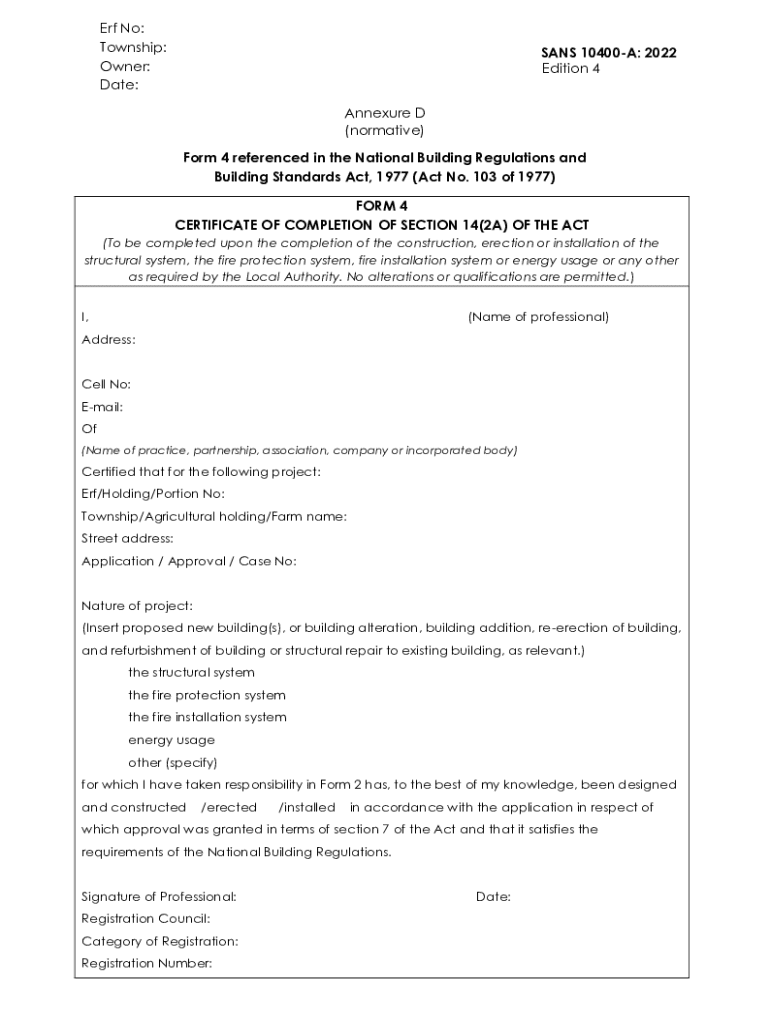







Definition and Meaning of Form 4
Form 4, as outlined by the National Building Regulations and Building Standards Act, 1977, serves as a Certificate of Completion required under SANS 10400-A: 2022. It certifies that a construction project has been completed according to approved plans and complies with all pertinent building regulations such as structural integrity, fire protection, and energy efficiency. This form is pivotal in affirming that all construction standards have been met, ensuring safety and regulatory adherence.
Importance in Construction Projects
- Ensures compliance with legal requirements
- Validates project completion in accordance with approved plans
- Essential for obtaining occupancy certificates
How to Use the Form 4
The Form 4 must be filled out by a registered professional responsible for overseeing the construction project. This process involves a detailed inspection to confirm that every aspect of the construction adheres to approved plans and building standards. The filled form is then submitted to the relevant building authority as part of the completion and approval process.
Specific Steps Involved
- Conduct a thorough final inspection of the project.
- Ensure all structural, fire protection, and energy usage regulations are met.
- Complete the Form 4 with detailed observations and confirmations.
- Submit the completed form to the local building authority.
Steps to Complete the Form 4
Detailed Process for Completion
- Preparation: Gather all necessary project documents, including approved plans and inspection notes.
- Inspection: Perform a comprehensive inspection to ensure all regulatory guidelines have been met.
- Documentation: Fill out the form with precise details about the compliance status of each building aspect.
- Submission: Deliver the completed form to the designated local building department for final approval.
Key Considerations
- Ensure accuracy in reporting compliance
- Address any discrepancies prior to submission
- Include any variations from original plans, if applicable
Who Typically Uses the Form 4
The Form 4 is primarily used by registered professionals such as architects, engineers, and project managers involved in the oversight and completion of construction projects. These professionals are responsible for ensuring all construction aspects meet national standards and regulations.


Relevant Roles
- Project Managers
- Civil Engineers
- Structural Engineers
- Architects
Legal Use of the Form 4
Regulations and Compliance
The legal use of Form 4 is entrenched in national regulations that mandate its completion for certifying the compliant completion of construction projects. By providing this form, professionals verify adherence to construction codes and building standards, mitigating legal risks related to non-compliance.
Legal Implications
- Issuance of occupancy certificates is contingent on Form 4 submission.
- Failure to submit or erroneous submission can result in legal penalties.
State-Specific Rules for the Form 4
While the Form 4 is a national requirement, certain state-level adaptations or additional rules might apply based on local laws and regulations. Professionals must familiarize themselves with these variations to ensure full compliance.
Examples of Variations
- Some states may require additional documentation with the form.
- Specific states might have stricter energy efficiency thresholds.
Examples of Using the Form 4
Real-World Scenarios
A construction firm completes a multi-story office building. Before clients can move in, the project manager ensures that all building work complies with regulatory standards. The Form 4 is then completed and submitted to verify compliance. Another scenario involves a residential development where the architect completes the Form 4 to gain approval for occupancy from local authorities.
Variations in DocHub
- Upload blank Form 4, fill it using DocHub’s tools, and apply digital signatures.
- Collaborate with other team members to ensure all necessary fields are accurately completed.
Key Elements of the Form 4
Required Information
- Project details including address and permit numbers
- Confirmation of compliance with structural, fire, and energy use standards
- Signatures of responsible professionals certifying accuracy and completeness
Additional Elements
- Certifications for specific environmental or safety standards
- Notes on any plan deviations and how they were addressed
Digital vs. Paper Version of Form 4
The Form 4 can be completed digitally using platforms like DocHub, streamlining the submission and signing process. Digital forms allow for easy sharing, secure storage, and real-time collaboration, making them a practical choice compared to traditional paper methods.
Advantages of Digital Forms
- Enhanced security with digital encryption
- Convenience in editing and real-time updates
- Easy archival and retrieval through cloud storage
Compliance and Penalties for Non-Compliance
Non-compliance in submitting a correctly filled Form 4 can lead to significant legal and financial repercussions. Projects might face delays in obtaining occupancy approval, leading to increased costs and potential liability issues.
Types of Penalties
- Fines or legal sanctions under building regulatory frameworks
- Revocation of professional licenses for severe breaches
Each section above addresses critical aspects of Form 4, providing users with comprehensive guidance and real-world applicability of each element.




