01. Edit your form online
Type text, add images, blackout confidential details, add comments, highlights and more.

Type text, add images, blackout confidential details, add comments, highlights and more.

Draw your signature, type it, upload its image, or use your mobile device as a signature pad.

Send it via email, link, or fax. You can also download it, export it or print it out.
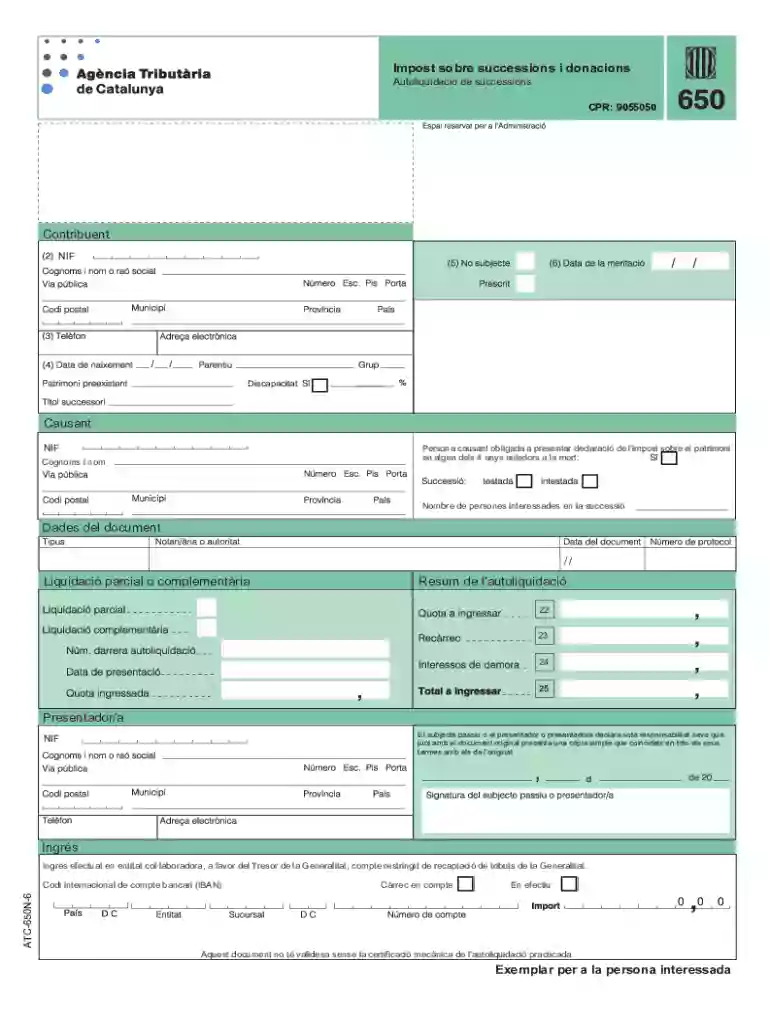
The "Autoliquidació De Successions" is a self-assessment form used for inheritance and donation taxes in Catalonia. It is crucial for those dealing with estates, as it involves the declaration and calculation of taxes owed to the government upon receiving assets from a deceased individual. This form ensures taxpayers fulfill their fiscal responsibilities concerning inherited property, and its completion is mandatory to comply with legal obligations.
Obtaining the Autoliquidació De Successions form can be achieved through multiple channels, including online platforms and physical government offices. However, the most convenient method is typically downloading it from the official tax authority's website in Catalonia. Some local tax offices may also provide hard copies. This accessibility ensures that all eligible taxpayers can easily access the form to fulfill their tax obligations.
Gather Required Information: Collect all necessary details, including the identification number (NIF) of heirs and the deceased, details of inherited assets, and any applicable deductions.
Calculate Tax Liability: Use the form to determine the total inheritance tax owed. This process involves assessing the value of the estate and applying relevant deductions or exemptions.
Submit Documentation: Attach all required documents, such as death certificates, will copies, and property valuations.
Payment of Taxes: Follow the instructions on the form for submitting payment of any taxes owed, which may include bank transfers or direct payments at authorized offices.
Form Submission: Submit the completed form through designated online platforms or in person at tax authority offices. Ensure all sections are filled and supporting documents are included to avoid processing delays.
Using the Autoliquidació De Successions is essential for legal and financial compliance. It ensures that beneficiaries of an estate are aware of their tax obligations and helps in avoiding potential penalties for non-payment or late submission. Properly completing the form contributes to an organized succession process, minimizing the risk of disputes or errors related to asset distribution and tax liability.
To complete the Autoliquidació De Successions, certain documents are required:
Legally, the Autoliquidació De Successions form must be filed according to the existing Catalan tax laws. It serves as the official declaration of inheritance and ensures that the state receives the appropriate tax revenue from estate transfers. Adhering to this legal process also protects beneficiaries from future legal disputes with the tax authorities or other heirs.
While the basic principles of completing an inheritance self-assessment form are similar, specific rules and exemptions can vary significantly in Catalonia. For instance, certain tax benefits may apply based on the family relationship to the deceased or the nature of inherited assets. Familiarizing oneself with these regional variations ensures accurate and compliant form submission, thus avoiding unnecessary fiscal burdens or legal implications.
At DocHub, your data security is our priority. We follow HIPAA, SOC2, GDPR, and other standards, so you can work on your documents with confidence.