01. Edit your form online
Type text, add images, blackout confidential details, add comments, highlights and more.

Type text, add images, blackout confidential details, add comments, highlights and more.

Draw your signature, type it, upload its image, or use your mobile device as a signature pad.

Send it via email, link, or fax. You can also download it, export it or print it out.
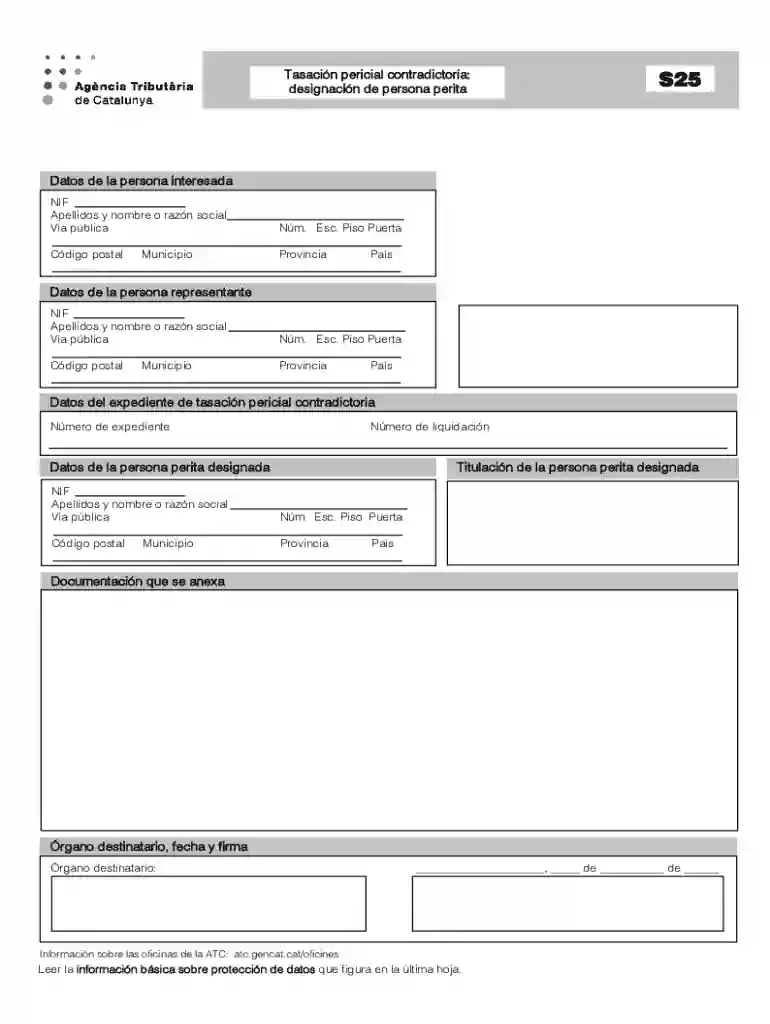
Tasación Pericial Contradictoria is a formal process used to determine the fair market value of a property or asset for tax, legal, or financial purposes. It involves appointing an independent expert appraiser to provide an objective evaluation. This process is commonly used in situations where the initial valuation by a tax authority or insurer is disputed by the taxpayer or property owner. By engaging a third-party expert, both parties aim to reach a mutually agreeable assessment.
Completing the Tasación Pericial Contradictoria involves several well-defined steps to ensure accuracy and compliance with legal standards.
Initiate the Process: Start by submitting a formal request to invoke the tasación pericial contradictoria, usually within a specific timeframe after receiving the initial valuation.
Appoint an Appraiser: Both parties must agree upon an impartial appraiser capable of delivering a fair assessment.
Gather Necessary Documents: Compile all relevant documents related to the property or asset, including previous valuations, property descriptions, and any relevant correspondence.
Conduct Appraisal: The appointed appraiser evaluates the property using standardized methods to establish its fair market value.
Review and Approve Findings: The parties review the appraiser's report. If both agree, the new valuation is finalized; if not, further negotiation or legal steps may be necessary.
The Tasación Pericial Contradictoria is often employed to ensure fairness and accuracy in valuation disputes.
Understanding the terminology associated with this process is crucial for comprehending the nuances involved.
Gathering the appropriate documentation is a critical step in the Tasación Pericial Contradictoria process.
In a legal context, the tasación pericial contradictoria serves as a tool to address valuation discrepancies within the framework of property and tax law.
While this process can be employed by various individuals and entities, certain groups are more likely to engage in contradictory appraisal procedures.


Practical examples can illuminate how Tasación Pericial Contradictoria works in real-world scenarios.
Case Study 1: A homeowner disagrees with the property tax assessment provided by the local government. They request a tasación pericial contradictoria to obtain an independent valuation.
Case Study 2: A company argues that the insurance valuation of their headquarters does not reflect the true market conditions. Through a contradictory appraisal, they achieve a revised valuation.
The application of tasación pericial contradictoria can vary based on state-specific regulations and procedures.
Initiating a Tasación Pericial Contradictoria involves an application process with particular timelines for approval.
Different types of businesses can gain various advantages from using Tasación Pericial Contradictoria.
At DocHub, your data security is our priority. We follow HIPAA, SOC2, GDPR, and other standards, so you can work on your documents with confidence.