






Definition & Meaning
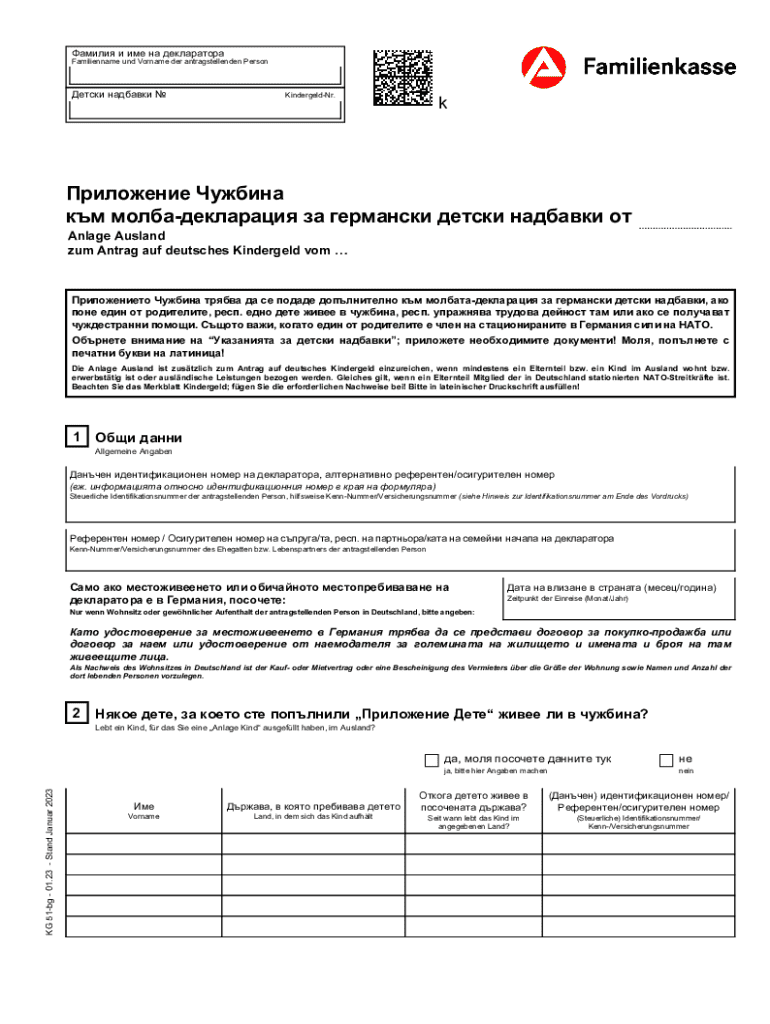
The "Familienname und Vorname der antragstellenden Person" refers to the section of a form that specifies the last name (family name) and first name of the applicant. This part of the form is essential for identifying the person submitting the application, ensuring all related documents can be accurately processed and matched to the correct individual. In the context of German child benefits applications, this field is integral as it connects the applicant to their benefits request, ensuring all accompanying documentation aligns with the correct personal records.
Steps to Complete the Familienname und Vorname der antragstellenden Person
- Gather Personal Information: Ensure you have the correct spelling of your family and first name as officially recorded on legal documents like passports or ID cards.
- Locate the Field on the Form: This section is often prominently placed near the beginning of the application form, indicating its importance.
- Enter Your Information: Write your family name and first name exactly as they appear on your official identification. Double-check for any typos or discrepancies.
- Verify with Identification: Compare the entered details against your ID to ensure accuracy.
- Consult a Translator if Necessary: If the form is in German and you're unfamiliar with the language, use a professional translator to avoid mistakes.
How to Use the Familienname und Vorname der antragstellenden Person
- Identifying the Applicant: This section assures that the person filling out the form is correctly identified, significantly important in governmental or legal contexts.
- Processing Applications: With precise identification, administrative entities can efficiently process applications, reducing the risk of processing errors.
- Cross-Verification: It serves a crucial role when verifying other attached documents to ensure they match the applicant named in this section.
Required Documents
To accurately fill out the "Familienname und Vorname der antragstellenden Person" section, you should have the following documents:
- Passport or National ID: Both include the necessary legal spelling of your name.
- Birth Certificate: Helpful if ID details are unavailable, especially for initial verifications.
- Legal Name Change Documentation: Required if your name has changed since the last governmental filing.
Legal Use of the Familienname und Vorname der antragstellenden Person
In legal contexts, accurately completing this section is necessary because:
- Verification of Identity: Official bodies use these details to verify your identity.
- Document Authenticity: Confirms the legitimacy of the documents connected and makes them legally binding.
- Rights and Obligations: Properly entering your information ensures that you receive your legal rights and obligations are properly addressed.
Important Terms Related to Familienname und Vorname der antragstellenden Person
- Antragstellende Person: The individual applying or requesting the service.
- Familienname: Also known as the surname or last name, it's traditionally inherited from one's family lineage.
- Vorname: The given or first name, specifying the individual's personal name.
Examples of Using the Familienname und Vorname der antragstellenden Person
Scenario 1: Child Benefits Application
A parent applies for Kindergeld (child benefits) while residing abroad. Accurate entry of their "Familienname und Vorname" ensures that their application can be processed seamlessly, linking all relevant documentation to their record.
Scenario 2: Cross-Border Employment
An applicant working in Germany but living elsewhere needs to fill in these details for tax or social security purposes, ensuring accurate cross-border tax compliance.
State-Specific Rules for the Familienname und Vorname der antragstellenden Person
While the core requirement remains the same, some states might have specific mandates regarding the name formats. It is crucial to:
- Check Local Requirements: States may have specific guidelines for how names should be formatted.
- Understand Name Order: The order of surnames may differ based on regional conventions.
Who Typically Uses the Familienname und Vorname der antragstellenden Person
- Parents Applying for Benefits: Especially when applying for child-related benefits abroad.
- Cross-Border Workers: Who are handling legal forms relating to residency or employment in multiple countries.
- Residents with Legal Name Discrepancies: Who need to formalize their identification during application processes.