






Definition and Meaning of Life Space Assessment
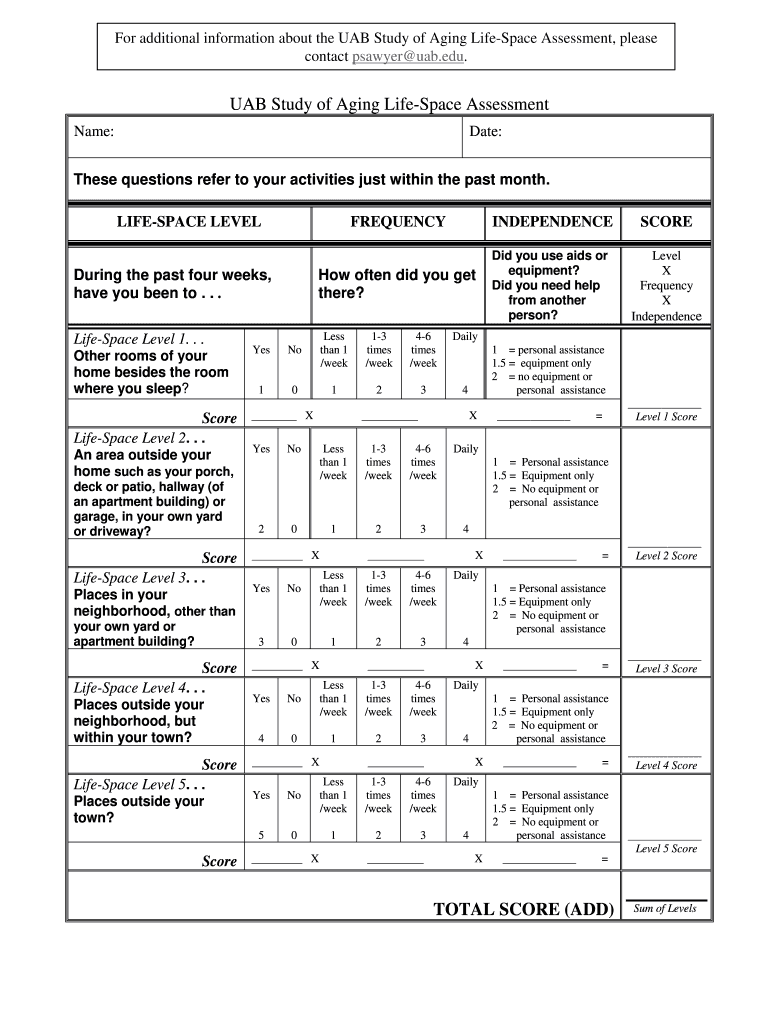
The life space assessment is a measurement tool that evaluates an individual's mobility and activity levels within their living environment over a specified period, often the past month. It provides a detailed analysis of how far and how often a person travels outside their home, emphasizing the connection between mobility and overall well-being. This assessment aids in understanding the individual's level of independence and functional capabilities in various settings, from home to community.
The assessment is typically scored by categorizing different life-space levels, which can range from activities performed solely within the home to those conducted outside the immediate neighborhood. The scoring system often involves a questionnaire format to record frequency of activities and the participant’s perceived independence in completing them.
Key Features of Life Space Assessment
-
Mobility Levels: The assessment categorizes mobility into levels, including:
- Home (inside the residence)
- Local area (in the immediate surroundings)
- Neighborhood (within a few blocks)
- Community (the city or town level)
-
Activity Frequency: It captures how often individuals engage in various activities across these locations, providing a tangible measure of their active engagement with their environment.
-
Independence Measurement: The assessment also gauges the individual’s perceived independence in conducting these activities, offering insights into their confidence and potential barriers.
How to Use the Life Space Assessment
Implementing the life space assessment involves a structured approach that requires collecting specific information to evaluate an individual's mobility effectively.
-
Preparation: Identify the individual for assessment and gather necessary materials, such as a life space assessment questionnaire.
-
Conducting the Assessment: Have the participant complete the questionnaire, which may include items on travel frequency, distance travelled, and types of activities performed within various life space levels.
-
Scoring and Interpretation: After submission, scores are calculated based on the defined categories, allowing for comparisons over time or against established norms. Interpret the results in the context of the individual’s health and mobility goals.
-
Follow-Up Actions: Depending on the findings, follow up with appropriate interventions, such as physical therapy or community resources, to support mobility enhancement.
Steps to Complete the Life Space Assessment
Completing a life space assessment can be methodical and straightforward if guided by clear steps:
-
Distribute the Questionnaire: Provide the life space assessment form, ensuring it's accessible to the individual completing it. Consider offering assistance if needed.
-
Document Responses: Guide the individual to fill out the assessment, recording answers regarding their travel habits, level of independence, and perceived barriers.
-
Calculate Scores: Use the scoring system to evaluate the responses quantitatively. This usually involves tallying the points based on life space level categories.
-
Assess the Results: Review the calculated scores and identify areas of mobility strength and potential improvement, noting any inconsistencies or unexpected findings.
-
Develop an Action Plan: Based on the assessment results, develop a tailored mobility enhancement plan that addresses areas requiring attention.
Who Typically Uses the Life Space Assessment
The life space assessment is utilized by a diverse group of professionals and organizations focused on individual mobility, health, and overall quality of life. This includes:
-
Healthcare Providers: Physicians and physical therapists use the assessment to evaluate patient mobility and create rehabilitation strategies.
-
Research Institutions: Academics and researchers leverage the life space assessment to study aging, mobility, and community involvement.
-
Rehabilitative Programs: Occupational therapists incorporate it into treatment plans to monitor progress in mobility and increased engagement in daily activities.
-
Senior Living Communities: Staff in residential facilities may use it to tailor programs promoting independence and active living among residents.


Important Terms Related to Life Space Assessment
Familiarity with specific terminology is crucial when discussing or utilizing the life space assessment. Important terms include:
-
Life Space Levels: Various categories that classify the extent of an individual’s mobility, ranging from home to community activities.
-
Mobility Metrics: Quantitative measures derived from the assessment, reflecting aspects such as travel distance and frequency.
-
Independence Scale: A measure evaluating an individual's ability to perform activities without assistance, critical in determining support needs.
-
Scoring Rubric: The framework used to convert responses from the life space assessment into numerical values for analysis.
Understanding these terms can significantly ease communication among professionals and increase the effectiveness of interventions based on the assessment's findings.