




Definition and Meaning
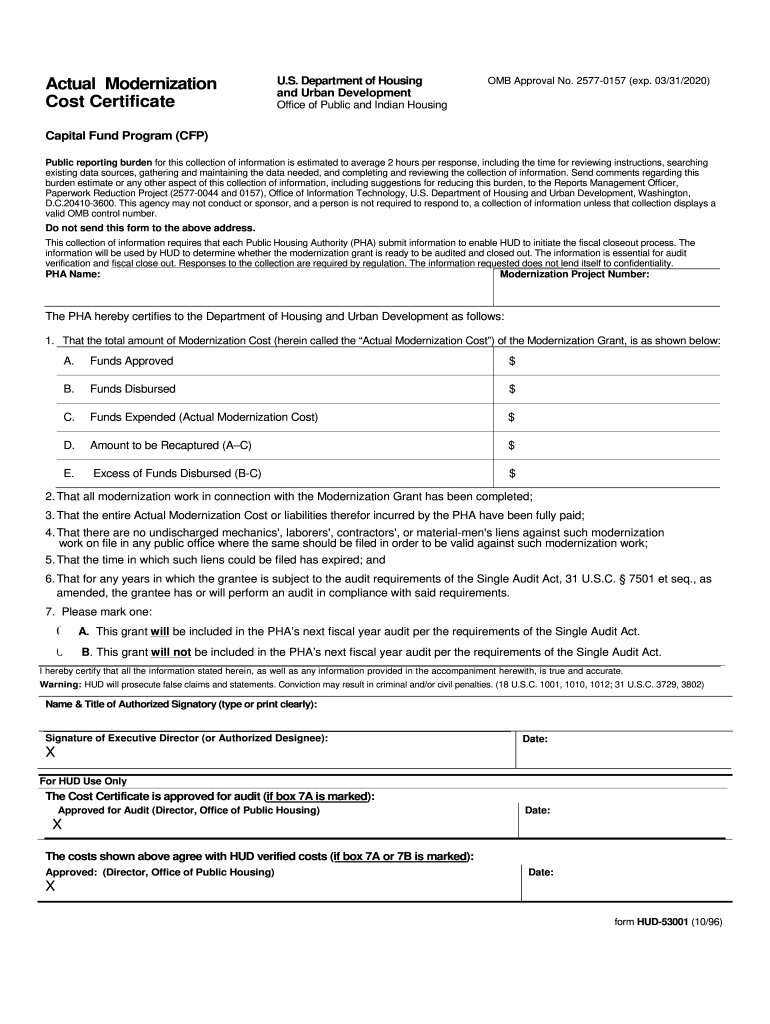
An actual cost certificate is a formal document, primarily associated with the United States Department of Housing and Urban Development (HUD), used by Public Housing Authorities (PHAs) to report the true modernization expenses undertaken through modernization grants under the Capital Fund Program. The document serves as a pivotal element in confirming that modernization tasks have been completed, ensuring that funds have been appropriately utilized, disbursed, and expended. This certification is not only essential for fiscal transparency and accountability but also facilitates the financial closeout process, aiding in compliance with audit requirements.
Steps to Complete the Actual Cost Certificate
Completing an actual cost certificate requires several detailed steps, ensuring accurate and compliant submissions:
-
Gather Financial Documents: Collect all relevant financial records, including receipts, invoices, and statements that detail the funds approved, disbursed, and spent.
-
Verify Completion of Work: Confirm that all modernization work stated in the grant has been completed as per guidelines.
-
Fill Out the Form: Enter all necessary details, including financial summaries and attestations of work completion on the HUD-53001 form.
-
Compliance and Audit Checks: Ensure that all aspects of the modernization work align with audit requirements.
-
Review and Submit: Double-check all information, possibly involving a second pair of eyes for validation, before officially submitting the certificate.
Many PHAs follow this sequence of actions to guarantee precise and error-free reporting.
Key Elements of the Actual Cost Certificate
The actual cost certificate comprises various crucial elements that outline its contents and purpose:
- Financial Overview: Details of the funds approved, received, and spent for modernization works.
- Completion Certification: An official statement asserting the completion of all specified tasks.
- Audit Compliance Confirmation: Confirmation that the work is compliant with audit standards.
- Signature of Authority: A section for the authorized representative’s signature to validate the document’s authenticity.
Understanding these elements is imperative for those tasked with preparing or reviewing the certificate, ensuring comprehensive coverage of all requisite areas.
Importance of the Actual Cost Certificate
Utilizing an actual cost certificate has far-reaching implications for PHAs:
- Financial Accountability: Provides a clear record of expenditure in line with grant disbursements, promoting fiscal transparency.
- Audit Facilitation: Serves as a vital documentation tool for audits, simplifying the review process.
- Legal Compliance: Ensures adherence to stipulated legal requirements, reducing risks associated with non-compliance.
It underscores the need for PHAs to maintain systematic and thorough documentation throughout the modernization process.
Legal Use of the Actual Cost Certificate
The actual cost certificate carries legal weight, primarily within the framework of HUD regulations:
- Contractual Basis: Serves as a binding document between the PHAs and HUD, safeguarding both parties' interests.
- Audit Requirements: Legally necessary for completing audits and resolving fiscal evaluations.
- Certifying Expenditure Legitimacy: Offers legal confirmation of the legitimacy and appropriateness of financial transactions related to the grants.
Adherence to these legal aspects ensures that PHAs are both compliant and protected in their dealings.
Who Typically Uses the Actual Cost Certificate
The actual cost certificate is primarily utilized by:
- Public Housing Authorities: The main entities required to file this form, ensuring the correct and lawful use of HUD modernization funds.
- HUD Auditors: Analysts and auditors from HUD reviewing submitted certificates for compliance verification.
- Financial Officers: Individuals responsible for the fiscal management within PHAs, who rely on this document for accurate financial reporting.
Each user group has specific responsibilities regarding the certificate, ensuring accuracy and compliance in their respective domains.

State-Specific Rules for the Actual Cost Certificate
While the actual cost certificate is federally mandated, state-specific regulations can impact:
- Submission Procedures: Some states may have additional filing requirements or deadlines.
- Compliance Standards: State regulations may influence specific compliance checks or audit standards.
- Financial Reporting Norms: Variations in financial reporting might exist based on local regulations.
PHAs should stay informed on any supplementary state-specific rules that could affect their submissions.
Examples of Using the Actual Cost Certificate
Practical examples and scenarios illuminate how the actual cost certificate operates in real-world contexts:
- Modernization Projects: PHAs overseeing large-scale updates to public housing infrastructure might use the certificate to report and verify project costs.
- Grant Management: It becomes a critical component for financial officers managing HUD grants, offering a structured method for documenting fund usage.
- Audit Preparations: The certificate's detailed reporting format assists PHAs in preparing for both internal and external audits.
These examples underline the certificate's role as a versatile tool in maintaining fiscal integrity and accountability.