






Definition and Meaning
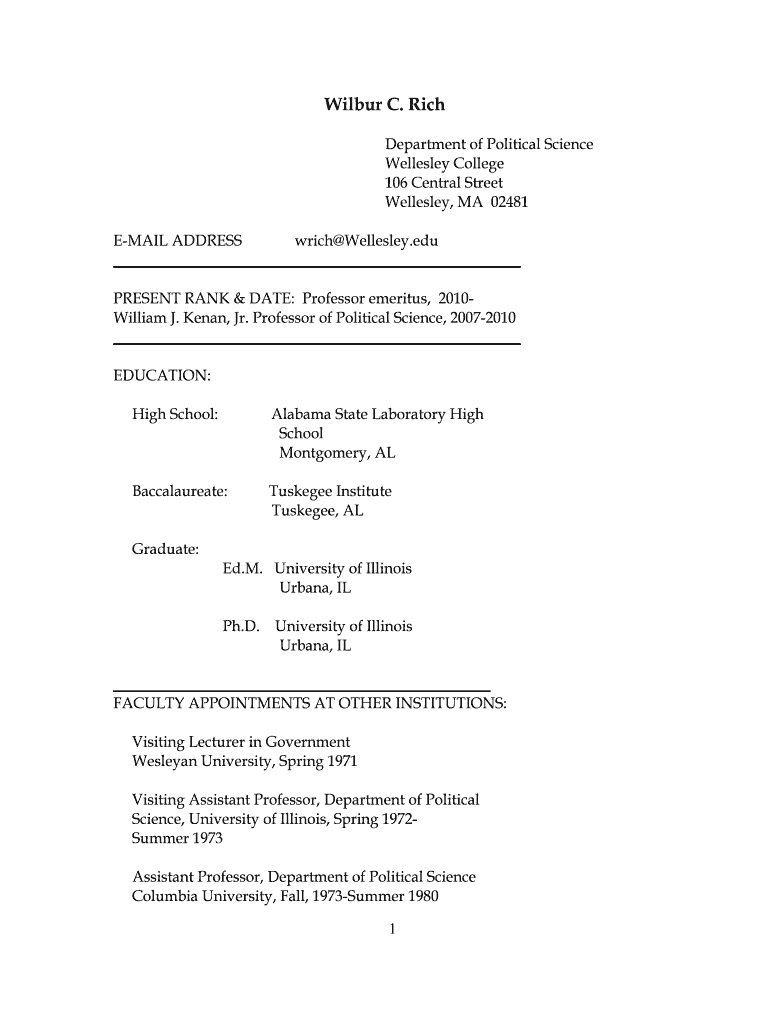
The Curriculum Vitae - Wellesley College - new Wellesley is a comprehensive document detailing an individual's academic and professional history. It goes beyond a typical resume by providing in-depth information about a person's education, research, teaching experience, publications, and honors. Often used in academic, research, and medical fields, this document serves to highlight the depth and breadth of one’s expertise and contributions to their field.
Unlike a standard resume that focuses on succinct highlighting of skills and experiences over one or two pages, a curriculum vitae (CV) is a detailed record that can encompass several pages. This is particularly important in academia, where the CV plays a critical role in applications for positions, grants, and other opportunities that require a detailed understanding of a candidate’s background and achievements.
How to Use the Curriculum Vitae - Wellesley College - new Wellesley
Using this document involves tailoring the information to reflect the specific qualifications that align with the role or opportunity being pursued. Key sections of the CV should include comprehensive information on academic credentials, research experience, teaching roles, publications, presentations, awards, and affiliations.
When applying for a faculty position or academic grant, it is crucial to include a detailed list of publications, including peer-reviewed articles, conference papers, and books. For positions that require teaching, the CV should emphasize teaching experience and any curriculum development roles. Always ensure that the information is updated and accurately reflects the most current achievements and roles.
Steps to Complete the Curriculum Vitae - Wellesley College - new Wellesley
-
Personal Information: Begin with your contact details and a professional summary that encapsulates your career goals and expertise.
-
Education History: Provide details of your academic background including degrees, institutions attended, and dates of attendance.
-
Professional Experience: List your work history in reverse chronological order, emphasizing roles that align closely with your academic pursuits.
-
Publications and Presentations: Include all scholarly articles, books, chapters, and papers presented at conferences.
-
Awards and Honors: Detail any recognitions received in your field, highlighting prestigious awards and grants.
-
Affiliations: List professional organizations and societies related to your academic discipline.
-
References: Provide contact information for academic and professional references who can speak to your qualifications and achievements.
Key Elements of the Curriculum Vitae - Wellesley College - new Wellesley
- Professional Summary: A brief overview highlighting career goals and key accomplishments.
- Education and Qualifications: Lists degrees, certificates, relevant training courses, and any continuing professional development.
- Work Experience: Details roles held, responsibilities, and achievements. Emphasizes positions related to academia, research, and teaching.
- Publications: A categorical listing of books, journal articles, conference papers, and reports.
- Awards: Recognition of academic and professional accomplishments.
- Membership in Professional Organizations: Participation in or leadership roles within relevant societies or committees.
Legal Use of the Curriculum Vitae - Wellesley College - new Wellesley
Primarily used in academic and research contexts, the Curriculum Vitae - Wellesley College - new Wellesley holds significant importance in legal and formal scenarios, such as in applications for faculty positions, Ph.D. programs, research grants, and scholarly projects. It must be accurate and truthful, as any misrepresentation of credentials can lead to rejection or penalties in professional fields.
Ensure that all included information can be verified and corroborated by official transcripts, certificates, or confirmations from previous employers. This document represents a formal declaration of an individual's qualifications and should be treated with the utmost integrity.
Who Typically Uses the Curriculum Vitae - Wellesley College - new Wellesley
- Academics and Researchers: Individuals seeking faculty positions or participating in scholarly pursuits.
- Graduate Students: Those applying to doctoral programs or for research funding.
- Medical Professionals: Doctors and specialists applying for roles in teaching hospitals or research institutions.
The document is widely used across disciplines that require a comprehensive overview of an individual's professional and academic lifecycle, particularly where research and teaching are central to the role.


Examples of Using the Curriculum Vitae - Wellesley College - new Wellesley
- An academic applying for a tenured faculty position at a university.
- A researcher seeking funding for a study in a competitive science grant.
- A graduate student developing their candidacy for a highly selective Ph.D. program.
Each example reflects the adaptability of the CV for different academic and professional contexts, ensuring that it serves as a robust tool to outline an individual's credentials in detail.
Software Compatibility and Integration
Ensuring the curriculum vitae is prepared in widely used formats such as DOC or PDF facilitates its access and review across different platforms. Tools like DocHub can be utilized to not only edit and format CVs but also enhance them with annotations or additions such as electronic signatures. This is particularly useful when documents need to be submitted in digital formats with online applications or shared over platforms like email and cloud services.