






Definition & Meaning
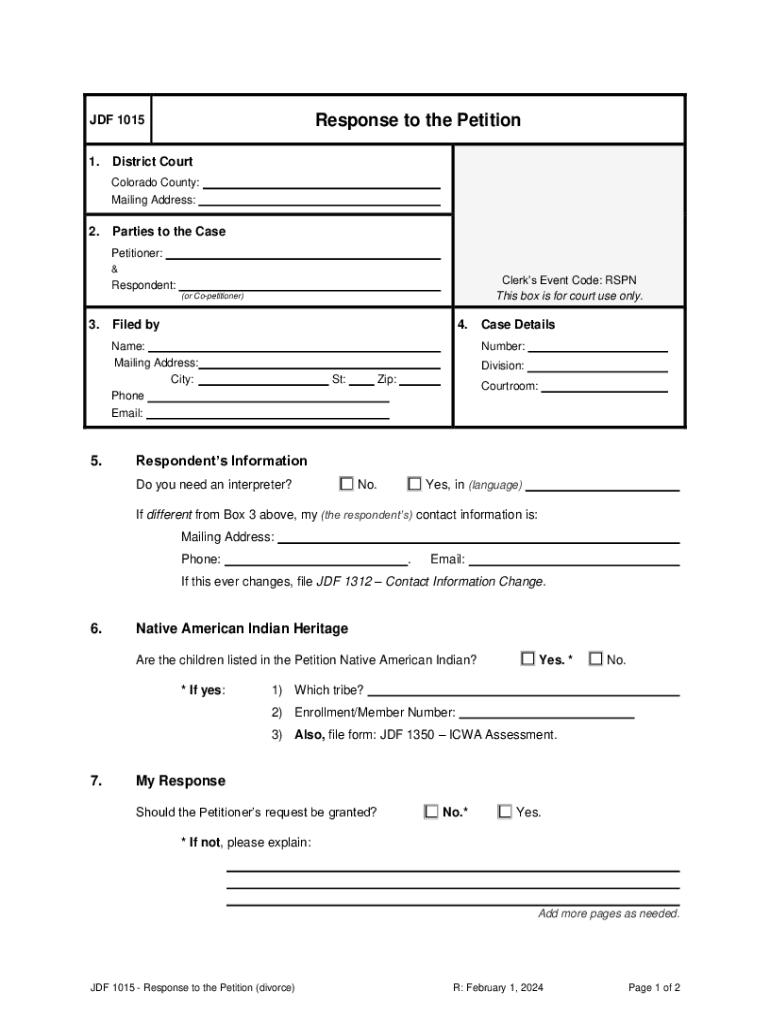
The JDF 1015 - Response to the Petition (divorce) is a legal document utilized in the Colorado District Court system for individuals responding to a divorce petition. This form allows the respondent to officially answer and address the claims and requests outlined in the initial divorce petition filed by the petitioner. The document includes sections to state agreement or disagreement with the petitioner's assertions and requests, ensuring the respondent's voice is considered in the divorce proceedings.
How to Use the JDF 1015 - Response to the Petition (Divorce)
To use the JDF 1015 effectively, respondents must carefully review the divorce petition they are responding to. The form is structured to guide respondents in providing clear and concise answers to each claim made by the petitioner. Respondents should fill out all sections of the form, including personal information, responses to specific claims, and any additional requests or information they wish to include. Utilizing DocHub's tools, respondents can edit the form directly, ensuring all necessary fields are completed accurately before submission to the court.
Steps to Complete the JDF 1015 - Response to the Petition (Divorce)
- Review the Divorce Petition: Understand each claim and request made by the petitioner.
- Fill Out Personal Information: Include names, addresses, and any relevant case identifiers.
- Respond to Each Claim: Use the form's sections to express agreement or disagreement with the petitioner's points.
- Include Additional Information: Add any pertinent information or requests, such as child custody preferences or financial support needs.
- Sign and Date the Form: Ensure the form is legally binding by signing and dating it.
- Submit to the Court: File the completed form with the appropriate Colorado District Court.
Key Elements of the JDF 1015 - Response to the Petition (Divorce)
The JDF 1015 contains several key sections that are critical for a comprehensive response:
- Parties Involved: Lists information about both the petitioner and respondent.
- Case Details: Provides specific case identifiers for reference.
- Responses to Petitioner’s Claims: Section to agree or disagree with the petitioner's requests.
- Native American Heritage Inquiries: Asks about any Native American heritage, which can affect child custody decisions.
- Certificate of Service: Certifies that copies of the response have been sent to the petitioning party or their attorney.
Legal Use of the JDF 1015 - Response to the Petition (Divorce)
Legally, the JDF 1015 is used to ensure that the respondent's position and any counterclaims are officially recorded during divorce proceedings. It acts as a formal counter to the initial divorce petition, allowing courts to consider both parties' positions before making rulings on marital dissolution, property division, and child custody. Adherence to legal norms and state-specific guidelines is critical when completing this form to ensure its validity in court.
State-Specific Rules for the JDF 1015 - Response to the Petition (Divorce)
In Colorado, specific rules govern the completion and submission of the JDF 1015. Respondents must submit their response within a set timeframe, typically 21 days if served within Colorado, and must do so by filing with the district court where the original petition was lodged. Failure to adhere to these deadlines can result in default judgments against the respondent, highlighting the importance of timely and accurate completion.
Examples of Using the JDF 1015 - Response to the Petition (Divorce)
Consider a scenario where the petitioner requests primary custody of children and claims certain marital assets. The respondent might use the JDF 1015 to provide their agreement to shared custody while countering claims on certain assets owing to differing contributions. By filling out the response accurately, the respondent can provide a balanced view for the court to consider, potentially strengthening their position in negotiations.
Penalties for Non-Compliance
Failing to file the JDF 1015 within the designated timeframe could result in significant penalties. The court may issue a default judgment, granting all requests made by the petitioner without consideration of the respondent's situation. This underscores the importance of not only completing the form accurately but ensuring it is submitted promptly to the Colorado District Court.