01. Edit your form online
Type text, add images, blackout confidential details, add comments, highlights and more.

Type text, add images, blackout confidential details, add comments, highlights and more.

Draw your signature, type it, upload its image, or use your mobile device as a signature pad.

Send it via email, link, or fax. You can also download it, export it or print it out.
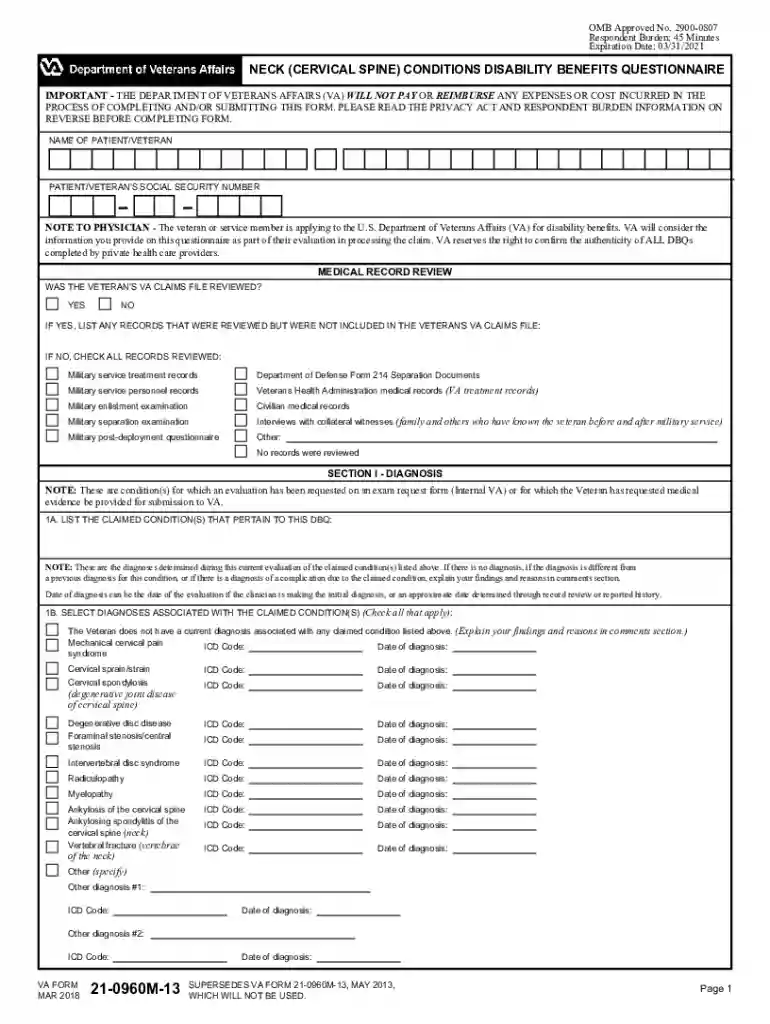
The 21-0960M-13 is a Disability Benefits Questionnaire (DBQ) specifically used by the U.S. Department of Veterans Affairs (VA) to assess neck (cervical spine) conditions in veterans. This form helps evaluate the severity and impact of the veteran's neck condition when they apply for disability benefits. The form includes fields for the physician to fill in details regarding medical history, diagnosis, and functional capacity of the affected individual. It provides a standardized format for collecting comprehensive medical information essential for evaluating a claim for VA disability benefits.
Veterans seeking disability benefits for cervical spine conditions must submit the 21-0960M-13 as part of their application. Physicians use the form to report detailed medical findings about a veteran's neck condition. Here’s how to effectively utilize the form:
Consult a Medical Professional: The form should be completed by a healthcare provider, typically someone familiar with the veteran's medical history and current health status.
Input Accurate Information: Ensure that the medical history, diagnosis, and treatment records are accurately documented.
Complete All Sections: Each section of the form should be thoroughly completed to avoid processing delays.
Submit to the VA: Once completed, the form is submitted as part of the disability benefits application package to the VA for evaluation.
Veterans can access the 21-0960M-13 form through various methods:
VA Website: The form is available for download on the official VA website, ensuring veterans have direct access to the most recent version.
Veterans Affairs Offices: Copies of the form can be obtained from local VA offices, where staff can also provide assistance and guidance.
Veterans Service Organizations: These organizations often maintain forms and can assist veterans with their completion and submission processes.
Completing the form requires a systematic approach to ensure accuracy and completeness:
Gather Medical Records: Collect all relevant medical documents related to the neck condition.
Consult with Your Physician: Schedule an appointment to have sections of the form completed by a qualified healthcare provider.
Fill in Personal Details: Complete sections that require personal information, such as name and identification details.
Ensure Medical Accuracy: Verify that all medical details are provided accurately by the examining physician.
Review and Sign: Ensure that all parts of the form are reviewed, signed, and dated by the appropriate parties to reflect authenticity and completeness.
The primary users of the 21-0960M-13 form are:
Veterans: Individuals who have served in the military and are seeking disability benefits for neck-related conditions.
Healthcare Providers: Physicians and other medical professionals responsible for diagnosing and documenting the veteran's cervical spine health status.
VA Personnel: These include claims processors and evaluators who assess the veteran's eligibility for benefits based on the submitted medical evidence.


The form is structured to capture critical medical information through sections such as:
Medical History: Details regarding any previous or ongoing issues with cervical spine health.
Diagnosis Confirmation: Specifics about the diagnosed condition, including any relevant medical codes and terms.
Functional Impact Assessment: Evaluation of how neck conditions impact daily activities and occupational performance.
Understanding these terms is crucial for accurate completion:
Cervical Spine: Refers to the neck region of the spine, which is often affected by various musculoskeletal conditions.
Disability Benefits: Financial assistance provided to veterans affected by service-related conditions.
Functional Capacity: The ability to perform work-related tasks despite physical or medical limitations.
The form has legal significance as it:
Documents Medical Evidence: Substantiates a veteran's claim for disability benefits through documented medical evaluations.
Supports Legal Consistency: Ensures that all submitted claims are evaluated based on standardized criteria, providing fairness in the review process.
Acknowledges Responsibility: Holds healthcare providers accountable for accurately reporting medical findings that impact the veteran’s eligibility for benefits.
We've got more versions of the 21-0960M-13 form. Select the right 21-0960M-13 version from the list and start editing it straight away!
At DocHub, your data security is our priority. We follow HIPAA, SOC2, GDPR, and other standards, so you can work on your documents with confidence.