






Definition & Meaning
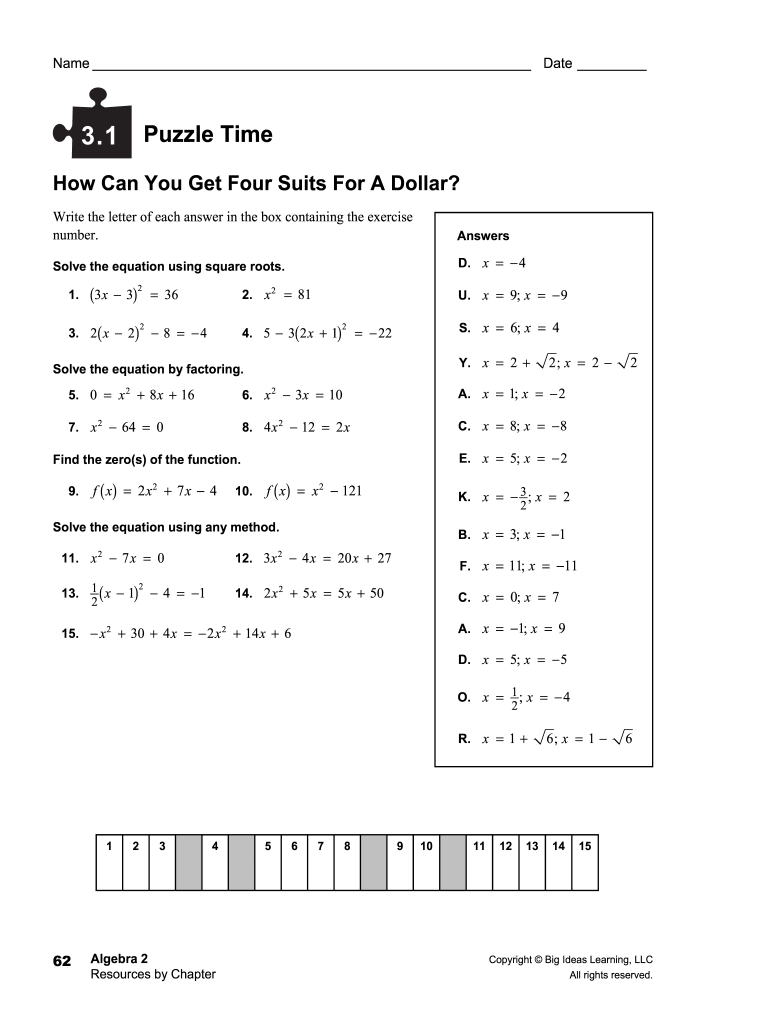
The phrase "how can you get four suits for a dollar 3 1 puzzle time answers" originates from a specific type of problem-solving exercise often integrated into educational material. The puzzles are a fun way to engage students by presenting logic problems or riddles associated with broader academic concepts, such as algebra or mathematics. In this context, "four suits for a dollar" typically refers to a clever or playful riddle that requires using creative thinking to identify the answer. Understanding these types of puzzles helps develop critical thinking skills while applying mathematical rules and formulas.
How to Use the Puzzle
To solve the "how can you get four suits for a dollar 3 1 puzzle time answers," participants need to approach the puzzle with an open mind, considering various possible interpretations of the clues. These puzzles often include elements of wordplay or require lateral thinking.
- Identify the Context: Begin by understanding the terms in the puzzle — “four suits” can imply either clothing or a deck of cards, while "a dollar" might suggest a monetary angle or a play on words.
- Analyze the Clues: Break down the puzzle into parts. "Puzzle time answers" signifies that logic and reasoning are needed to find a solution.
- Apply Problem-Solving Techniques: Consider the relationships between the puzzle's elements. Is it a math problem, a riddle, or a word puzzle?
- Cross-Check with Friends or Resources: Sometimes discussing with others or using resources can highlight overlooked clues or confirm assumptions.
Steps to Complete the Puzzle
Completing the puzzle involves a combination of sequential steps to ensure thorough understanding and accurate solving:
- Read Thoroughly: Carefully read each part of the puzzle to ensure no detail is ignored.
- Break it Down: Decompose the puzzle into manageable sections. Understanding smaller parts can reveal the bigger picture.
- Explore Various Answers: Experiment with different solutions to explore various outcomes.
- Check Consistency: Make sure your answer fits all given clues logically. The solution must satisfy all elements of the problem.
- Review and Reflect: Once you have a solution, review the puzzle and consider alternative answers or solutions. Reflection might provide deeper insights.
Key Elements of the Puzzle
The "how can you get four suits for a dollar" puzzle presents specific elements that are crucial for solving:
- Suits: Traditionally associated with playing cards, a deck of cards consists of four suits: hearts, diamonds, clubs, and spades. Considering these in different contexts might provide a hint.
- Dollar: Could represent monetary value or a figurative sense, requiring participants to think beyond literal definitions.
- Puzzle Time: Indicates that logical reasoning and potentially mathematical skills may be necessary to piece together the solution.
Who Typically Uses These Puzzles
Various demographic groups engage in these puzzles for educational and recreational purposes:
- Students: Often used as a tool in educational settings to promote critical thinking and problem-solving.
- Educators: Teachers may leverage these puzzles to make learning more interactive and engaging.
- Puzzle Enthusiasts: Individuals who enjoy brain teasers and logic puzzles often explore these exercises.


Why Solving These Puzzles is Beneficial
Engaging with puzzles like "how can you get four suits for a dollar" offers several cognitive advantages:
- Enhances Problem Solving: Encourages a systematic approach to tackling problems, incorporating logical thinking and pattern recognition.
- Boosts Creativity: Requires thinking outside the box and exploring unconventional solutions.
- Improves Concentration: Solving puzzles demands focus and attention to detail.
- Fosters Collaboration: Often, solving these puzzles in groups builds teamwork skills and a collaborative spirit.
Examples of Using the Puzzle
Examples demonstrate how different contexts can represent solutions:
- Card Game Context: ‘Four suits’ as the suits in a deck of cards, which, metaphorically, you could argue are valuable.
- Clothing Riddle: Considering if "suits" refers to clothing, imagine a scenario in a thrift store or pawn shop.
- Wordplay: Explore if the answer lies in a pun or play on the phrase "four suits for a dollar," suggesting an unorthodox interpretation.
State-Specific Rules
While not directly applicable, certain puzzles may have regional variations:
- Educational Contexts: Some states adopt specific educational strategies where puzzles are part of standardized testing or curriculum efforts.
- Cultural References: Puzzles may draw upon state-specific references or culturally significant themes to relate better to the audience.
This structured approach offers an in-depth exploration of the puzzle, providing comprehensive insights to enhance understanding and enjoyment.