




01. Edit your bill sale dirt bike printable online
Type text, add images, blackout confidential details, add comments, highlights and more.

Type text, add images, blackout confidential details, add comments, highlights and more.

Draw your signature, type it, upload its image, or use your mobile device as a signature pad.

Send bill sale dirt bike via email, link, or fax. You can also download it, export it or print it out.
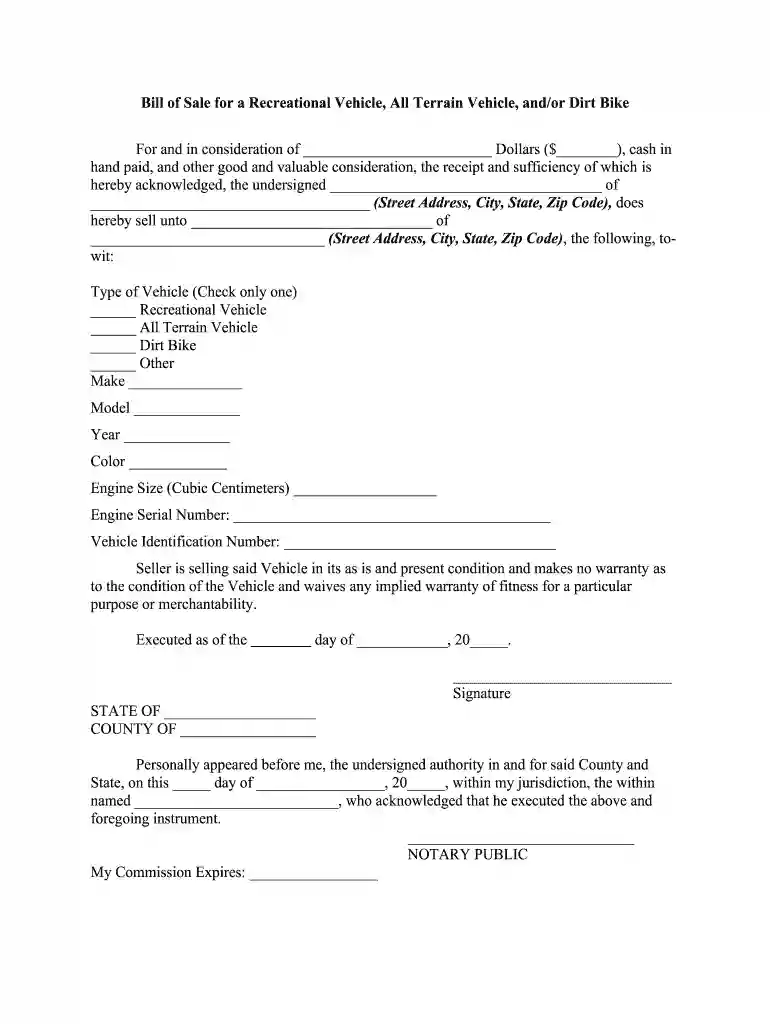
A bill of sale vehicle is a legal document that serves to formally transfer ownership of a vehicle from the seller to the buyer. It is typically used for transactions involving recreational vehicles, all-terrain vehicles, or dirt bikes. The document outlines crucial information including the sale price and detailed descriptions of the vehicle such as its make, model, year, color, engine size, and identification numbers. The seller frequently sells the vehicle on an "as is" basis, meaning there are no warranties regarding the condition of the vehicle. Both parties are required to sign the bill of sale, and there often is a section for notarization to validate the transaction legally.
Completing a bill of sale for a vehicle involves several specific steps to ensure accuracy and legality:
Detailed Vehicle Information: Include detailed information about the vehicle being sold, such as the make, model, year, and VIN (Vehicle Identification Number). This ensures that the correct vehicle is identified in the transaction.
Seller and Buyer Information: Clearly state the legal names and contact information of both the seller and buyer. This information should match their identification documents.
Sale Price and Terms: Specify the agreed-upon sale price and any terms of payment. If the vehicle is sold "as is," this should be explicitly mentioned.
Signatures: Both parties must sign the document to make it legally binding. It may be required or advisable to have the document notarized, depending on the state laws.
Notarization: If applicable, a notary should witness the signing of the document, adding a layer of authenticity and legal protection.
A well-prepared bill of sale for a vehicle should include several key components to ensure it is comprehensive and legally sound:
Identification of Parties: Complete details about the buyer and seller, including their full names and contact information.
Vehicle Description: Detailed information about the vehicle, including its VIN, make, model, year, and color.
Transaction Details: The sale price and any terms or conditions that apply to the sale. If the vehicle is sold without warranty, this should be clearly stated.
Signatures: Both parties need to provide their signatures. Including a section for notarization adds credibility and may be required by law in some jurisdictions.
Date of Sale: The date the transaction is completed and the document is signed.
A bill of sale vehicle is crucial for both legal and practical reasons. For the buyer, it serves as proof of ownership, which is essential for registering the vehicle and obtaining insurance. For the seller, it acts as a record of the sale, which can protect against future claims or liabilities related to the vehicle. This document is particularly important in establishing the change of ownership in case of disputes or legal issues.
The requirements for a bill of sale vehicle can vary significantly from one state to another in the United States. Some states might require a notarized bill of sale for all vehicle purchases, while others may not require it at all. Additionally, states might have different rules regarding the information that needs to be included in the bill of sale. It's important to check with the state's Department of Motor Vehicles (DMV) or equivalent authority to ensure compliance with local regulations.
The legal use of a bill of sale vehicle involves its function as a proof of the transaction. It is a critical document in transferring vehicle ownership legally and protects both parties in case of future disputes. In most jurisdictions, the bill of sale is not just a receipt of the sale but a binding contract, thus its accurate completion is essential.
Obtaining a bill of sale vehicle typically involves downloading a template from a trustworthy source, such as a DMV website or a legal document provider. Templates are often available in various formats, including PDF and DOC, allowing for easy editing and printing. Once downloaded, the form can be filled out manually or electronically, ensuring that all required sections are completed accurately.
Bill of sale vehicles are commonly used by:
Individual Sellers and Buyers: Private parties engaging in the sale or purchase of a used vehicle.
Dealerships: Car dealerships that sell vehicles also use bills of sale to document transactions and transfer ownership.
Financial Institutions: Banks or lenders that facilitate auto loans may require a bill of sale as part of the documentation needed for loan processing.
There are several variations and alternatives to a basic bill of sale vehicle, depending on specific needs and circumstances:
Conditional Sales Agreement: Used when the sale includes conditions, such as installment payments or satisfaction of certain criteria before transfer is complete.
Gift Affidavit: Utilized when ownership is transferred as a gift, sometimes in combination with a bill of sale to clarify the nature of the transaction.
Trade-in Transaction Forms: Specific forms used when a vehicle is part of a trade-in during a new vehicle purchase.
At DocHub, your data security is our priority. We follow HIPAA, SOC2, GDPR, and other standards, so you can work on your documents with confidence.


