01. Edit your form online
Type text, add images, blackout confidential details, add comments, highlights and more.

Type text, add images, blackout confidential details, add comments, highlights and more.

Draw your signature, type it, upload its image, or use your mobile device as a signature pad.

Send it via email, link, or fax. You can also download it, export it or print it out.
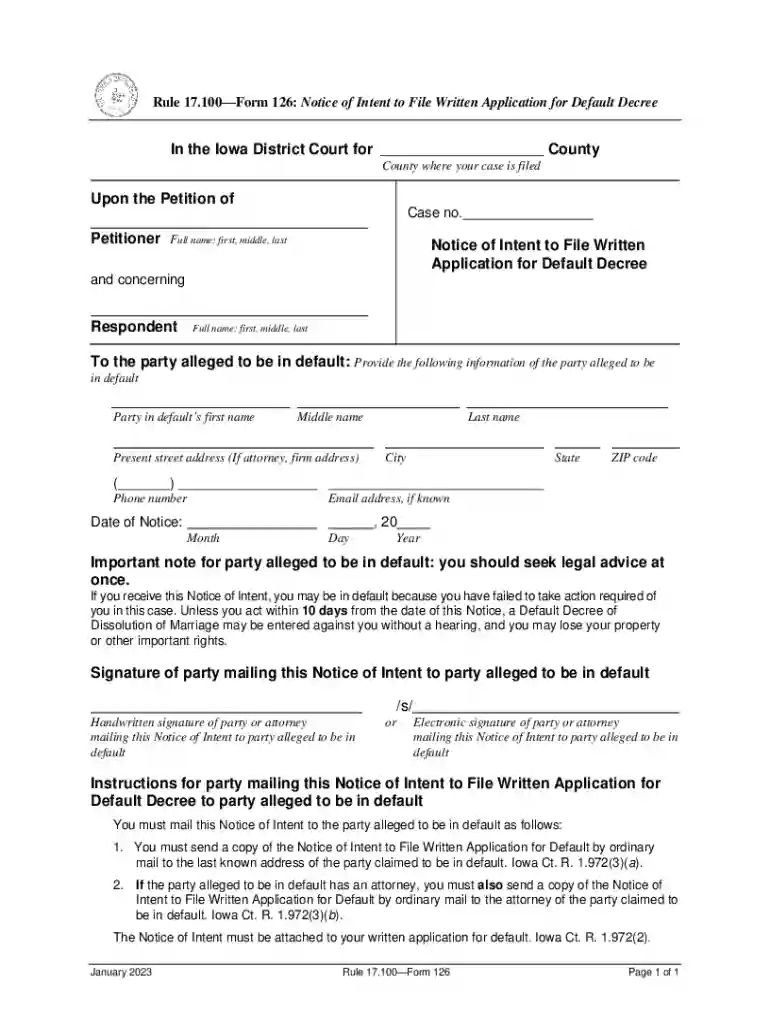
The "Rule 17 100Form 126: Notice of Intent to File Written Application" is a formal notification utilized within the Iowa District Court system. Its primary role is to inform a party alleged to be in default of their failure to act in a legal proceeding, particularly in matters like dissolution of marriage. This notice is crucial as it signals the potential for a Default Decree to be issued, which can significantly impact the involved party without further hearings.
This form is predominantly used by legal practitioners and parties involved in legal proceedings within the Iowa District Court system. It is essential for attorneys representing clients in default situations, plaintiffs or petitioners pursuing legal actions like divorce, and clerks or administrative personnel responsible for docket management. Understanding who should utilize this form helps ensure the correct application within judicial processes.


This form has a strict legal application as it relates to notifying a party of their default status in a legal case. Its usage is generally limited to court settings, emphasizing the necessity for legal counsel to guide the process. The form serves as an official record within the judicial system, aiding in maintaining procedural integrity and fairness.
While primarily utilized in Iowa, variations exist based on state-specific regulations governing default situations in legal cases. Users must consult local legal statutes to ensure compliance with state laws outside Iowa. Understanding these nuances is vital for accurate use and legal adherence.
Though this form's primary application is in Iowa, similar processes exist nationwide in courts handling defaults. Key differences might include deadlines, procedural requirements, and documentation formats. Legal professionals should navigate these differences meticulously to avoid procedural errors that could impact case outcomes.
For a Notice of Intent to lead to a Default Decree, specific filing deadlines are mandatory. Often, these forms require submission within ten days after a party fails to respond. Missing these deadlines can delay legal outcomes and potentially disadvantage the filing party. Therefore, punctual submission is critical to maintaining procedural advantages.
We've got more versions of the Rule 17 100Form 126: Notice of Intent to File Written Application form. Select the right Rule 17 100Form 126: Notice of Intent to File Written Application version from the list and start editing it straight away!
At DocHub, your data security is our priority. We follow HIPAA, SOC2, GDPR, and other standards, so you can work on your documents with confidence.