01. Edit your form online
Type text, add images, blackout confidential details, add comments, highlights and more.

Type text, add images, blackout confidential details, add comments, highlights and more.

Draw your signature, type it, upload its image, or use your mobile device as a signature pad.

Send it via email, link, or fax. You can also download it, export it or print it out.
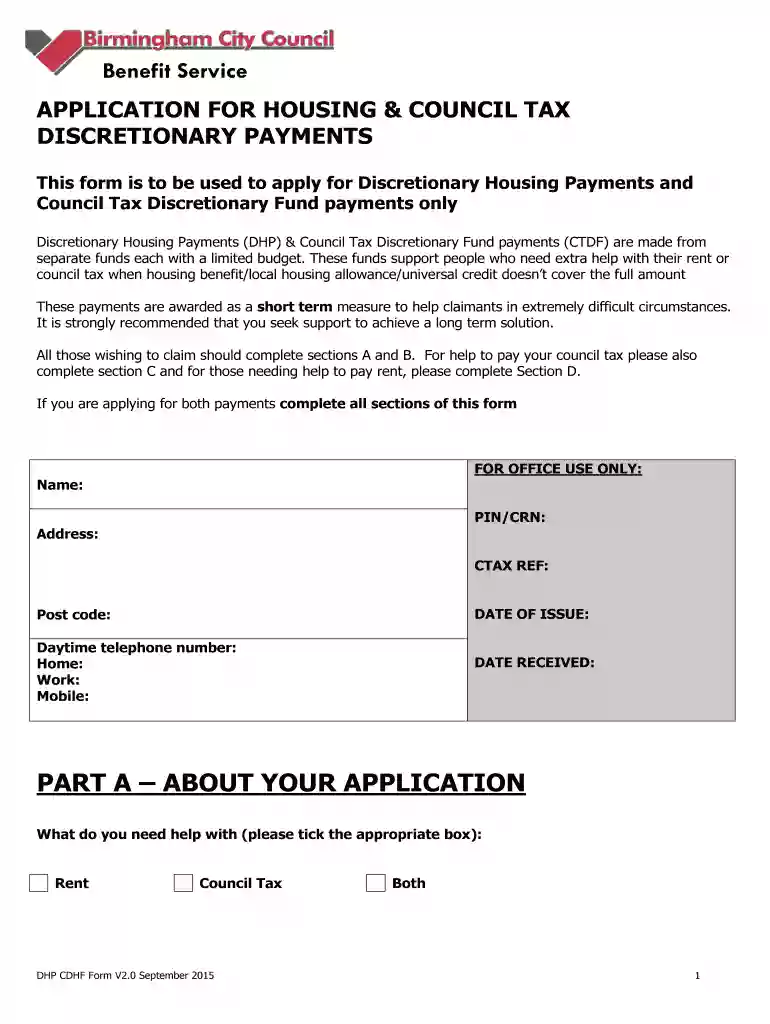
The "Discretionary Housing Payment Request" (DHP) is a vital form designed to help individuals experiencing financial hardship with their housing expenses, including rent or council tax, beyond what standard benefits typically cover. A DHP allocation is not an entitlement and is assessed based on individual circumstances. It functions as a supplementary financial resource to bridge the gap when regular benefits fall short, offering relief to those facing unexpected fiscal challenges.
DHPs are not meant to replace housing benefits but to complement them by addressing unique situations not considered by the standard benefit calculation. For individuals unable, for any valid reason, to meet their housing costs through general benefits, this request acts as a lifeline by providing sporadic support tailored to the applicants' specific needs and hardships.
Eligibility for a Discretionary Housing Payment is contingent upon qualifying for Housing Benefit or Universal Credit with housing costs. Applicants must demonstrate a tangible need for further financial assistance, including documentation showing their income, expenses, and the reasons for their financial difficulties. Each application undergoes a careful evaluation process to determine if the applicant's circumstances warrant supplementary support.
Gather Relevant Information: Before beginning the application, compile all necessary documents, such as income statements, expenditure details, and any correspondence related to your current housing benefits. This groundwork will streamline the completion process.
Fill Out Personal Information: Start by entering your basic information, including your full name, address, and contact details. It's essential to ensure accuracy as this data forms the foundation of your application.
Detail Financial Circumstances: Include a comprehensive account of your financial situation. Outline monthly income, expenditures, and any debts. Being thorough in this section is crucial as it dictates the need for the discretionary payment.
Explain Hardship: Clearly illustrate why additional help is necessary. Highlight any changes in circumstance, such as job loss or unexpected medical expenses, that have contributed to your current financial difficulty.
Submit Supporting Documentation: Attach all relevant documents to substantiate your claims. This might include pay slips, bank statements, and bills. Lack of proper documentation can delay the process or result in a denial.
Review and Submit the Form: Double-check all the information for completeness and accuracy before submitting your application. Ensure that every section is filled, and each attachment is valid and pertinent.
These elements are critically evaluated to assess the need for discretionary funds.
When facing unforeseen or difficult financial scenarios, submitting a DHP request can provide vital supplementary support. This request can mitigate the risk of eviction or insolvency by offering temporary financial relief when standard benefits fall short. It is particularly advantageous for those who have encountered sudden income disruptions or increased financial demands.
Submitting a well-prepared request can mean the difference between enduring continued financial struggle or receiving the aid necessary to regain financial stability. By accurately portraying one's dire circumstances and providing supporting evidence, an applicant enhances their chances of approval, thereby reducing immediate financial stress.
This form is predominantly utilized by individuals and families receiving Housing Benefit or Universal Credit who are struggling to meet their complete housing costs. Common users include:
Understanding who typically benefits can guide the applicability and completion of the form for potential applicants.


Applications for DHPs can generally be obtained through the local council's housing services department or from their official website. Residents may also contact their council for assistance and additional guidance on how to acquire and complete the form. Various councils might offer digital downloads or require physical collection of the forms from designated offices, making it crucial to understand the preferred methods for one's local authority.
Understanding these terms can facilitate a deeper comprehension of the application process and expectations.
While the overarching framework for DHPs is consistent, state-specific guidelines can affect the application process. Variations might include:
Awareness of state-specific nuances and regulations is crucial for accurately completing the request and understanding the local context of housing support.
At DocHub, your data security is our priority. We follow HIPAA, SOC2, GDPR, and other standards, so you can work on your documents with confidence.