Future Equity Agreement Template 2026

Get Form
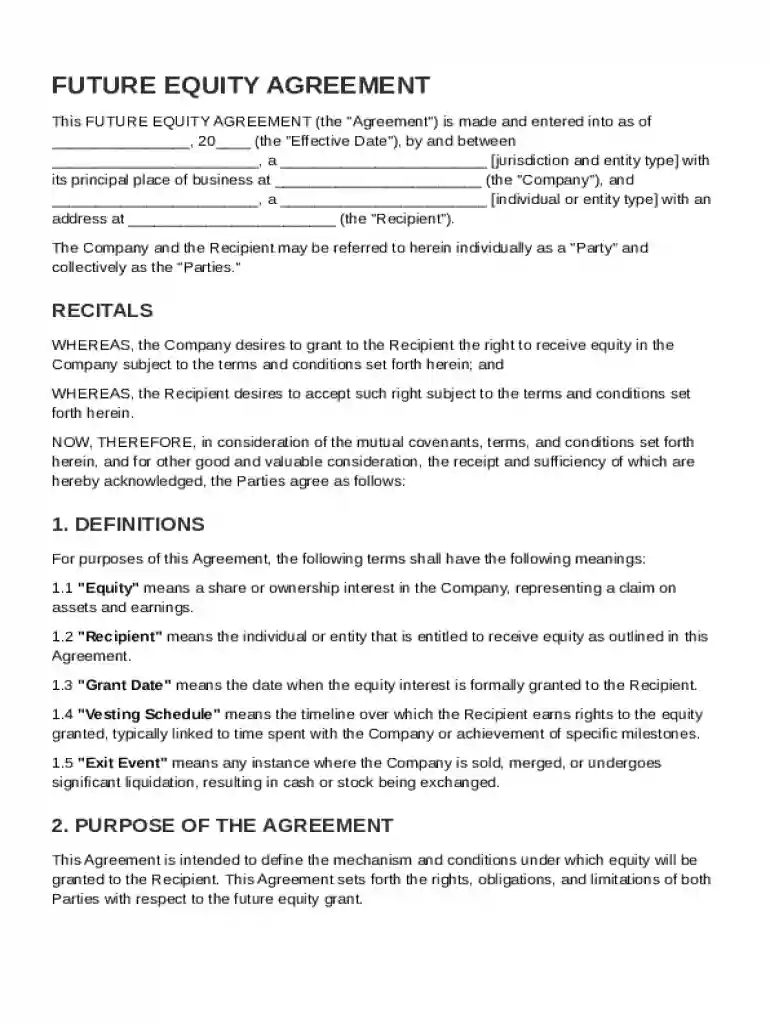
Future Equity Agreement Template Preview on Page 1

Here's how it works

01. Edit your form online
Type text, add images, blackout confidential details, add comments, highlights and more.

02. Sign it in a few clicks
Draw your signature, type it, upload its image, or use your mobile device as a signature pad.

03. Share your form with others
Send it via email, link, or fax. You can also download it, export it or print it out.

Definition & Meaning

A Future Equity Agreement Template is a legal document used by companies to outline the conditions under which equity is granted to an individual or entity. Commonly utilized in startups and companies seeking investment, this document formalizes the recipient's rights to potential future ownership. Key terms defined within the agreement include 'Equity', 'Grant Date', and 'Vesting Schedule'. It also delineates the parties' responsibilities concerning equity grants, such as vesting conditions, transferability, and company representations. The form is integral in safeguarding both company interests and recipients' rights, ensuring clarity in future equity transactions.

Key Elements of the Future Equity Agreement Template

Essential Components

  • Equity Grant Terms: Details about the type of equity granted, such as stock options or shares.
  • Vesting Schedule: Specifies when and how equity becomes available to the recipient.
  • Transferability: Conditions under which equity can be transferred to others.
  • Company Representations: Declarations made by the company about its standing and future prospects.

Standard Clauses

  • Indemnification: Protects parties from potential losses due to errors or breaches.
  • Governing Law: Jurisdiction that governs the agreement, often aligned with the company's locale.
  • Miscellaneous Provisions: Includes amendment and termination clauses, detailing how changes can be made and circumstances under which the agreement ends.

How to Use the Future Equity Agreement Template

Understanding the application of the Future Equity Agreement Template ensures it is leveraged effectively. The template serves as a guide for customizing agreements to match specific organizational needs. Prior to utilization, reviewing internal policy and legal requirements is crucial. Consulting with legal counsel is recommended to ensure the agreement meets all regulatory standards and adequately addresses unique situational needs.

Customization Process

  1. Identify Specific Needs: Assess what terms need customization based on recipient roles and company objectives.
  2. Draft Bespoke Clauses: Modify standard terms to reflect specific vesting schedules, equity types, and unique covenants.
  3. Review and Revise: Collaborate with legal experts to fine-tune language ensuring legal compliance and clarity.

Steps to Complete the Future Equity Agreement Template

Completing the template involves multiple steps to ensure accurate and compliant documentation.

  1. Enter Party Information: Fill in names and contact details for all parties involved.
  2. Detail Equity Information: Specify the type, amount, and conditions of equity being granted.
  3. Define Vesting Schedule: Clearly outline the timeline and conditions under which equity will vest.
  4. Incorporate Legal Clauses: Ensure all necessary indemnification, governing law, and amendment provisions are included.
  5. Review and Approve: A thorough review by stakeholders is essential before final approval and signing.

Important Terms Related to Future Equity Agreement Template

Understanding key terms is paramount in navigating the complexities of future equity agreements. Some important terms include:

  • Equity Compensation: The incentive structure offering ownership stakes as compensation.
  • Dilution: The reduction in existing shareholders' ownership percentage due to new equity issuance.
  • Exercise Price: The pre-set price at which equity options can be purchased.

Examples and Application

  • Scenario Exploration: How various vesting schedules affect equity disbursement.
  • Analysis of Transferability: Evaluating liquidity versus control in equity agreements.

State-Specific Rules for the Future Equity Agreement Template

Different states may impose varying regulations impacting the structure and enforcement of equity agreements.

Regulatory Variance

  • California: Stringent regulations may apply to employee stock plans.
  • New York: Additional securities laws might govern registration and disclosure requirements.

Compliance Resources

  • Maintains updated resources or legal guidebooks specific to individual state regulations.

Who Typically Uses the Future Equity Agreement Template

This template is primarily utilized by startups, venture capital firms, and emerging growth companies. Ideal for environments where offering equity is a primary incentive, it attracts talent and investment while preserving cash flow.


  • Startup Founders: Offer equity during early growth phases.
  • Investors: Use agreements to formalize equity stakes in emerging enterprises.
  • HR Departments: Manage equity distribution to retain high-caliber talent effectively.
decoration image ratings of Dochub

Software Compatibility with Future Equity Agreement Template

When preparing future equity agreements, ensuring compatibility with document management software can streamline workflow.

System Integration

  • DocHub: Facilitates editing, annotation, and signing of PDF and DOC formats for equity agreements.
  • Google Workspace: Seamless integration allows real-time collaboration and storage via Google Drive and Gmail.

Practical Advantages

  • Real-time synchronization across devices ensures the latest document version is secure and accessible.
  • Simplified signature collection using electronic methods compliant with legal standards.
be ready to get more

Complete this form in 5 minutes or less

Get form

Got questions?

We have answers to the most popular questions from our customers. If you can't find an answer to your question, please contact us.
Contact us
An equity futures contract is a type of derivative whereby parties involved must transact shares of a specific company at a predetermined future date and price. The price of the contract is namely determined by the spot price of the underlying stock.
A SAFE (Simple Agreement for Future Equity) is a legal contract between a startup and an investor that allows the investor to purchase equity in the company at a future date (typically during your companys next priced round or during a liquidity event).
When you draft an employment contract that includes equity incentives, you need to ensure you do the following: Define the equity package. Outline the type of equity, and the number of the shares or options (if relevant). Set out the vesting conditions. Clarify rights, responsibilities, and buyout clauses.
A simple agreement for future equity (SAFE) is an agreement between an investor and a startup that states an investor can receive an equity stake in the startup on a future date based on the occurrence of an agreed-upon event.
A SAFE is an investment contract between a startup and an investor that gives the investor the right to receive equity of the company on certain triggering events, such as a: Future equity financing (known as a Next Equity Financing or Qualified Financing), usually led by an institutional venture capital (VC) fund.

Security and compliance

At DocHub, your data security is our priority. We follow HIPAA, SOC2, GDPR, and other standards, so you can work on your documents with confidence.

Learn more
ccpa2
pci-dss
gdpr-compliance
hipaa
soc-compliance
be ready to get more

Complete this form in 5 minutes or less

Get form

People also ask

An equity purchase agreement, also known as a share purchase agreement or stock purchase agreement, is a contract that transfers shares of a company from a seller to a buyer. Equity purchases can be used to acquire a business in whole or in part.
SAFEs are flexible, as they dont carry interest or have a maturity date, which makes them more appealing for startups that want to avoid debt or immediate shareholder obligations. However, until the SAFE converts, investors have no voting rights or ownership in the company.

Related links