Definition & Meaning
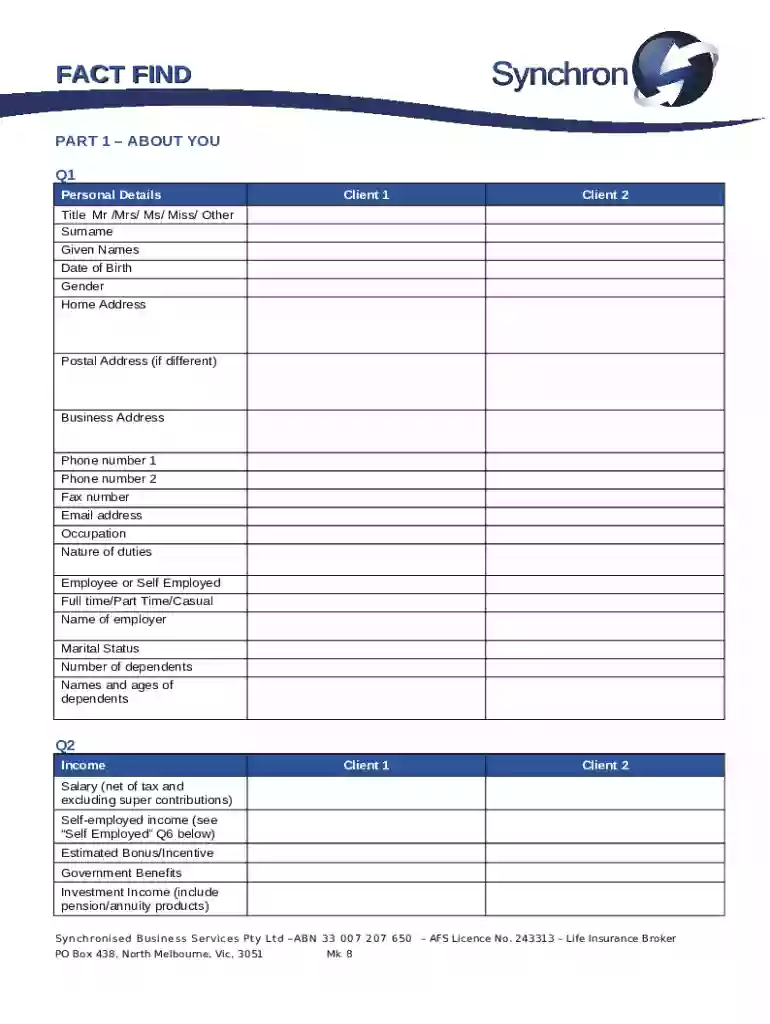
A fact find is a detailed questionnaire used to collect comprehensive personal, financial, and insurance information from clients. This process involves gathering data on several aspects, including income, expenses, assets, liabilities, insurance needs, investment prospects, and estate planning requirements. It is designed to provide a holistic overview of an individual's or household’s financial status.
- Income and Expenses: The fact find assesses regular income sources, including salary, rental income, or business revenue, along with regular expenses like mortgage, utilities, and other financial commitments.
- Assets and Liabilities: It covers owned assets such as properties, vehicles, and savings, as well as liabilities including outstanding loans and credit card balances.
- Insurance and Investment Needs: The questionnaire identifies existing insurance policies, investment portfolios, and potential requirements for further coverage or investment opportunities.
The primary aim is to empower financial advisors to offer tailored advice that aligns with clients' specific circumstances and future goals.
Key Elements of the FACT FIND
A thorough fact find includes essential components that ensure a comprehensive evaluation of the client's financial landscape. Here are the main elements:
- Personal Details: Names, contact information, and other identification details for accurate records.
- Financial Overview: Detailed income, expense, asset, and liability information to evaluate financial health.
- Self-Employment Information: For business owners, data on business income, expenses, and relevant tax obligations.
- Insurance Needs Assessment: Identification of gaps in existing coverage and opportunities for enhancement.
- Investment Requirements: Evaluation of investment goals and risk tolerance to tailor investment strategies.
- Estate Planning Details: Includes wills, trusts, and other legal documentation for effective inheritance planning.
Each element is crucial for building a complete picture, allowing for precise financial and investment planning.
Steps to Complete the FACT FIND
Completing a fact find requires meticulous attention to detail and accurate data collection. Here are the typical steps involved:
- Gather Preliminary Information: Begin by collecting basic personal and contact information for identification purposes.
- Income and Expense Analysis: Document all sources of income and regular expenses to assess cash flow and financial stability.
- Asset and Liability Inventory: Compile a comprehensive list of all assets owned and liabilities owed to understand net worth.
- Review Self-Employment Data: For clients who are business owners, detail business income sources and associated expenses.
- Insurance Policy Review: Document existing insurance policies, identifying areas for potential improvement or additional coverage needed.
- Investment Portfolio Assessment: Evaluate existing investments and identify opportunities for diversification or risk mitigation.
- Estate and Inheritance Planning: Collect information on estate planning measures like wills or trusts to safeguard client wishes posthumously.
Each step is vital in ensuring that the fact find reflects a complete and precise view of the client’s financial situation.
Why Should You FACT FIND
Conducting a fact find is critical for several reasons, particularly within financial planning and advisement.
- Tailored Financial Advice: Enables advisors to provide personalized guidance that aligns with the unique needs and objectives of the client.
- Risk Management: Identifies financial vulnerabilities and risks to mitigate potential losses or challenges in the future.
- Goal Alignment: Assists clients in clarifying financial goals and creating actionable plans to achieve them efficiently.
- Comprehensive Evaluation: Offers a complete financial snapshot that aids in informed decision-making regarding investments, savings, and expenditures.
Using a fact find ensures that all facets of personal finances are accounted for, leading to more effective and strategic financial management.
Important Terms Related to FACT FIND
Understanding key terminology is crucial for effectively utilizing a fact find:
- Net Worth: Calculated as the total assets minus total liabilities, representing an individual’s financial standing.
- Cash Flow: The total amount of money being transferred in and out, indicative of financial health.
- Risk Tolerance: The level of variability in investment returns that a client is willing to withstand.
- Beneficiary: An individual designated to receive benefits from insurance policies, trusts, or estates.
- Portfolio Diversification: The practice of spreading investments across various financial instruments to reduce risk.
These terms help facilitate a clearer understanding of financial concepts that are vital during the fact-find process.
State-Specific Rules for the FACT FIND
While many aspects of a fact find are standardized, certain elements may vary by state due to differing laws and regulations:
- State-Specific Tax Regulations: Variations in state income tax and deductions can influence financial evaluations.
- Insurance Requirements: States have different mandates for minimum insurance coverage levels.
- Inheritance Laws: Estate planning considerations may differ due to unique state inheritance tax laws.
It is important to factor in these state-specific rules to ensure the fact find accurately reflects and complies with local regulations.
Form Submission Methods (Online / Mail / In-Person)
How a fact find is submitted can vary based on the client's preferences and technological accessibility:
- Online Submission: Common for clients comfortable with digital platforms, allowing for faster processing and immediate feedback.
- Mail Submission: Traditional method for clients preferring physical documentation, though it may result in longer processing times.
- In-Person Submission: Enables direct interaction and immediate clarifications, beneficial for complex queries or extensive fact finds.
Each method has its advantages and can be selected based on ease, speed, and client preference.