






Definition and Meaning
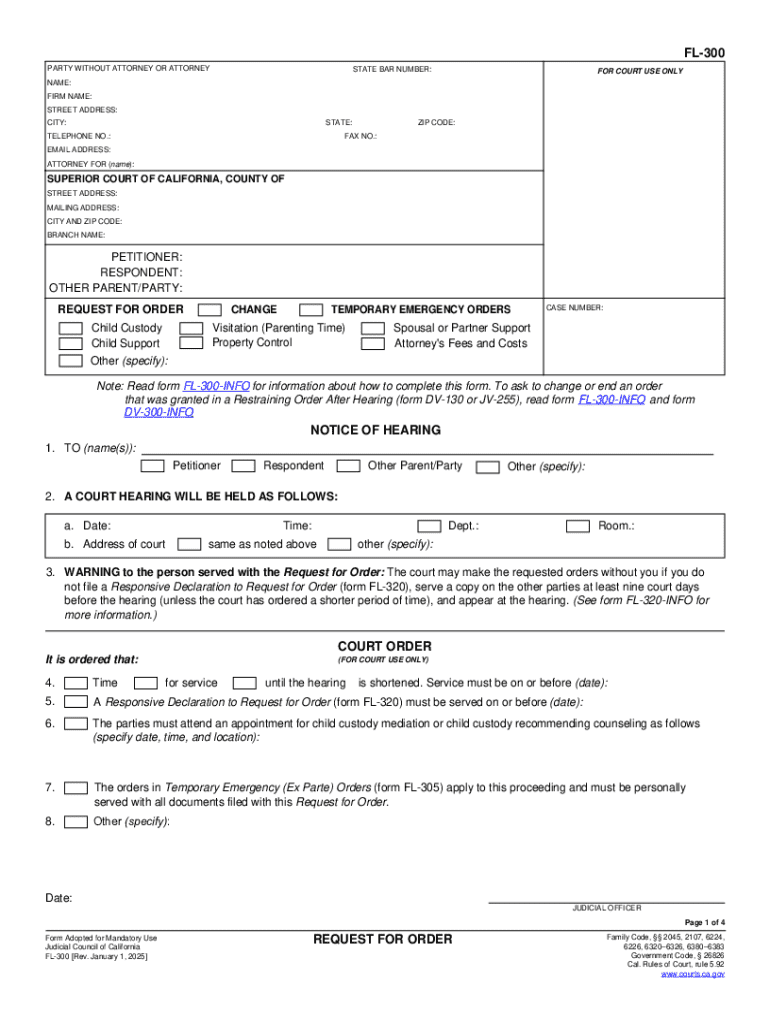
The FL-300 form, titled "Request for Order," is a legal document used in California's family court system. It facilitates requests for various family law court orders, encompassing areas such as child custody, child support, spousal support, and property control. It serves as a formal procedure for petitioners to outline their requests and for respondents to provide their replies. Both parties present their circumstances and the rationale for their requests, making it an essential legal tool in family law proceedings. It ensures that all necessary information is organized and submitted in accordance with legal standards.
How to Use the FL-300
To effectively use the FL-300, individuals must understand its purpose and the context in which it applies. It should be used when seeking court intervention in family law matters. The form acts as the official medium to petition the court for desired orders. When using the FL-300, it is crucial to provide accurate and comprehensive information. This includes personal details, the type of orders requested, and the justification behind such requests. Proper utilization ensures one's position is clearly communicated to the court.
Steps to Complete the FL-300
Completing the FL-300 involves several precise steps to ensure all necessary information is provided:
- Identify the Type of Request: Clearly state whether the request involves custody, support, or property matters.
- Fill Personal Information: Enter the names, addresses, and contact details of both the petitioner and respondent.
- Specify Orders Sought: Detail the specific relief or orders being requested from the court.
- Provide Supporting Information: Include relevant facts and circumstances that support the request.
- Sign and Date: Ensure both the petitioner and, if applicable, legal representatives sign and date the document.
Careful attention to these steps ensures that the form is properly filled, minimizing potential delays in court processing.
Importance of Using the FL-300
The FL-300 is pivotal in effectively communicating one's needs and circumstances to the family court. It standardizes the process of requesting judicial intervention, ensuring that key issues are addressed in a formal legal setting. By using the FL-300, individuals can seek temporary or permanent resolutions to sensitive family matters, ensuring that legal rights are asserted and considered. This form is integral in ensuring fair court proceedings, where each party’s requests and responses are documented and assessed.
Who Typically Uses the FL-300
The FL-300 is primarily used by individuals involved in family law disputes in California. This includes:
- Parents: Seeking child custody or child support modifications.
- Spouses or Ex-Spouses: Requesting spousal support adjustments or property control orders.
- Legal Guardians: Involved in custody or visitation disputes.
These parties often need to formalize their requests for orders, making the FL-300 a critical document in their legal toolkit.

Key Elements of the FL-300
Several key elements define the FL-300's structure and purpose:
- Order Request Sections: Designated sections address different types of court orders.
- Temporary Emergency Orders: Allows for the request of urgent orders that require immediate court attention.
- Supporting Declarations: Space to attach additional documentation or declarations supporting the request.
These elements ensure that the FL-300 accommodates the varied needs of family law cases, providing comprehensive options for court requests.
State-Specific Rules for the FL-300
The FL-300 adheres to California's specific legal standards and requirements for family law proceedings. It must:
- Conform to California Law: All submissions need to follow California's family code and procedural rules.
- Align with Court Procedures: The form should be submitted to the appropriate family law court for jurisdiction.
- Adhere to Filing Deadlines: Timeliness is crucial in filing the FL-300 to ensure the court can address the requests promptly.
Understanding state-specific rules ensures that the FL-300 is effectively utilized in alignment with legal frameworks governing family law cases.
Examples of Using the FL-300
Practical scenarios where the FL-300 might be used include:
- Modifying Child Support: A parent requests a modification due to significant changes in financial circumstances.
- Changing Custody Arrangements: A custodial parent pursues a change in visitation schedules to accommodate a new work schedule.
- Spousal Support Adjustments: A spouse seeks increased support following a job loss.
These examples illustrate the form’s flexibility and vital role in facilitating changes and requests essential to family dynamics.