






Definition and Meaning
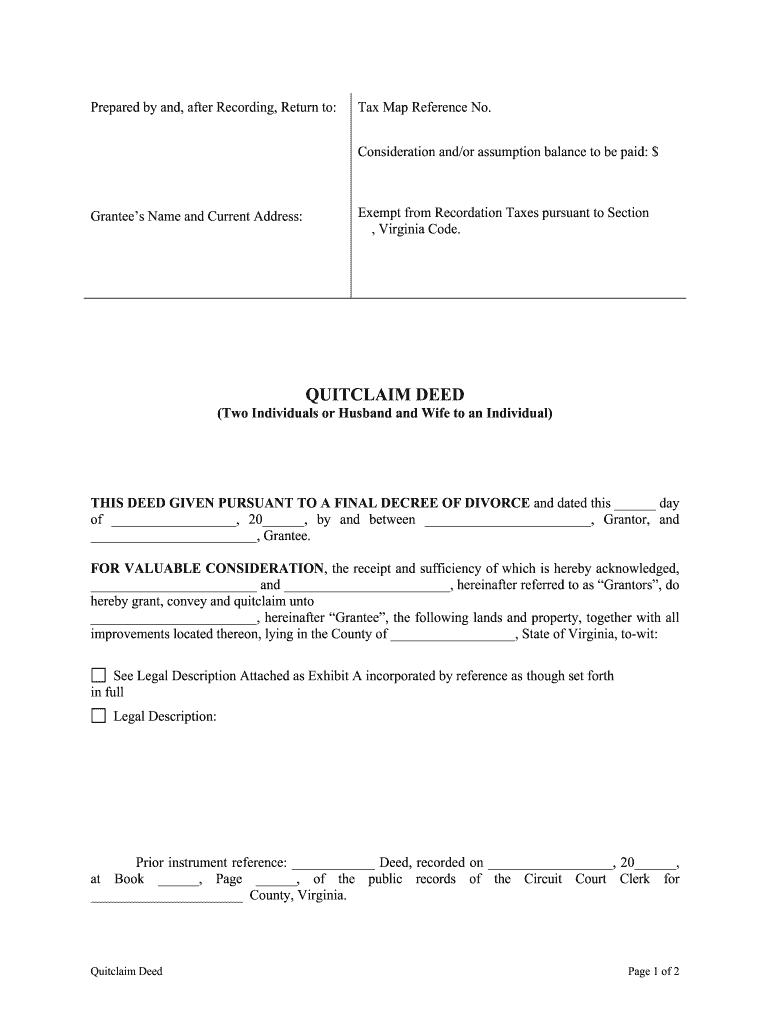
A Virginia Quitclaim Deed following a Final Decree of Divorce is a legal document employed to transfer property ownership from two individuals to one individual due to divorce proceedings. This form is particularly useful when the final decree mandates the reallocation of property assets. It does not guarantee that the property is free from claims; rather, it transfers whatever interest the transferring parties have to the recipient.
Key Characteristics
- Non-Warranty: The deed does not offer any guarantee about the title’s condition.
- Interest Transfer: Only the interest that the transferors possess is transferred.
- Use Case: Typically used when divorcing parties need to allocate property as per a divorce decree.
Practical Implications
- Risk: The grantee receives the property "as-is" with no title guarantees.
- Legal Simplicity: Easier than other deeds due to the lack of warranty.
How to Use the Form
Proper usage of the Virginia Quitclaim Deed requires understanding both the procedural and legal aspects. Here is a step-by-step guide:
- Acquire the Form: Obtain the form from a reliable source, such as a legal provider or the courthouse.
- Identify Parties: Clearly specify the grantors (those relinquishing ownership) and the grantee (individual gaining ownership).
- Property Description: Include a precise legal description of the property, as expectations in Virginia Law are stringent.
- Notarization: The form must be notarized to verify its authenticity.
- Record the Deed: Submit the completed deed to the local county clerk or land records office to make it legally effective.
Steps to Complete the Form
Completing a Virginia Quitclaim Deed involves several detailed steps:
- Title Information: Fill in all relevant information about the parties involved.
- Property Details: Include specifics such as property boundaries and legal descriptions.
- Signatures: Both parties should sign the document in the presence of a notary public.
- Notarization: Engage a notary public to certify the parties' identities and their signing of the document.
- Submission: File the notarized document with the appropriate county recorder’s office.
Detailed Execution
- Verification: Double-check all entries for accuracy.
- Documentation: Retain copies for personal records and future reference.
Key Elements of the Form
The Virginia Quitclaim Deed necessitates certain core elements for validity:
- Grantor and Grantee Information: Names and contact info of the parties involved.
- Legal Description of Property: Precise details that identify the property legally.
- Execution Date: The date the document is signed.
Supporting Components
- Notary Section: Space for the notary public to affirm the document's signing.
- Exemption Clauses: Specify any applicable exemptions from recording taxes per Virginia state laws.
Legal Use and Compliance
The legitimate utilization of a Quitclaim Deed is bound by several legal stipulations:
- Recordation Requirements: Adhere strictly to the recording laws in the jurisdiction where the property is located.
- Divorce Decree Compliance: Ensure that the transactions correspond with the court’s finalized divorce decree.
Legal Precautions
- Consult an Attorney: Legal counsel may be advisable to navigate complex cases or confirm adherence to divorce settlements.
- Disclosure: While full disclosure is not mandated, detailing the state of the property adds transparency.
Who Uses this Form
Primarily, this form is used by:
- Divorcing Couples: As dictated by the divorce decree to address the formal transfer of shared property to one individual.
- Family Law Attorneys: To manage the documentation needed for property division during divorce proceedings.
- Real Estate Professionals: Assisting clients to ensure the legal transfer of property as required by personal agreements or court orders.
State-Specific Rules
Virginia imposes unique rules that impact the use of Quitclaim Deeds:
Notable Virginia Regulations
- Exemption from Recordation Tax: Many transfers linked to divorce are tax-exempt, though one must specify the applicable exemption on the deed.
- Local Variations: Recording processes can differ slightly by county, necessitating contact with local authorities.
Practical Considerations
- Research Required: Ensure familiarization with state regulations and local procedures to avoid legal missteps.
Important Terms to Understand
It is crucial to comprehend certain terms when dealing with a Quitclaim Deed:
- Grantor: Persons transferring their interest.
- Grantee: Individual receiving the property interest.
- Consideration: Often stated as nominal, reflecting the non-sale nature of the transfer.
Additional Legal Terminology
- Encumbrance: Claims or liens that may exist on the property.
- Notarization: Certification by a notary public to confirm document execution.
Examples of Use
Illustrative scenarios in which this form is used:
- Post-Divorce: John and Jane Doe agree Jane retains sole ownership of a shared house following their divorce, facilitated by a Quitclaim Deed.
- Estate Distribution: Although less typical, it can be used for reallocation among family members if specified in a will or legal decree.