




01. Edit your vesting worksheet online
Type text, add images, blackout confidential details, add comments, highlights and more.

Type text, add images, blackout confidential details, add comments, highlights and more.

Draw your signature, type it, upload its image, or use your mobile device as a signature pad.

Send vesting worksheet via email, link, or fax. You can also download it, export it or print it out.
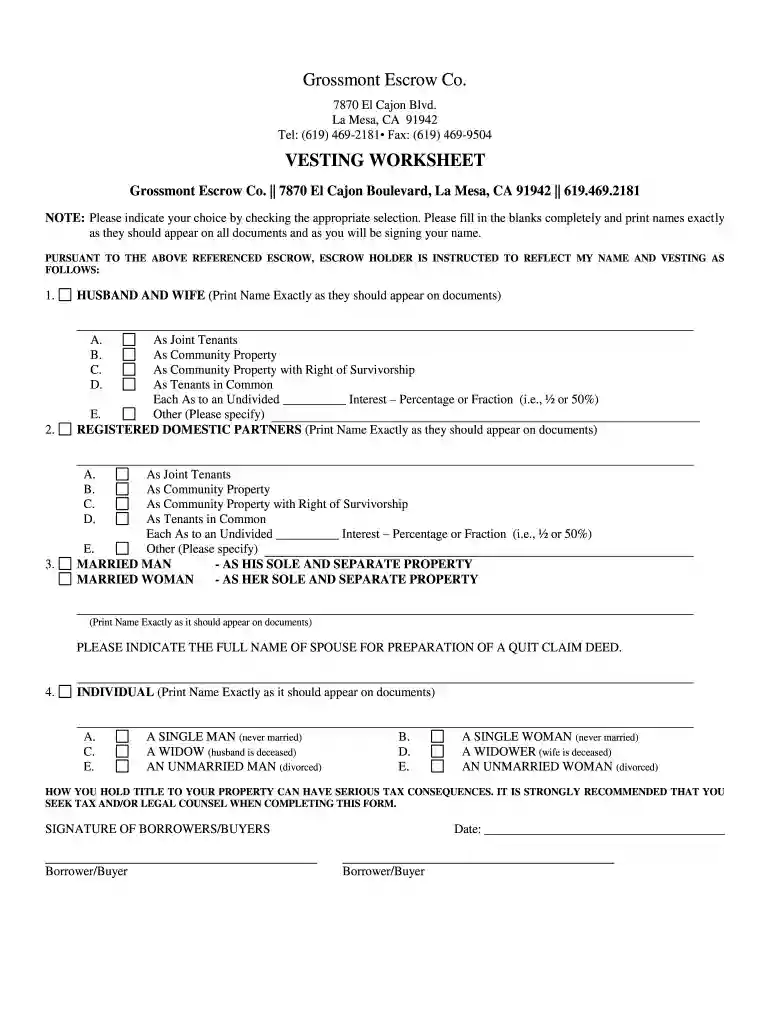
A vesting worksheet typically serves as an informational tool used during property transactions to outline methods of holding title. Titles can be held in various forms, such as Joint Tenants, Community Property, or Sole and Separate Property, each carrying different implications for ownership rights, transferability, and liability. The worksheet helps individuals and entities understand these options and make informed decisions that best align with their legal and financial objectives. It's crucial to accurately fill out the information on the vesting worksheet as it can have significant legal and tax consequences.
To use the vesting worksheet effectively, one must first gather personal and transaction-specific details, such as the names of all parties involved and the property description. The worksheet will guide you through evaluating different ownership types. Once names and ownership structures are filled in, users should review the implications associated with each type. For instance, choosing Joint Tenancy often means the property will pass directly to the other tenant(s) upon death, bypassing probate. Comparing these implications with personal circumstances is essential to choosing the right vesting option, often with the help of legal or tax advisors.
The vesting worksheet contains specific elements crucial for completion. These include fields for the legal names of parties involved, a check-box or selection area for the type of vesting, and an explanation of each vesting choice. Supporting details, such as notary acknowledgment or legal descriptions, might also be necessary. These elements serve to ensure that all relevant data is captured correctly, impacting both the legality of the document and its effectiveness in serving its purpose during property transactions.
Several terms are key to understanding a vesting worksheet. These include:
Clarifying these terms can prevent misunderstandings and ensure that the worksheet is utilized correctly, influencing decisions around property ownership and management.
Legally, a vesting worksheet functions as a preparatory document in real estate transactions. It does not itself transfer or grant property rights but rather facilitates decisions about legal ownership forms that will be finalized in the title deed. Different states may have specific guidelines or legal standards that must be adhered to when completing the vesting worksheet. Therefore, it is advisable to consult local real estate or legal experts to ensure compliance with applicable laws.
State laws significantly influence the options available in a vesting worksheet. For example, community property classifications are restricted to states recognizing this form of ownership, such as California and Texas. On the other hand, some states might not recognize community property, altering available options. Familiarity with state-specific regulations is beneficial, as is consulting a legal expert within your jurisdiction to navigate these regional differences effectively.
Consider a married couple in a community property state purchasing a residential property. They decide to select a community property ownership model on their vesting worksheet to benefit from equal ownership and favorable tax treatment upon the sale of the property.
Alternatively, consider a group of investors purchasing commercial property who opts for joint tenancy, ensuring streamlined transfer of shares in the event of an investor's death. These examples highlight practical applications of vesting worksheets in different scenarios, demonstrating their utility in facilitating informed ownership decisions.
At DocHub, your data security is our priority. We follow HIPAA, SOC2, GDPR, and other standards, so you can work on your documents with confidence.


