Definition and Meaning of the B319 - Department of Home Affairs
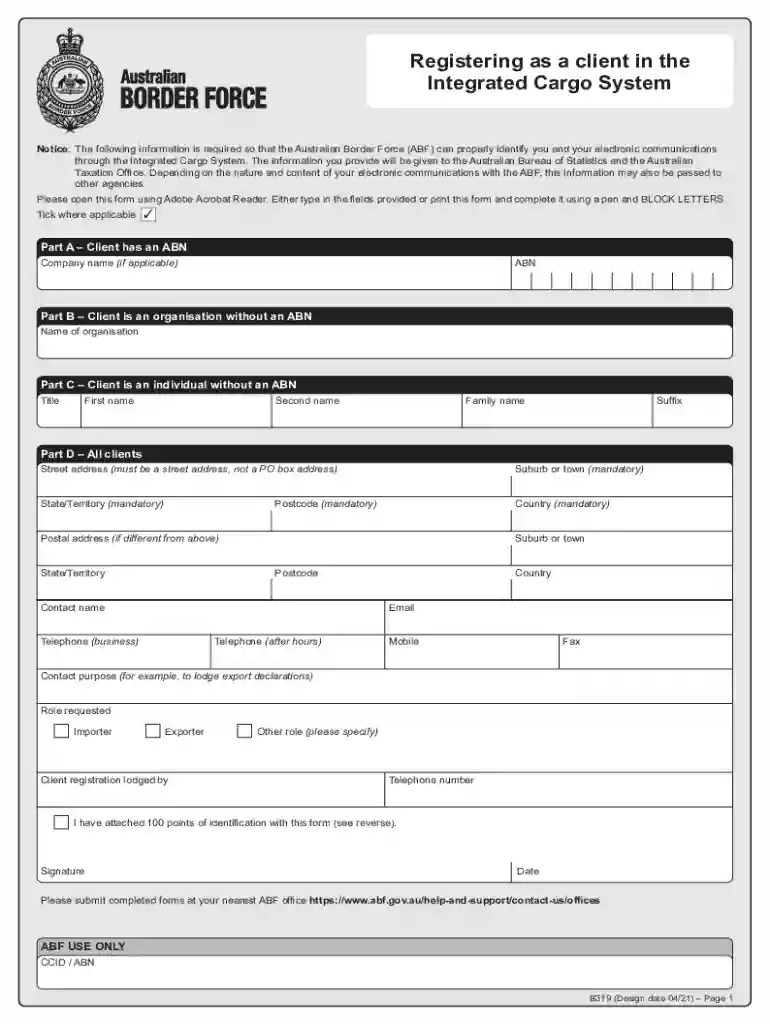
The B319 form, issued by the Department of Home Affairs, serves as a regulatory document within the Integrated Cargo System (ICS) managed by the Australian Border Force (ABF). Its primary function is to facilitate the registration of clients participating in the import and export processes within Australia's jurisdiction. The form ensures that all entities comply with established regulatory frameworks, providing a standardized method for collecting essential information.
Key Importance
- Regulatory Compliance: Ensures adherence to legal and import/export regulations.
- Data Collection: Gathers crucial personal and organizational details for identification purposes.
- Verification: Assists in conducting a 100-point identity check.
How to Use the B319 - Department of Home Affairs
Utilizing the B319 form requires a thorough understanding of its structure and the information it seeks to collect. To use the form effectively, one must follow the detailed instructions provided, focusing on accuracy and completeness.
Detailed Procedures
- Data Entry: Complete all required sections with accurate information.
- Verification: Perform a 100-point check using primary and secondary identity documents.
- Submission: Present the completed form at an ABF office for final processing.
Common Usage Scenarios
- Customs Registration: For businesses and individuals engaging with Australia's import/export communities.
- Identity Verification: For establishing credibility and legitimacy within governmental records.
How to Obtain the B319 - Department of Home Affairs
Acquiring the B319 form can be done through official channels provided by the Department of Home Affairs or the Australian Border Force.
Acquisition Channels
- Department of Home Affairs Website: Downloadable copies available for registered users.
- Local ABF Offices: Physical copies can be obtained by visiting an office in person.
Important Considerations
- Eligibility: Check if you meet the criteria for form submission.
- Documentation: Prepare all necessary documents in advance for a seamless collection process.
Steps to Complete the B319 - Department of Home Affairs
Completing the B319 form involves a series of deliberate steps that must be followed to ensure eligibility and proper processing.
Step-by-Step Instructions
- Read Guidelines: Understand the instructions accompanying the form.
- Fill in Personal Details: Provide full name, date of birth, address, and contact information.
- List Organizational Details: Include business registration numbers and official addresses.
- Attach Documents: Ensure all identity verification documents are attached.
- Review and Sign: Double-check for completeness before signing.
- Submit: Deliver the form to an ABF location or submit it digitally if available.
Additional Tips
- Double-Check: Avoid common errors by reviewing each section carefully.
- Photocopies: Retain copies of all submitted documents for your records.
Key Elements of the B319 - Department of Home Affairs
Understanding the core components of the B319 form will assist in successful completion and submission.
Essential Sections
- Identification Information: Collects basic personal and business identifiers.
- Verification Checks: Includes requirements for supporting documents.
- Official Use Area: To be completed by ABF officials during processing.
Document Requirements
- Primary Identity Proof: Passport or national ID.
- Secondary Identity Documents: Utility bills or bank statements confirming address.
Legal Use of the B319 - Department of Home Affairs
The B319 form adheres strictly to legal standards set by the Australian government, ensuring entities engage in compliant trade activities.
Jurisdictional Compliance
- Australian Regulations: Aligns with laws governing import/export procedures.
- Identification Protocols: Mandates comprehensive personal verification.
Penalties for Non-Compliance
Failing to submit or correctly complete the B319 form can result in several repercussions, ranging from fines to operational restrictions.
Potential Consequences
- Financial Penalties: Imposed for inaccurate or omitted information.
- Trading Delays: Suspension of import/export rights pending form correction.
Avoiding Compliance Issues
- Regular Audits: Periodically review documentation for accuracy.
- Professional Assistance: Seek expert advice when in doubt about form completion.
Examples of Using the B319 - Department of Home Affairs
Practical examples provide clarity on real-world applications of the B319 form.
Case Studies
- Multinational Corporations: Ensures smooth operations of international trade.
- Small Businesses: Assists in expanding market reach through legal compliance.
Through accurate completion and submission of the B319 form, entities can effectively navigate the complexities of international trade and regulatory compliance within Australia, ensuring operational continuity and adherence to legal standards.