
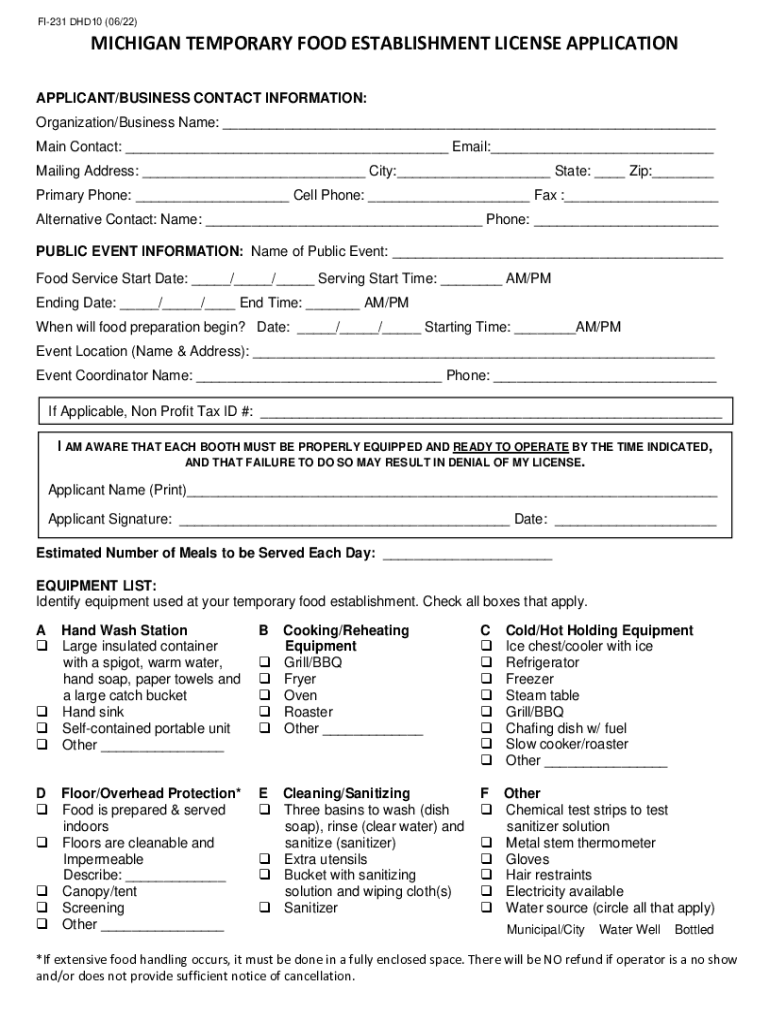







Definition and Purpose of the Michigan Temporary Food Establishment License
The Michigan Temporary Food Establishment License is a legal authorization required for operating temporary food service operations at public events within the state. This license is essential for ensuring that food vendors comply with health and safety regulations, safeguarding public health during events such as fairs, festivals, and street markets. It acts as a regulatory tool to control the hygiene standards of food preparation and serving in non-permanent settings, making it a crucial document for event-based food businesses.
How to Use the Michigan Temporary Food Establishment License
Utilizing the Michigan Temporary Food Establishment License involves displaying the license prominently at the event location to demonstrate compliance with state regulations. License holders should ensure that all food handling and preparation activities adhere to the guidelines specified in the license, which typically includes maintaining proper food temperatures, ensuring sanitary conditions, and using approved equipment. Additionally, licensees must follow any specific instructions provided by the local health department to maintain high standards of food safety.
Obtaining the Michigan Temporary Food Establishment License
To acquire the Michigan Temporary Food Establishment License, applicants must submit a detailed application to the local health department well in advance of the intended event. The application process requires providing comprehensive information about the event, including location, duration, and the types of food to be served. Applicants should also be prepared to demonstrate their food safety knowledge and may need to undergo a pre-event inspection by health officials to ensure compliance with safety standards.
Steps to Complete the Application
-
Gather Required Documentation: Before starting the application, collect all necessary documents such as business details, menu items, and food handling procedures.
-
Submit Application: Complete the application form with detailed event information and submit it to the local health department. This form should include evidence of compliance with safety regulations and a commissary agreement if applicable.
-
Pay Fees: Include the required fees with your application. Fees can vary based on the location and size of the event.
-
Health Department Review: The health department will review the application, ensuring all safety and operational criteria are met.
-
Pre-event Inspection: An inspection may be carried out to assess compliance with the health codes and practices outlined in the application.
-
Receive and Display License: Once approved, the license should be visibly displayed on-site at the event as proof of compliance.
Importance of the License
The Michigan Temporary Food Establishment License is critical for maintaining public health standards at temporary events. It ensures that food vendors meet strict hygiene requirements, thereby preventing foodborne illnesses. This license also provides credibility to the vendors, assuring event organizers and attendees of their commitment to food safety.
Typical Users of the License
This license is commonly sought by food vendors, caterers, and event organizers who plan to sell or serve food at temporary gatherings. It is particularly relevant for those involved in events like farmers' markets, music festivals, and community fairs, where food service is a key attraction. Vendors who operate seasonally or at multiple locations also benefit from this license, as it enables legal food service across various public venues.
Key Elements of the License Requirements
- Contact Information: The license requires the contact details of the individual or entity applying, including phone numbers and addresses.
- Event Details: Information about the location, duration, and nature of the event.
- Menu Information: A detailed list of all food and beverages to be offered.
- Food Handling Procedures: Description of methods to ensure food safety during preparation and serving.
- Equipment List: Comprehensive inventory of equipment used on-site, such as refrigeration units and cooking appliances.
- Commissary Agreement: If applicable, a contract for the use of an offsite kitchen.
State-Specific Rules for Compliance
In Michigan, specific state regulations govern temporary food establishments. These include requirements for minimum sanitary conditions, such as hand-washing stations, food storage temperatures, and waste disposal systems. Vendors must ensure compliance with these state-specific rules, which are enforced by local health departments through periodic inspections and monitoring.
Penalties for Non-Compliance
Operating without a Michigan Temporary Food Establishment License or failing to adhere to its conditions can result in significant penalties. These may include fines, immediate cessation of operations, or legal actions. Repeated offenses can lead to more severe consequences, such as being barred from participating in future events. Therefore, compliance is necessary to operate legally and avoid disruptions.
Application Process and Approval Time
The application process for the Michigan Temporary Food Establishment License typically requires submission several weeks prior to the event. Approval times may vary based on the complexity of the event and the local health department's capacity. Vendors should account for this timeline when planning their operations to ensure they receive the license in time for the event.




