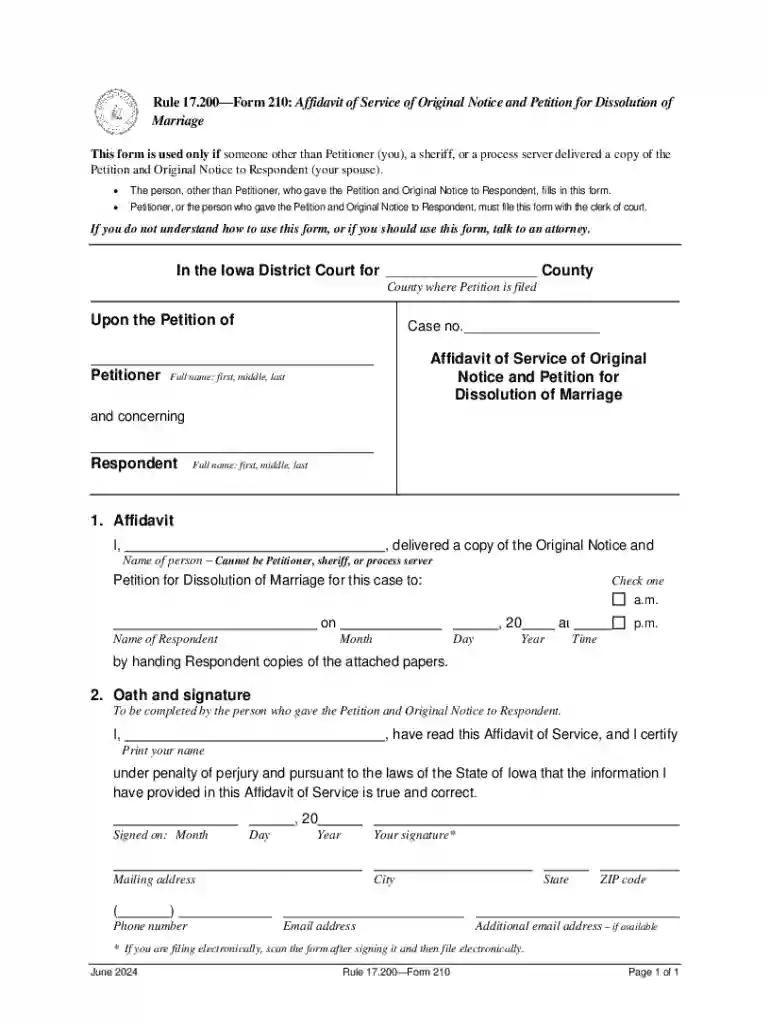
17 210 Affidavit of Service of Original Notice and Petition for Dissolution of Marriage 2026

Get Form
17 210 Affidavit of Service of Original Notice and Petition for Dissolution of Marriage Preview on Page 1

Here's how it works

01. Edit your form online
Type text, add images, blackout confidential details, add comments, highlights and more.

02. Sign it in a few clicks
Draw your signature, type it, upload its image, or use your mobile device as a signature pad.

03. Share your form with others
Send it via email, link, or fax. You can also download it, export it or print it out.

Definition & Meaning

The "17 210 Affidavit of Service of Original Notice and Petition for Dissolution of Marriage" is a formal legal document used within the jurisdiction of Iowa. It serves to confirm that a third party has successfully delivered the Original Notice and Petition for Dissolution of Marriage to the appropriate respondent. This affidavit must be completed and filed by someone other than the petitioner, sheriff, or standard process server, ensuring the impartiality of the service.

How to Use the 17 210 Affidavit of Service

To use the 17 210 Affidavit, the individual who is responsible for serving the documents must accurately complete the form, detailing how and when the service was completed. This includes providing the date, time, and location of the service, along with any other specific details that establish the delivery's validity. Once completed, this affidavit should be promptly filed with the clerk of court as part of the legal proceedings related to the dissolution of marriage.

Filing Considerations

  • Ensure that all sections are thoroughly and accurately filled out.
  • Verify the identity of the respondent to ensure correct service.
  • Keep a copy of the completed affidavit for personal records.

Steps to Complete the Affidavit

  1. Identify the Parties Involved: Begin by filling in the names of the petitioner and respondent, ensuring that all spellings are accurate and correspond with the main petition.

  2. Detail the Service Information: Document the exact date and time the notice was delivered, alongside the location where the service took place.

  3. Describe the Delivery Process: Provide an account of how the documents were served. Include details such as the identification of the respondent at the point of delivery.

  4. Complete the Certification: The server must sign the form under oath, confirming truthfulness. This signature often needs to be notarized for added legitimacy.

  5. File with the Clerk: Submit the completed affidavit to the clerk of court to become part of the official case record.

Common Errors to Avoid

  • Mistakes in dates or names
  • Missing signatures or notarization
  • Incomplete service descriptions

Why Use the 17 210 Affidavit?

Employing this affidavit ensures that due process is followed, protecting the legal rights of both the petitioner and respondent in a dissolution of marriage case. It acts as an official record that the necessary documents have been properly served, which is a critical procedural requirement in divorce proceedings.

Key Elements of the Affidavit

Identification Details

  • Names and Addresses: Clear identification of both the petitioner and respondent, included with residential details.

Service Details

  • Timing and Method: Exact information regarding when and how the notice was served to clarify the service process and timing.

Affirmation Section

  • Signature and Oath: Signature under oath of the individual serving the documents, providing legal affirmation of service completion.

Filing Certification

  • Courthouse Filings: Confirmation that the affidavit has been properly submitted to the appropriate court, making the service official and binding.

State-Specific Rules

In Iowa, this form is governed by Rule 17.200—Form 210. Understanding the state's specific legal framework regarding this affidavit is crucial to ensure compliance and to avoid any legal loopholes that might cause a delay in the proceedings.

Notable Requirements in Iowa

  • Must be served by someone distinct from the petitioner, sheriff, or a professional process server.
  • Filing must occur promptly with the court to maintain the case schedule.

Legal Use of the Affidavit

The affidavit is a legally binding document used to establish that the respondent has been duly informed of the proceedings against them. This notification is crucial as it provides the respondent an opportunity to participate in the legal process, ensuring that decisions are made with both parties duly informed.

Implications of Non-Compliance

  • Delay in proceedings
  • Potential dismissal of the case
  • Legal penalties or sanctions

State-by-State Differences

While this document is specific to Iowa, similar affidavits exist in various states, each with unique protocols and regulations. Understanding state-specific variations is essential for anyone involved in multi-state legal processes.

be ready to get more

Complete this form in 5 minutes or less

Get form

Got questions?

We have answers to the most popular questions from our customers. If you can't find an answer to your question, please contact us.
Contact us
Rule 17.10 Forms for relief from domestic abuse. Persons without attorney representation in legal actions seeking protection from domestic abuse under Iowa Code chapter 236 must use the forms listed in this rule. The forms are available on the Iowa Judicial Branch website at: .iowacourts.gov.
A Divorce Affidavit serves as a sworn statement, often providing key details about finances, child custody, or other vital matters that influence the courts decisions.
The term dissolution is meant to convey the equitable nature of modern divorce. For practical purposes, there is no distinction between dissolution and divorce in a California family law proceeding.
A divorce decree is a court order ending a marriage. A divorce certificate is a vital document proving a divorce occurred.
A petition for dissolution of marriage is the legal document that is filed with a state court when either party desires to dissolve a marriage that was legally entered into. Divorce is very specific to each individual state so it will be imperative that you check the local laws where you intend to file.

Security and compliance

At DocHub, your data security is our priority. We follow HIPAA, SOC2, GDPR, and other standards, so you can work on your documents with confidence.

Learn more
ccpa2
pci-dss
gdpr-compliance
hipaa
soc-compliance
be ready to get more

Complete this form in 5 minutes or less

Get form

People also ask

A dissolution is faster and may be less expensive than divorce. You can end your marriage in about 1 to 3 months after filing. However, if you and your spouse start to disagree about any of the terms after you file, you must start over with a new dissolution or divorce.
Dissolution is the formal, legal ending of a marriage by a court, commonly called a divorce. A dissolution of marriage completely ends your legal relationship as spouses and ends your marriage. Unlike an annulment, a dissolution does not undo the marriage as if it never existed.
The difference is whether the couple agrees or disagrees about the issues. If they agree on all issues, they can file a dissolution case together. If they dont agree, one spouse can file a divorce case. Filing for Dissolution or Divorce - Ending Your Marriage has more details.

Related links