






Definition & Meaning
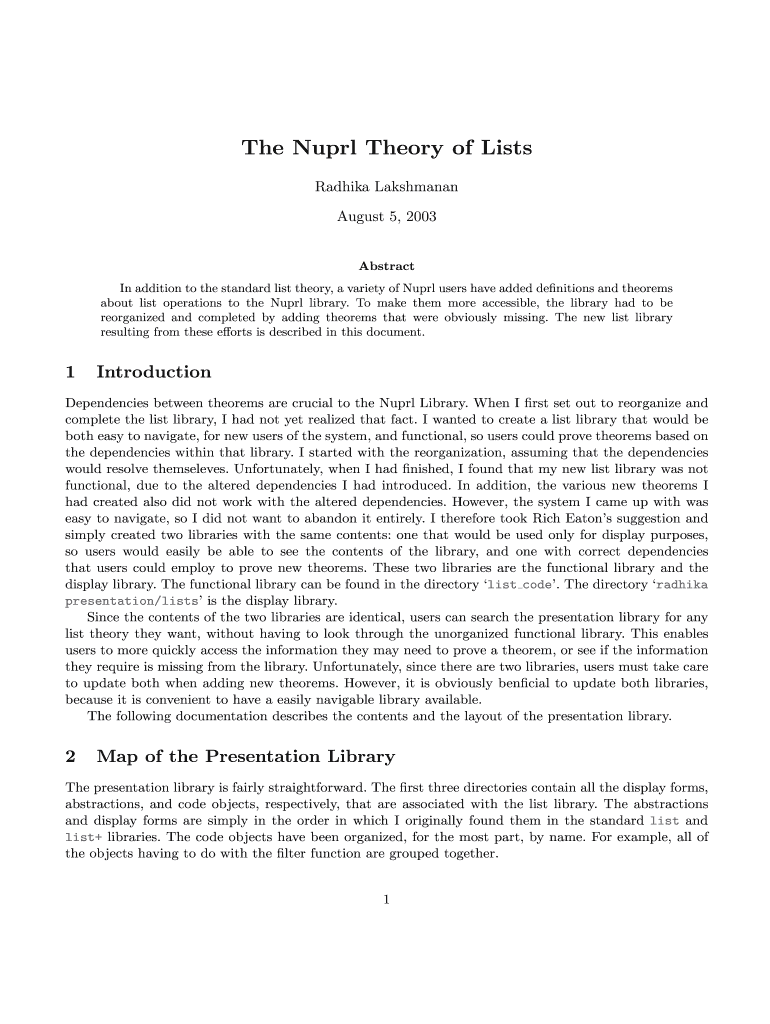
The Nuprl Theory of Lists, as developed by CS Cornell, refers to a structured framework within the Nuprl proof development system focusing on list operations and theories. This library facilitates formal theorem proving related to list manipulation, essential for computational logic and formal methods. The theory emphasizes constructing lists, proving theorems, and verifying properties systematically.
Key Elements of the Nuprl Theory of Lists
- Functional Library: Contains definitions and fundamental operations for list manipulation, enabling verification and proof generation for list-related problems.
- Presentation Library: Structured for easier navigation, it includes categorized directories for list operations such as append, map, and filter. This supports users in understanding and utilizing theorem dependencies effectively.
How to Use the Nuprl Theory of Lists
Users can leverage the library for both educational purposes and advanced theorem proving. By accessing directories within the presentation library, one can explore predefined theorems and experiment with creating novel proofs. Each section's design allows users to apply these operations in practice, innovating within computational contexts such as algorithm optimization and software verification.
Steps to Complete Tasks Using the Nuprl Theory of Lists
- Access the Library: Begin by accessing the library through the Nuprl environment.
- Explore Directories: Browse through the categorized sections to identify relevant list operations and theorems.
- Select Operations: Choose list operations pertinent to your task such as map or filter.
- Apply Theorems: Utilize the available theorems to support formal proofs and logical reasoning within your project.
- Verify Proofs: Use the system to check the correctness of your proof or solution.
Who Typically Uses the Nuprl Theory of Lists
The Nuprl Theory of Lists is predominantly used by computer scientists, mathematicians, and researchers specializing in formal methods, algorithm design, and logic verification. Additionally, educators and students within computational logic courses utilize the framework to facilitate learning about list manipulation and theorem proving.


Important Terms Related to the Nuprl Theory of Lists
- Append: Operation to concatenate two lists.
- Map: Function to apply a specified operation to each list item.
- Filter: Process to remove elements from a list based on criteria.
- Theorem Dependency: Relationships indicating how the validity of certain theorems depends on others.
Examples of Using the Nuprl Theory of Lists
- Educational Assignments: Students employ the library to solve logical problems and establish proofs as part of their coursework.
- Research Projects: Researchers in computational logic utilize the structured operations within the library to build and test new theorems or validate existing ones.
- Software Verification: Engineers apply theorems from the library to ensure the correctness and reliability of software components that rely on list operations.
Software Compatibility
To work seamlessly with the Nuprl system, users often operate within compatible platforms and tools that support formal logic systems. The environment may interface with supportive tools such as automated proof checkers and IDEs for software development, enhancing its practical application in technology sectors requiring rigorous logic and theorem validation.
Versions or Alternatives to the Nuprl Theory of Lists
There may be updates or variations of the Nuprl Theory catered to specific use cases or technological advancements. Users may also encounter alternative theorem proving systems such as Coq or Isabelle/HOL that offer different functionalities or specializations for list operations and formal proof creation.