




01. Edit your breach actions online
Type text, add images, blackout confidential details, add comments, highlights and more.

Type text, add images, blackout confidential details, add comments, highlights and more.

Draw your signature, type it, upload its image, or use your mobile device as a signature pad.

Send breach actions via email, link, or fax. You can also download it, export it or print it out.
A breach of contract occurs when one party fails to fulfill their obligations as outlined in a legally binding agreement. This can happen in both personal and business contexts, leading to potential legal repercussions. The breach could be partial or complete and may result in various outcomes depending on the severity and context. For instance, if a supplier fails to deliver goods within the agreed timeline, this may constitute a breach, potentially entitling the other party to damages.
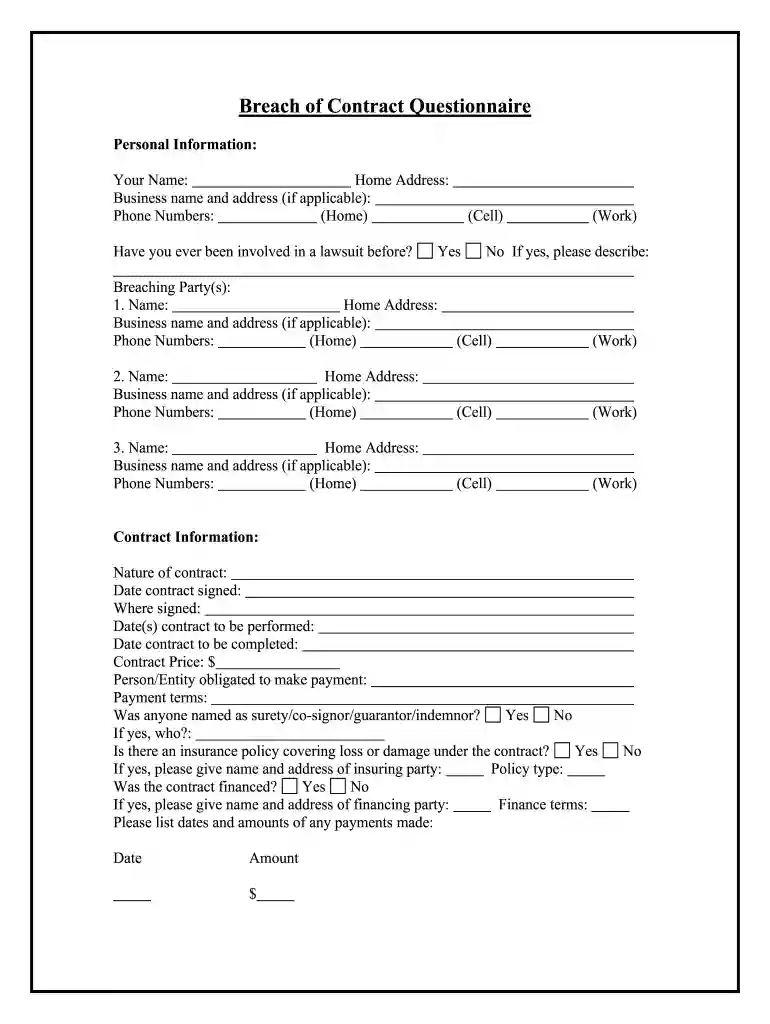
A breach contract questionnaire helps in documenting the circumstances and details surrounding a breach. It guides the user through gathering pertinent information, which is crucial for legal proceedings or dispute resolutions. This involves capturing personal details, aspects of the breach, and any associated claims or damages.
Completing the breach contract questionnaire involves several detailed steps to ensure all relevant information is accurately provided, which aids in potential legal proceedings.
Understanding essential terminology can help accurately navigate breach of contract situations and associated documentation.
Proper understanding and use of breach contracts involve awareness of how legal parameters guide such agreements, ensuring adherence to laws and fair processes.
Different states in the U.S. may have specific laws impacting how breach contracts are handled, influencing the legal steps and remedies available.
Identifying core components of a breach contract is crucial in determining its validity and potential enforcement. This includes:
While the fundamental principles of breach contracts remain consistent, state-specific regulations can impact their application.
Several scenarios illustrate how breach contracts can be applied in real-world contexts.
Each scenario would require detailing the agreement terms and the nature of the breach, utilizing the breach contract questionnaire to systematically record this information.
At DocHub, your data security is our priority. We follow HIPAA, SOC2, GDPR, and other standards, so you can work on your documents with confidence.

A bDocHub of contract is when one party to the contract doesnt do what they agreed example: unpaid loan. You lend a friend $15,000. You both make a verbalRead more
A bDocHub of contract occurs whenever a party who entered a contract fails to perform their promised obligations.


