




01. Edit your form online
Type text, add images, blackout confidential details, add comments, highlights and more.

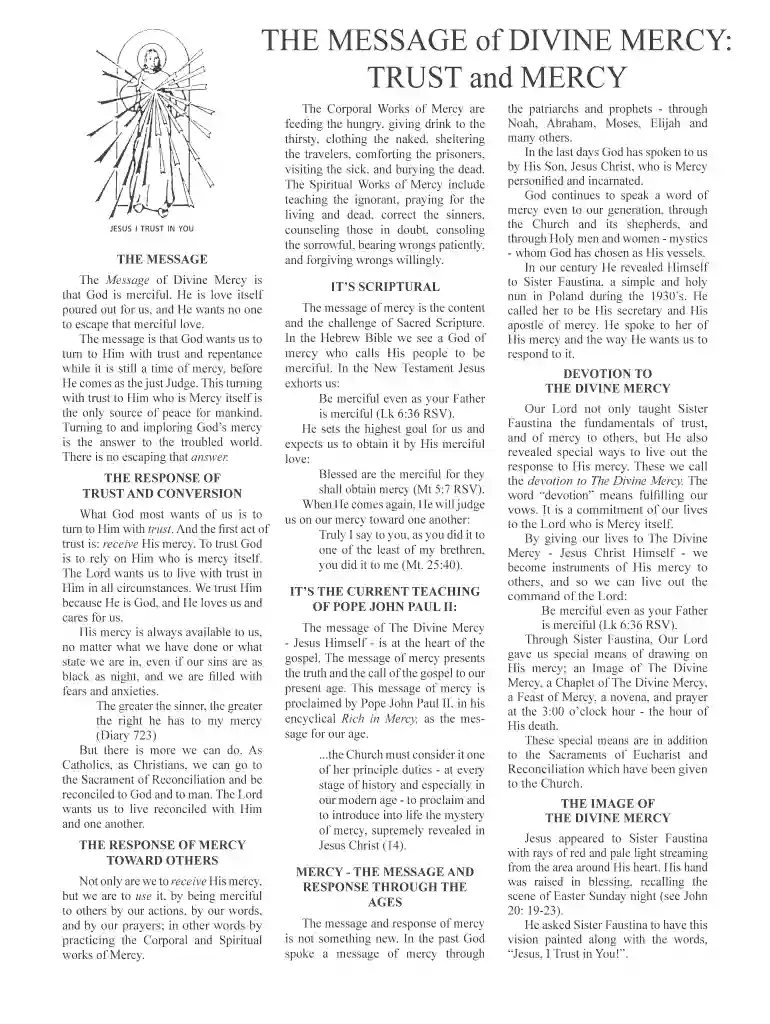
Type text, add images, blackout confidential details, add comments, highlights and more.

Draw your signature, type it, upload its image, or use your mobile device as a signature pad.

Send it via email, link, or fax. You can also download it, export it or print it out.
The Message of Divine Mercy centers on understanding and embracing God's merciful nature. It emphasizes that God's mercy is boundless and accessible to all, encouraging individuals to seek divine forgiveness and reflect on their lives through trust and repentance. Scriptural foundations support this message, promoting peace in a troubled world by fostering a deeper connection with God. The teachings from significant religious figures such as Pope John Paul II and the revelations given to Sister Faustina add further depth to the understanding of Divine Mercy.
The Message of Divine Mercy comprises several fundamental elements that guide believers in their spiritual journey. These include trust in God's mercy, repentance, and the call to perform acts of mercy toward others. This involves practicing the Corporal and Spiritual Works of Mercy, which focus on aiding both the physical and spiritual needs of individuals. Additionally, special devotions like the Chaplet of Divine Mercy and the Feast of Divine Mercy play vital roles in reinforcing these elements, encouraging believers to integrate them into their daily lives for spiritual growth and peace.
Individuals can utilize the Message of Divine Mercy in various ways to enhance their spiritual lives. It involves daily prayer, participation in specific religious practices such as reciting the Chaplet, and observing the Feast of Divine Mercy. Engaging in acts of mercy towards others, such as helping those in need, is a practical application that extends the message beyond mere contemplation. The teachings also encourage personal reflection and confession to foster a closer relationship with God, making mercy a living, active aspect of everyday life.
Embracing the Message of Divine Mercy involves specific actions and reflections:
Each step plays a crucial role in nurturing a spiritual life filled with peace and divine guidance.
The Message of Divine Mercy is embraced by individuals seeking spiritual growth, faith communities, and religious organizations. It resonates especially with those navigating personal challenges and seeking peace through divine connection. Priests, spiritual leaders, and laypersons involved in religious education also disseminate and teach this message. It serves not only as a personal guide for believers but also as a foundation for community activities aimed at fostering compassion and understanding.


Understanding the Message of Divine Mercy involves familiarizing oneself with key terms and concepts:
These terms provide a framework for understanding and applying the message in everyday life.
The practical applications of the Message of Divine Mercy are diverse:
Such examples demonstrate how the message can be incorporated into both personal and community activities, promoting a more compassionate and understanding society.
At DocHub, your data security is our priority. We follow HIPAA, SOC2, GDPR, and other standards, so you can work on your documents with confidence.
Apr 27, 2021 Mercy is the desire and will to forgive past wounds and misdeeds. God in His mercy has revealed to us that He is willing to forgive all. to ask
The National Shrine of the Divine Mercy is a sacred space dedicated to the devotion of the Divine Mercy as revealed to Saint Faustina Kowalska.
At present, the copies of the Divine Mercy icon are widely distributed around the world. They often contain the printed message : Jesus, I trust in You.Read more


