






Definition and Purpose of MCE Advice Letter 54-E
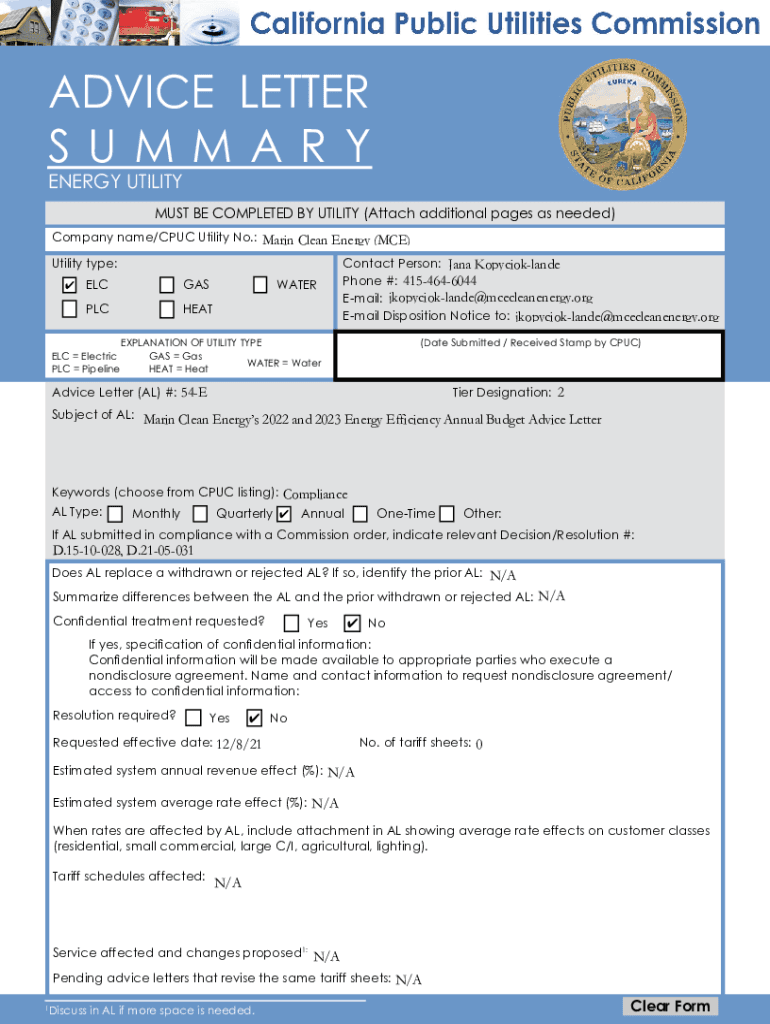
The MCE Advice Letter 54-E, submitted by Marin Clean Energy (MCE), serves as a detailed proposal to the California Public Utilities Commission (CPUC). This document outlines MCE's energy efficiency budget for the years 2022 and 2023. It highlights how the funds are allocated across various program categories: Resource Acquisition, Market Support, and Equity. The primary objective of this advice letter is to adhere to CPUC decisions, detailing how MCE plans to achieve specific energy efficiency goals and funding targets. With a total budget request of $30,066,888, the document delineates anticipated savings targets and allocated funds by sector, providing comprehensive insight into MCE's strategic initiatives.
How to Obtain the MCE Advice Letter 54-E
Acquiring the MCE Advice Letter 54-E can be done through multiple channels. For those interested, the document is typically accessible on the MCE's official website under their documents or resources section. Additionally, it may be found within public records on the CPUC's website, as MCE submits this document for commission review. Stakeholders or individuals may also request a copy directly from MCE's customer service or communications department, ensuring a direct line for obtaining current advice letters and related documentation.
Completing the MCE Advice Letter 54-E
To address the MCE Advice Letter 54-E successfully, understanding the structure is crucial. The document follows a specific format mandated by the CPUC. It is essential to outline all financials accurately, ensuring that each budget category is distinct and aligns with CPUC guidelines. When completing the letter, focus on specifying projected goals, compliance with precedents, and justifying budget requests against historical data and expected outcomes. An accompanying narrative should elucidate how the budget will translate into tangible energy efficiency improvements, supporting both CPUC objectives and community benefits.
- Include fiscal summaries for each program.
- Address past performance metrics relative to the proposed goals.
- Clearly present funding allocations with justifications.
Key Elements of the MCE Advice Letter 54-E
Several pivotal components define the MCE Advice Letter 54-E. These include:
- Budget Breakdown: Detailed financial plan for proposed expenses.
- Program Segmentation: Allocation into Resource Acquisition, Market Support, and Equity.
- Compliance Information: How the proposal aligns with CPUC decisions and expectations.
- Savings Targets and Projections: Anticipated energy savings detailed by sector.
- Organizational Structure: Insight into MCE's support infrastructure for these initiatives.
Each element must be meticulously detailed to ensure the CPUC has sufficient information to make an informed decision regarding the proposal.
Legal Use and Compliance
Ensuring legal compliance is paramount when drafting and submitting the MCE Advice Letter 54-E. It must adhere to the CPUC's regulatory framework, which governs public utilities' operations and financial proposals in California. Missteps or non-compliance can lead to rejection or requests for substantial revision, potentially delaying program implementation. Legal language should be clear, avoiding ambiguity, and any claims regarding energy goals should be supported by robust data and historical precedent.
State-Specific Rules
California laws and regulations have a noteworthy impact on the content and compliance of the MCE Advice Letter 54-E. Given MCE's operational domain, the advice letter must reflect California's specific mandates on renewable energy targets and efficiency benchmarks. The document needs to accommodate laws like the California Energy Efficiency Strategic Plan and align closely with state-wide energy transition goals. Understanding these nuances is crucial for ensuring that the advice letter fulfills both legislative requirements and community energy needs.
Examples of Successful Implementation
Examining previous successful MCE Advice Letters can provide invaluable insights for formulating an impactful submission. Historically, effective proposals have clearly linked budget allocations to specific, measurable outcomes and demonstrated past achievements as a predictor for future success. Lessons learned from these examples underscore the importance of transparency, data-driven arguments, and the capacity for adaptations in response to regulatory feedback.
Steps for Submitting the MCE Advice Letter 54-E
Submitting the MCE Advice Letter 54-E involves a structured approach:
- Preparation: Compile all relevant data and financial summaries.
- Drafting: Establish a clear narrative that explains the budget and projected impacts.
- Review: Conduct internal audits and peer reviews to ensure accuracy and compliance.
- Submission: Follow CPUC’s submission guidelines, often involving digital uploads and specific document formats.
- Follow-up: Track submission status and be ready to make any requested corrections promptly.
Ensuring these steps are adhered to is critical for the timely and effective acceptance of the advice letter.