






Definition and Meaning
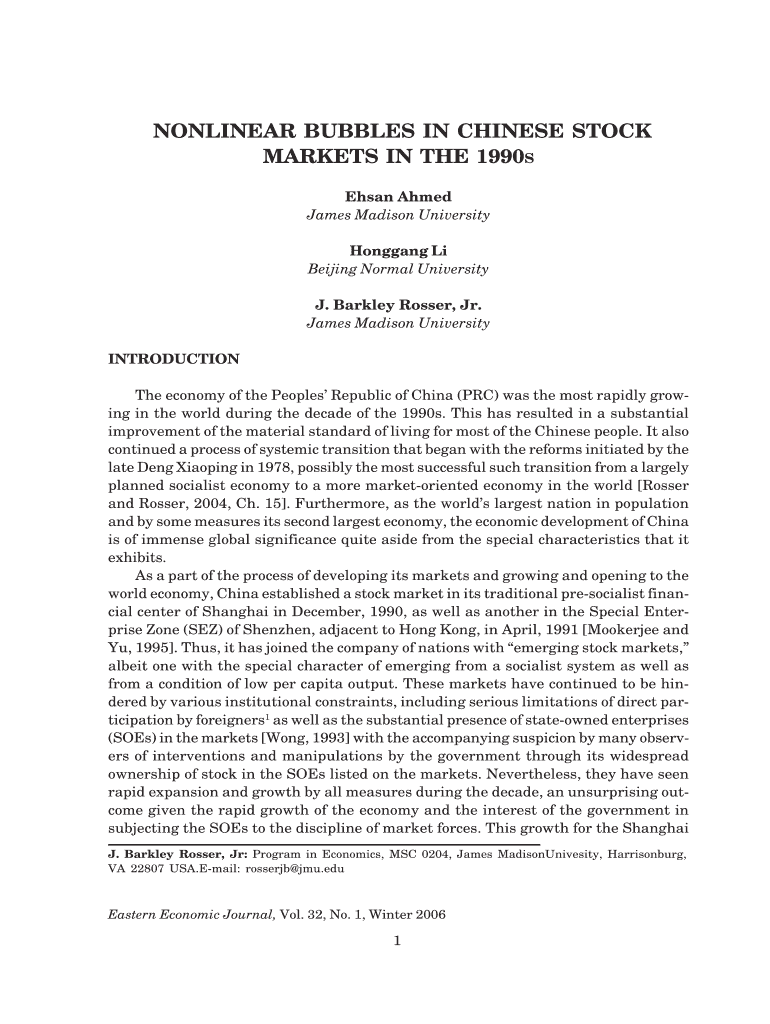
The concept of "Nonlinear bubbles in Chinese stock markets in the 1990s" explores the occurrence and characteristics of speculative bubbles that are not linear in their nature. During the 1990s, China underwent rapid economic expansion, which led to the birth of stock markets in Shanghai and Shenzhen. These markets exhibited unique dynamics, driven by factors like state-owned enterprises and limited foreign investment.
- Speculative Bubbles: A situation where asset prices substantially exceed their intrinsic value, often driven by investor behavior and market psychology rather than fundamental factors.
- Nonlinear Dynamics: Refers to unpredictable and complex patterns in stock price movements that do not follow a straightforward, linear model.
Key Elements of the Topic
Understanding the behavior of nonlinear bubbles in the Chinese stock markets involves examining several critical factors:
- Market Development: Establishment of stock exchanges in Shanghai and Shenzhen, which marked a significant shift in the Chinese financial landscape.
- Economic Context: This period coincided with China's transition towards a market-oriented economy, necessitating reforms and new regulatory frameworks.
- Investor Behavior: Speculation driven by domestic investors who were primarily unfamiliar with stock investments, leading to volatile market conditions.
- Regulatory Environment: Challenges related to government intervention and regulation, which sometimes exacerbated market trends.
Steps to Analyze Nonlinear Bubbles
Analyzing nonlinear bubbles involves a systematic approach to understanding the underlying market forces and dynamics.
- Data Collection: Gather historical stock market data from the 1990s, focusing on the Shanghai and Shenzhen exchanges.
- Econometric Modeling: Use econometric models to identify nonlinear patterns and trends in stock prices. Models should account for variables such as market sentiment and trading volume.
- Historical Context Analysis: Examine historical records and economic reports to contextualize market behavior within the broader economic reforms of China.
- Speculative Analysis: Study the role of speculation and investor psychology, often influenced by cultural and regulatory factors prevalent in that era.
Examples in Practice
Real-world scenarios provide tangible examples of how nonlinear bubbles manifested in the Chinese stock markets:
- High Volatility: In many instances, stock prices exhibited dramatic swings within short periods, indicative of speculative trading and investor herd behavior.
- Government Interventions: Frequent regulatory changes aimed at stabilizing markets, which sometimes led to unintended speculation bursts.
- Limited Foreign Access: Stringent restrictions on foreign investments presented unique market dynamics, primarily influenced by domestic actors.
Stakeholders Impacted
Several groups had vested interests in the evolution of Chinese stock markets during this era:
- Domestic Investors: Played a significant role, largely driven by speculative motives in unfamiliar financial waters.
- Regulators: Faced the challenge of balancing market growth with the need for stability and investor protection.
- Academic Researchers: Economists and academicians employed this period to study emerging market dynamics and nonlinear phenomena.
Importance of Understanding Nonlinear Bubbles
Studying these bubbles provides valuable insights into:
- Financial Risk Management: Recognizing patterns of speculative behavior and their potential impact aids in creating regulatory safety nets.
- Economic Policy Formulation: Informing government policies to avoid future market volatility and encourage sustainable economic growth.
- Investor Education: Highlighting the importance of informed investing and financial literacy to prevent speculative risks.
Econometric Models Used
Various econometric models have been utilized to analyze the stock markets:
- ARIMA Models: Applied to identify and predict trends in stock price movements.
- Nonlinear Time Series Analysis: To capture the complexity and dynamic interactions within the stock market.
- Threshold Models: Employed to evaluate the influence of regulatory changes on market behavior.
Lessons for Future Markets
The study of nonlinear speculative bubbles provides lessons for similar emerging markets today:
- Regulatory Vigilance: Continual oversight and adaptiveness in regulatory frameworks are vital to counteract bubbles.
- Market Education: Strong emphasis on investor education to foster a deeper understanding of market mechanisms.
- Global Integration: Taking strategic steps towards integrating with global market practices while maintaining domestic growth objectives.
These comprehensive insights offer a rounded understanding of how nonlinear speculative bubbles played a crucial role in shaping the trajectory of Chinese stock markets in the 1990s, with lasting impacts on global economic practices.