01. Edit your form online
Type text, add images, blackout confidential details, add comments, highlights and more.

Type text, add images, blackout confidential details, add comments, highlights and more.

Draw your signature, type it, upload its image, or use your mobile device as a signature pad.

Send it via email, link, or fax. You can also download it, export it or print it out.
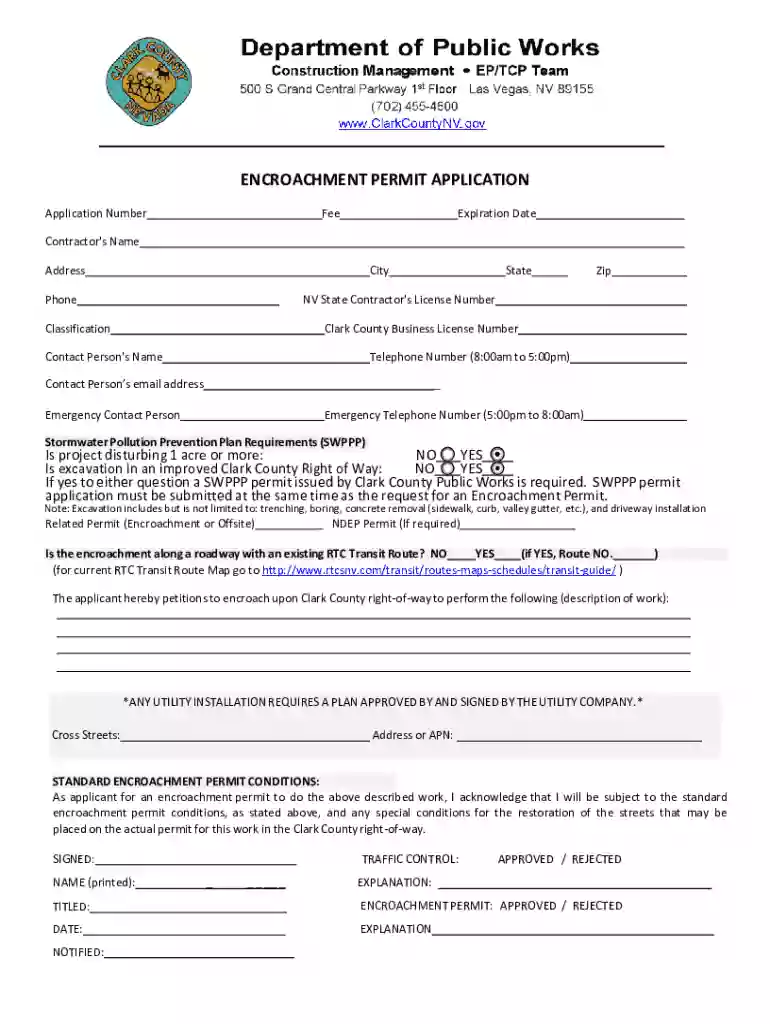
The Encroachment Permit Application is a document required when a project involves work within a public right-of-way in areas such as Clark County. This application ensures that any construction, installation, or maintenance activities conducted within these areas adhere to local regulations and do not interfere with public utilities or infrastructure. The form collects important details such as the applicant's personal and project information to assess the scope and impact of the proposed work.
Using the Encroachment Permit Application effectively involves understanding the basic components required for a successful submission. Applicants need to fill out personal details, project specifications, and any conditions required for compliance with local codes. This includes acknowledgment of safety measures like a Stormwater Pollution Prevention Plan (SWPPP), if applicable. Users should also be aware of associated traffic control plans, ensuring the proposed work does not disrupt local traffic flow.
Prepare Required Information: Collect all necessary details, including personal identification, project location, and scope.
Complete Project Details: Provide a clear description of the work, including start and end dates and methods used.
Attach Supporting Documents: Include plans, diagrams, and any environmental or traffic studies required.
Review Compliance Requirements: Ensure all the county's regulations and guidelines are met, especially concerning SWPPP.
Submit the Application: Follow the designated submission process, which might include electronic or paper methods.
Follow Up: Verify receipt of the application and await feedback or requests for further information.
The Encroachment Permit Application is commonly utilized by a range of stakeholders, including construction companies, utility providers, and private property developers. These users require permission to access public lands or rights-of-way for various projects, such as installing gas lines, fiber optics, or road expansions. Public agencies may also be involved when government projects overlap with these jurisdictions.


Applicant Information: Includes name, contact details, and representative authority.
Project Description: Detailed explanation of work, including location and anticipated impact.
Compliance Confirmation: Submission of SWPPP details and traffic control considerations.
Signatures: Authorizations from relevant parties confirming agreement to comply with terms.
Ensuring legal compliance when applying for an encroachment permit is paramount. Applicants must adhere to federal, state, and local laws governing public land use. This includes understanding environmental impact assessments and the necessity for a SWPPP. Legal use involves tendering truthful project assessments and timely submission of applications to avoid penalties or project delays.
While the Encroachment Permit Application has broad requirements, each state or locality may impose additional specific requirements. For example, in states like California, there may be more stringent environmental guidelines that must be followed. Understanding these regional differences is critical for compliance and successful permit approval.
Submitting the Encroachment Permit Application can often be done through multiple channels. Many jurisdictions offer online submission through their official portals, allowing for a quicker and more trackable process. Paper submissions might be required in some areas, involving mailing or in-person delivery to the appropriate agency office. Both methods require the same level of detail and accuracy to ensure processing without delays.
We've got more versions of the Encroachment Permit Application form. Select the right Encroachment Permit Application version from the list and start editing it straight away!
At DocHub, your data security is our priority. We follow HIPAA, SOC2, GDPR, and other standards, so you can work on your documents with confidence.