




01. Edit your form online
Type text, add images, blackout confidential details, add comments, highlights and more.

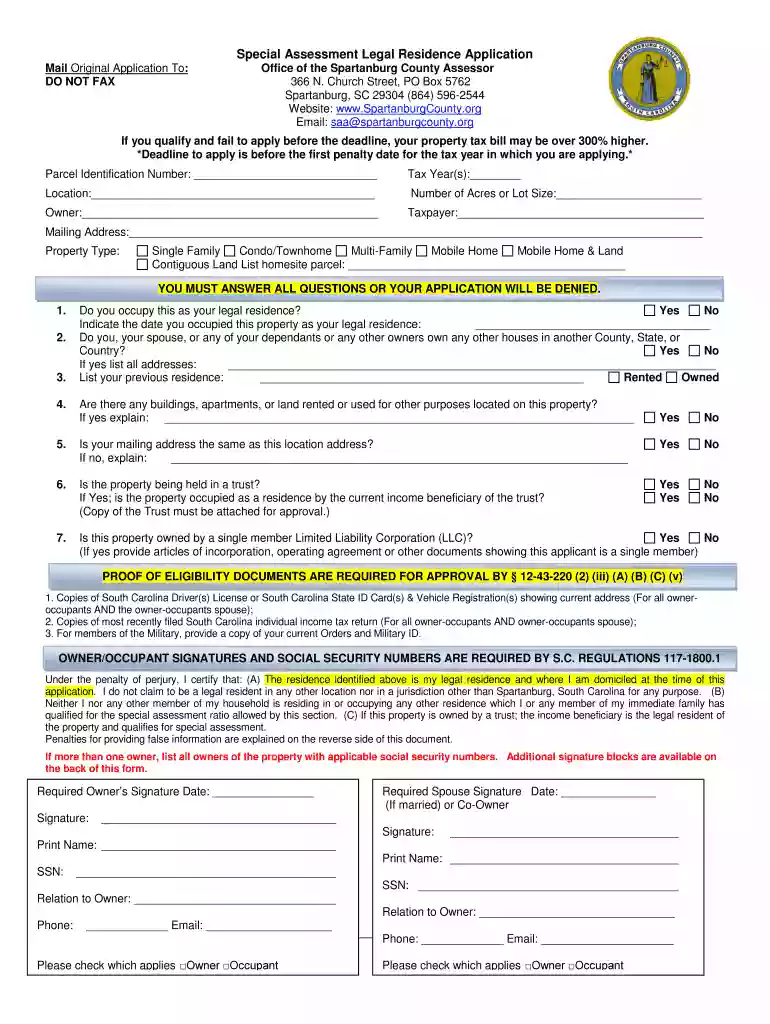
Type text, add images, blackout confidential details, add comments, highlights and more.

Draw your signature, type it, upload its image, or use your mobile device as a signature pad.

Send it via email, link, or fax. You can also download it, export it or print it out.
The Special Assessment Legal Residence Application is a crucial document used in Spartanburg County, South Carolina, to apply for a reduced property tax assessment rate for owner-occupied residences. This form is designed to verify that a property meets the eligibility criteria for such an assessment. It serves as proof that the applicant's dwelling is an owner-occupied primary residence, potentially qualifying it for lower property tax rates. By accurately completing this application, homeowners can ensure they receive the financial benefits tied to residential property tax reductions.
To qualify for the Special Assessment Legal Residence, applicants must meet specific eligibility requirements. The residence must be owner-occupied and serve as the primary domicile of the applicant. Additionally, ownership of the property must be clearly established, showing that the applicant is listed as the property owner in official records. Any discrepancies in documentation or failure to reside in the property as the primary residence will result in denial of the application, highlighting the importance of meeting all outlined conditions.


Submitting the Special Assessment Legal Residence Application requires precise documentation to verify primary ownership and occupation. This documentation ensures the authenticity of the application and facilitates approval. Applicants typically need to provide:
Providing complete and accurate documentation reduces processing time and increases the likelihood of a favorable outcome.
Completing the Special Assessment Legal Residence Application involves several detailed steps to ensure successful submission and processing. Below is a step-by-step guide to efficiently filling out the form:
Accurate completion of each step is essential for processing the application without delays or rejections.
Obtaining the Special Assessment Legal Residence Application involves simple methods that ensure every eligible resident can file easily. Interested homeowners can:
Digital copies of the form can be filled out and printed, offering a convenient method for those with internet access. This option encourages timely application and preparation by allowing users to start the process immediately.
The Special Assessment Legal Residence Application plays a vital legal role by formally documenting a taxpayer's claim to lower property taxes under specific conditions. This official recognition ensures the homeowner receives any financial benefit they are entitled to, by demonstrating:
The application maintains legal clarity for both the applicant and the county, preventing misapplications and preserving the integrity of the tax assessment process.
Failing to submit the Special Assessment Legal Residence Application by the designated deadlines can lead to significant financial implications. Homeowners not in compliance may face:
Ensuring timely and correct submission of the application safeguards against unnecessary penalties and ensures continued eligibility for reduced tax assessment rates.
While the information presented is specific to Spartanburg County in South Carolina, procedures and requirements for similar applications can vary significantly across states. States may differ regarding:
Applicants should check their respective state's guidelines to ensure accurate filing and adherence to local requirements.
We've got more versions of the Special Assessment Legal Residence Application Office of form. Select the right Special Assessment Legal Residence Application Office of version from the list and start editing it straight away!
At DocHub, your data security is our priority. We follow HIPAA, SOC2, GDPR, and other standards, so you can work on your documents with confidence.


Legal Residence Special Assessment Legal Residence refers to the special 4% assessment ratio for owner-occupied homes. Definition of Legal ResidenceRead more
This publication offers a brief introduction into how property taxes are determined and used in Mississippi. exemption from all ad valorem taxes on the


