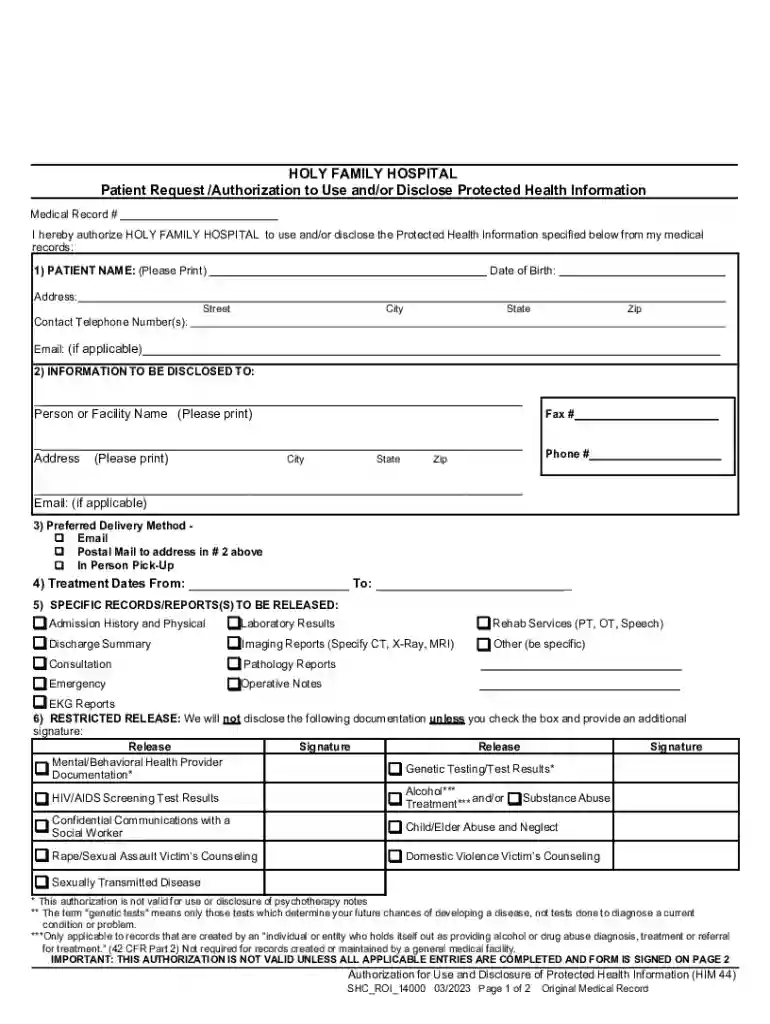
HOLY FAMILY HOSPITAL Patient Request Authorization 2026

Get Form
HOLY FAMILY HOSPITAL Patient Request Authorization Preview on Page 1

Here's how it works

01. Edit your form online
Type text, add images, blackout confidential details, add comments, highlights and more.

02. Sign it in a few clicks
Draw your signature, type it, upload its image, or use your mobile device as a signature pad.

03. Share your form with others
Send it via email, link, or fax. You can also download it, export it or print it out.

Definition & Meaning

The "HOLY FAMILY HOSPITAL Patient Request Authorization" form is a critical document utilized by patients to authorize the use and disclosure of their Protected Health Information (PHI). This form serves as a legal agreement between the patient and the hospital, specifying the terms under which personal health information can be shared with third parties. It includes essential areas like patient identification details, specific data to be disclosed, and authorization duration. Patients use this form to control their medical data, ensuring confidentiality and compliance with health privacy laws like HIPAA.

How to Use the HOLY FAMILY HOSPITAL Patient Request Authorization

To effectively utilize the "HOLY FAMILY HOSPITAL Patient Request Authorization," patients should follow a methodical approach:

  1. Understanding Purpose and Scope: Recognize the purpose of the form—granting permission to disclose specific health information.
  2. Detailing Patient Information: Accurately fill out personal details, such as name, address, and date of birth, to ensure correct identification.
  3. Selecting Information to be Disclosed: Clearly specify the health records or information that may be shared.
  4. Choosing Delivery Methods: Decide on how the authorized information will be delivered, whether through mail, email, or another preferred method.
  5. Reviewing and Signing: Thoroughly review all entries before signing, as the form’s validity hinges on the patient’s signature.

These steps help maintain accuracy and relevance in the information disclosed.

Steps to Complete the HOLY FAMILY HOSPITAL Patient Request Authorization

Completing the "HOLY FAMILY HOSPITAL Patient Request Authorization" form involves specific steps:

  1. Filling Personal Information:
    • Include full name, address, contact information, and any other identifying details required by the form.
  2. Identifying Recipients:
    • List parties authorized to receive the information; this could be a family member, another healthcare provider, or an insurance company.
  3. Defining Purpose for Disclosure:
    • Specify reasons for disclosure, such as treatment coordination or billing purposes.
  4. Setting Validity and Revocation Terms:
    • Decide on the time frame for which the authorization is valid, and understand revocation rights if changes are necessary.
  5. Signing and Witnessing:
    • Ensure the patient or an authorized representative signs the form. A witness may also be required, depending on state laws.

Each step is crucial for compliance and effective patient information management.

Important Terms Related to HOLY FAMILY HOSPITAL Patient Request Authorization

Understanding key terms enhances the comprehension and use of the form:

  • Protected Health Information (PHI): Any information about health status, healthcare provision, or payment that relates to an individual.
  • Authorization: Consent provided by the patient to use or disclose PHI.
  • Revocation: The right to withdraw authorization, ceasing the further release of PHI.
  • Validity Period: Duration for which the authorization remains effective.
  • Third-Party Disclosure: Sharing PHI with entities other than Holy Family Hospital, specified by the patient.

Familiarity with these terms aids in effectively completing and enforcing the form.

Key Elements of the HOLY FAMILY HOSPITAL Patient Request Authorization

Several vital components ensure the form’s completeness:

  • Patient Information Section: Accurate identification details of the patient.
  • Information to be Disclosed: Clearly defined records or data for release.
  • Purpose of Disclosure: Specific reason for sharing information.
  • Authorization Duration: Time frame within which the form remains valid.
  • Signature Section: Mandatory areas for the patient’s or representative’s signature to authenticate consent.

Covering these elements ensures the form's legitimacy and utility.

Legal Use of the HOLY FAMILY HOSPITAL Patient Request Authorization

Legally, the form is critical in maintaining the confidentiality and authorized sharing of PHI. It supports compliance with the Health Insurance Portability and Accountability Act (HIPAA), ensuring patient data is managed according to federal regulations. The form also allows patients to specify terms for data sharing, including revocation rights, enhancing control over personal health information.

Who Typically Uses the HOLY FAMILY HOSPITAL Patient Request Authorization

The form is primarily employed by:

  • Patients: To authorize data sharing for various needs like transferring records to a new doctor or providing information to insurance companies.
  • Healthcare Professionals: To request additional documentation or verify patient history.
  • Insurance Providers: For claim processing and verification purposes.
  • Legal Entities: In cases requiring medical documentation for legal or compliance reasons.

Understanding typical users helps streamline its application in different contexts.

decoration image ratings of Dochub

State-Specific Rules for the HOLY FAMILY HOSPITAL Patient Request Authorization

Different states may have varying regulations regarding PHI disclosures:

  • Consent Requirements: Some states may necessitate additional consent for HIV-related information or mental health records.
  • Data Sharing Restrictions: States like California have specific laws about how health data must be handled.
  • Minors' Rights: Rules about minors’ consent and when parental consent is necessary differ among states.

Being aware of and adhering to state-specific rules ensure compliance and prevent legal issues.

Examples of Using the HOLY FAMILY HOSPITAL Patient Request Authorization

Practical scenarios for the form include:

  • Transition of Care: Authorizing release of records when moving to a different healthcare provider.
  • Insurance Processing: Allowing insurers to access medical histories for policy adjustments.
  • Family Member Involvement: Granting family member access to health information for decision-making support.

These examples illustrate the form's flexibility and relevance in varied situations.

be ready to get more

Complete this form in 5 minutes or less

Get form

Got questions?

We have answers to the most popular questions from our customers. If you can't find an answer to your question, please contact us.
Contact us
825410 Koderma / Zip code
The Jainagar S.O (Koderma) Pin code is 825109 and it comes under Hazaribagh Division which is located in Koderma district of Jharkhand State.
Holy Family Hospital is situated at National Highway 31, Koderma HO-825410 which is easily accessible through various modes of transport.
Fr. George P.A., Director, and Dr. Sumit Ray, Medical Director. We are proud to be registered under the Delhi Nursing Home Act and accredited with ISO 9001:2000 and NABH certifications, underscoring our unwavering dedication to quality and safety in patient care.
Post OfficeJA Hospital SO Postal Region Gwalior Postal Division Gwalior Taluk Gird Address Post Office JA Hospital SO (Sub-Office), Gwalior, Madhya Pradesh, India (IN), Pin Code: 47400911 more rows

Security and compliance

At DocHub, your data security is our priority. We follow HIPAA, SOC2, GDPR, and other standards, so you can work on your documents with confidence.
Learn more
ccpa2
pci-dss
gdpr-compliance
hipaa
soc-compliance
be ready to get more

Complete this form in 5 minutes or less

Get form

People also ask

Kodarma Pin Code is 825410.
A HIPAA authorization form gives covered entities permission to use protected health information for purposes other than treatment, payment, or health care operations.

Related links