




01. Edit your form online
Type text, add images, blackout confidential details, add comments, highlights and more.

Type text, add images, blackout confidential details, add comments, highlights and more.

Draw your signature, type it, upload its image, or use your mobile device as a signature pad.

Send it via email, link, or fax. You can also download it, export it or print it out.
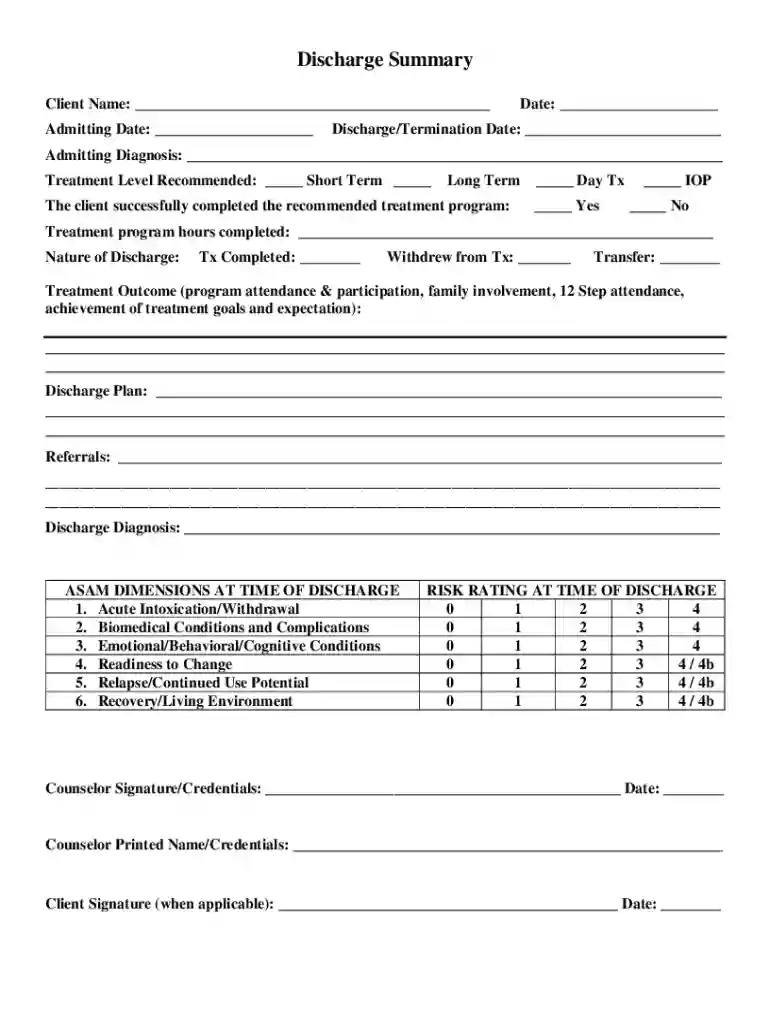
A discharge summary is a vital document used in healthcare settings to record the details of a patient's treatment and discharge from a medical facility. This document serves as a comprehensive summary of a patient's medical history during their stay, treatment provided, and the plan for continuing care after discharge. It typically includes the patient's admission and discharge dates, diagnosis, treatment outcomes, and any follow-up instructions or referrals. Additionally, the discharge summary provides critical insights into the patient’s progress, helping future healthcare providers continue with appropriate care.
A discharge summary contains several key elements that provide a complete picture of the patient's healthcare journey:
Completing a discharge summary involves several crucial steps to ensure accuracy and comprehensiveness:
The discharge summary serves multiple purposes, both for healthcare providers and patients. Healthcare professionals utilize this document to ensure continuity of care, as it provides relevant medical information that can be crucial for subsequent treatments and interventions. Patients can use the discharge summary to understand their treatment and follow-up requirements, facilitating their active participation in their health management. It's essential for patients to keep this document accessible for future reference.
Discharge summaries play a critical role in patient care by bridging the gap between inpatient treatment and post-discharge care. They ensure seamless communication among healthcare providers by documenting vital medical information. These summaries help prevent errors by consolidating a patient's healthcare details in one place, supporting informed decision-making for future treatments. They also engage patients in their healthcare journey, promoting better health outcomes through clearer understanding and compliance with discharge instructions.
Discharge summaries are primarily used by various healthcare stakeholders to enhance patient care:


In the United States, discharge summaries must comply with healthcare regulations such as the Health Insurance Portability and Accountability Act (HIPAA). This ensures that patient information is kept confidential and is shared only with authorized personnel. Discharge summaries must be completed accurately and stored securely to comply with legal standards. They may also be used as evidence in medical legal cases, reinforcing the need for accurate and comprehensive documentation.
When dealing with discharge summaries, understanding specific terms is crucial:
By thoroughly understanding these concepts, healthcare providers and patients can better navigate the complexities of discharge summaries, ensuring enhanced care and improved health outcomes.
We've got more versions of the Discharge Summary form. Select the right Discharge Summary version from the list and start editing it straight away!
At DocHub, your data security is our priority. We follow HIPAA, SOC2, GDPR, and other standards, so you can work on your documents with confidence.


Jun 8, 2026 The hospital discharge summary a document that outlines a patients hospital stay for their outpatient providers can take up a lot of
Description: A clinical document summarizing a patients episode of inpatient care for communication to the receiving provider. Accessed by Application(s):.
by LA Lenert 2014 Cited by 62 The discharge summary is one of the most critical documents in medical care settings. The effects of its absence perhaps best define its importance: delayedRead more


