Definition & Purpose of the MC 2118 I, California IRP Vehicle Data Schedule C
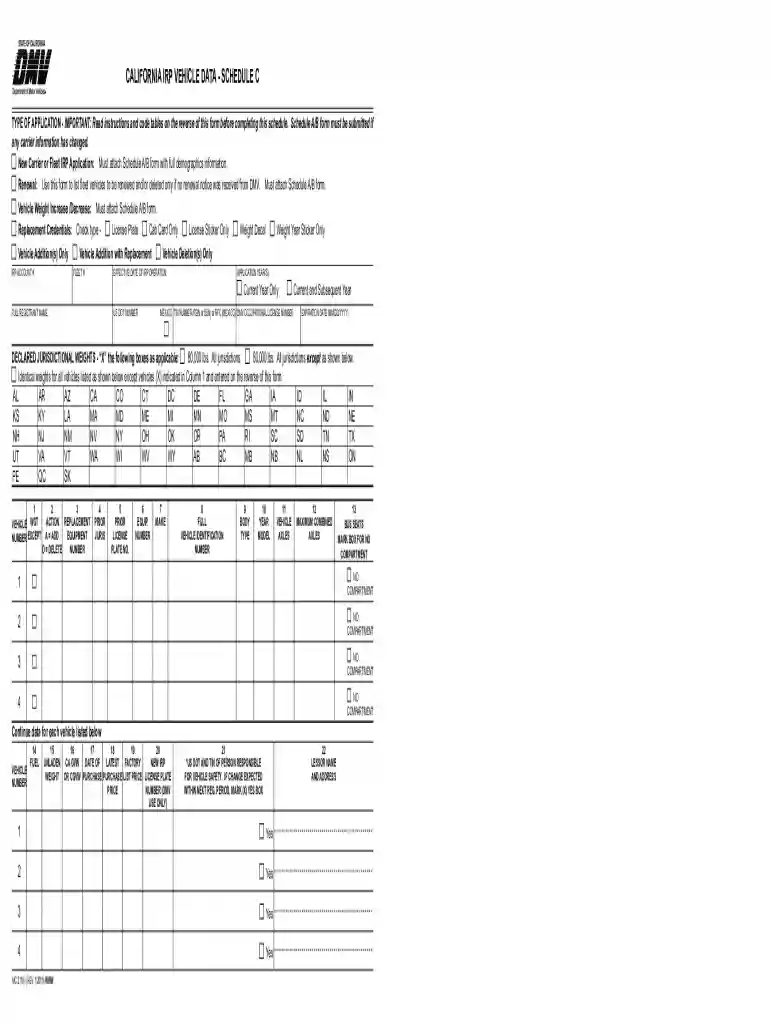
The MC 2118 I, California IRP Vehicle Data Schedule C is a crucial component of the International Registration Plan (IRP) application process, specifically tailored for vehicle registrations within California. This form is used by commercial vehicle operators to report and manage vehicle data, facilitating the multi-jurisdictional registration necessary for operating commercial vehicles across various states. It is essential for new carrier registrations, fleet additions, and annual renewals, ensuring compliance with state regulations and appropriate fee calculations.
Key Elements of the Form
- Account Numbers: Each submission requires an accurate account number correlating to the existing registration account to maintain consistency and validity.
- Effective Dates: Specifies when the registration changes should take effect, ensuring valid operation across jurisdictions.
- Vehicle Details: Includes crucial information such as the vehicle's weight, identification number, and other specific attributes critical for compliance with regulatory standards.
- Fee Computations: Detailed instructions facilitate accurate fee calculations based on the reported data, which is essential for budget planning and allocation.
- Required Signatures: Ensures that all submissions are legally certified, holding the signatories accountable for the information provided.
Steps to Complete the MC 2118 I, California IRP Vehicle Data Schedule C
- Gather Required Information: Before filling out the form, collect all the necessary details regarding your fleet and vehicles, including VIN numbers and weight specifications.
- Account Details: Enter the existing account numbers with precision to avoid processing delays.
- Vehicle Data Entry: Accurately record each vehicle’s specifics, including weight and identification, to ensure registration is correctly processed.
- Compute Fees: Use the guidance provided on the form to calculate the necessary fees, considering all aspects of the vehicle’s registration and operation.
- Sign and Authenticate: Once completed, ensure all required fields are signed by authorized personnel to confirm the form's validity.
- Submit the Form: Depending on the chosen method of submission, ensure all data is accurately transferred and sent through the appropriate channels.
Form Submission Methods
- Online Submission: Preferred for its efficiency and speed, allowing immediate processing and confirmation.
- Mail Submission: For operators without digital access, traditional mailing options are still supported.
- In-Person Submission: Available for those who wish to consult directly with IRP representatives.
How to Obtain the Form
The MC 2118 I can be obtained directly from the California Department of Motor Vehicles (DMV) website, where it is available for download. Physical copies are also available at DMV locations for those who require assistance in filling out the form.
Required Documents
- Proof of Vehicle Ownership: Documentation such as the vehicle title.
- Previous Registration: For renewals, past registration documents are needed for reference.
- Insurance Documents: Proof of insurance is crucial for validating coverage during registration.
Who Typically Uses the MC 2118 I, California IRP Vehicle Data Schedule C
The form is primarily used by:
- Commercial Fleet Operators: Managing multiple vehicles that operate across various states in the U.S.
- New Carriers: Those entering the commercial transportation sector and needing to register their fleet for interstate operations.
- Existing Carriers: Operators looking to update, renew, or modify their current registration details.
Important Terms Related to the MC 2118 I
- IRP: The International Registration Plan that facilitates multi-state registration through a unified system.
- Fleet: A group of vehicles registered under one account or operator, allowing centralized management.
Legal Use and Compliance
Adherence to the guidelines embossed in the MC 2118 I is legally mandatory for fleet operators. Non-compliance can lead to penalties, fines, or the suspension of operating privileges within the IRP framework.
Penalties for Non-Compliance
Failing to accurately fill out and submit the MC 2118 I can result in serious repercussions, including:
- Fines: Monetary penalties imposed for incorrect or late submissions.
- Operational Suspension: Temporary or permanent cessation of registration privileges.
- Legal Action: In extreme cases, legal proceedings may be initiated for fraudulent information or continuous non-compliance.
Penalty Mitigation
To avoid penalties, always ensure information is up-to-date, accurate, and submitted before any deadlines. Automated reminders or professional consultation might be beneficial for complex submissions.
Examples of Using the MC 2118 I, California IRP Vehicle Data Schedule C
Commercial operators often use this form in scenarios such as:
- Fleet Expansion: Adding new vehicles to an existing account to accommodate business growth.
- Annual Renewals: Updating vehicle data each year to ensure continued compliance across different states.
- Regulatory Adjustments: Modifying current vehicle data to reflect changes like weight adjustments or fleet reconfigurations.
Subsection: Practical Use Cases
- Consider a logistics company expanding into new territories; the form becomes essential for registering their increased fleet capacity while maintaining legal operation standards.
- An operator needing to replace an old vehicle can use the form to seamlessly integrate new acquisitions into their fleet without operational disruption.
This comprehensive understanding of the MC 2118 I form helps ensure compliance with state regulations and facilitates the efficient management of multi-state vehicle operations.