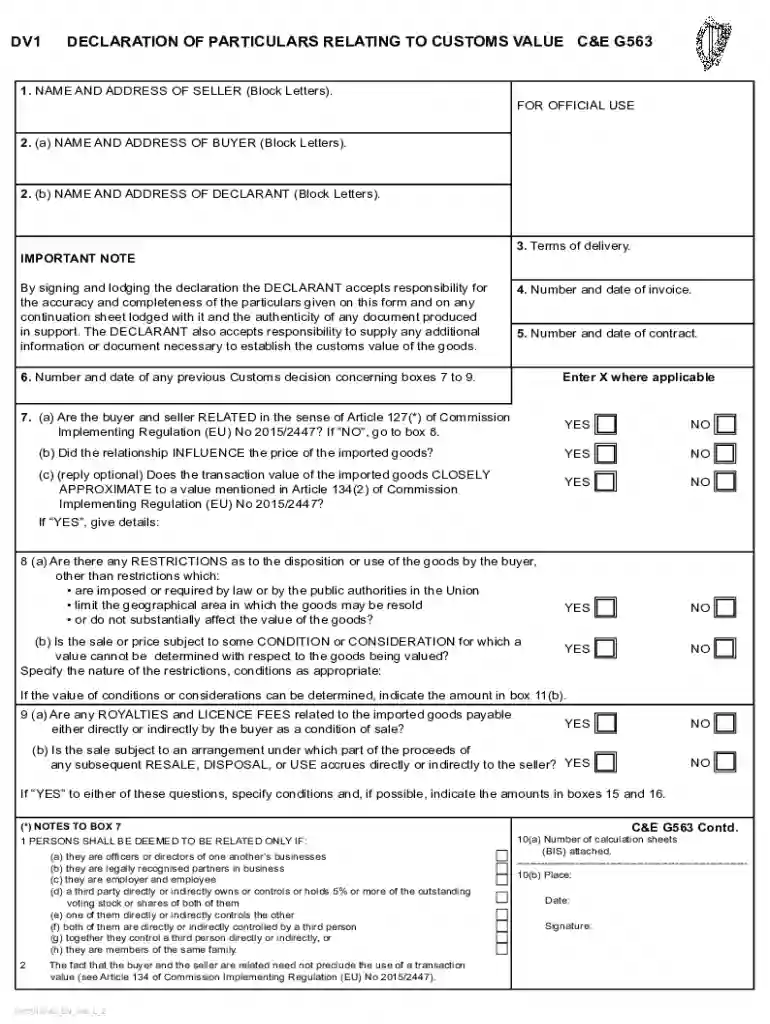
CandE G563 Declaration of particulars relating to Customs value 2026

Get Form
CandE G563 Declaration of particulars relating to Customs value Preview on Page 1

Here's how it works

01. Edit your form online
Type text, add images, blackout confidential details, add comments, highlights and more.

02. Sign it in a few clicks
Draw your signature, type it, upload its image, or use your mobile device as a signature pad.

03. Share your form with others
Send it via email, link, or fax. You can also download it, export it or print it out.

Definition and Meaning

The C&E G563 form, or "Declaration of Particulars Relating to Customs Value," is a crucial customs declaration document used to communicate details about the customs value of imported goods. This form captures intricate information regarding the transaction, including the relationships between involved parties, restrictions on the goods, and any additional costs associated with the shipment. This document is primarily employed to ensure compliance with international trade regulations and to determine the correct customs duties owed on imported items.

  • It requires inputs from the seller, the buyer, and the declarant.
  • The purpose is to validate the accuracy of imported goods' valuations to adhere to customs regulations.

Key Elements of the C&E G563

Understanding the specific components of the C&E G563 form is essential for accurate completion:

  • Seller and Buyer Information: Details such as names, addresses, and contact information for each party involved in the transaction.
  • Declarant Identification: The individual responsible for completing the form must provide personal and business information.
  • Transaction Details: Include specifics about the sale, like the invoice number, date of transaction, and terms of sale.
  • Customs Value Calculation: A section dedicated to outlining the value of goods imported, including provisions for calculating additional costs like insurance and freight.

Specifics of Customs Value

The customs value is vital for determining duties and taxes. It typically includes:

  • Cost of Goods: The purchase price agreed upon between the buyer and seller.
  • Additions to Value: Costs that may include licensing fees for using the goods, which must be accounted for.

Example Case

For instance, if a U.S. company purchases electronics from a European supplier, the C&E G563 form would require declarations regarding the relationship between these entities and any existing agreements that might affect the goods' pricing.

How to Obtain the C&E G563 Declaration

Securing the form is a straightforward process:

  1. Official Sources: The form can be acquired from the customs authority’s official website.
  2. Customs Brokers: Many businesses opt to acquire these forms through licensed customs brokers familiar with import procedures.

Steps to Complete the C&E G563

Thorough completion of the form involves several critical steps:

  1. Acquire Information: Gather all necessary details from the seller, buyer, and any third parties involved.
  2. Fill Out Seller and Buyer Sections: Enter comprehensive identification and contact information.
  3. Detail the Transaction: Include dates, invoice numbers, and payment terms.
  4. Customs Value Calculation: Accurately calculate the customs value, considering all compensatory costs like freight and insurance.
  5. Review and Sign: The declarant must validate all information, ensuring compliance with regulations.

Practical Scenario

For example, a clothing retailer importing garments should confirm all values are correctly stated, to avoid penalties due to miscalculation or omission.

Who Typically Uses the C&E G563

The form is specifically utilized by various stakeholders involved in international trade and imports:


  • Importers: Businesses that import goods into the U.S. for retail or manufacturing purposes.
  • Customs Brokers: Facilitate the customs clearance process by ensuring all documentation is accurate and complete.
  • Trade Compliance Officers: Ensure the company's adherence to customs regulations through proper documentation and filing.
decoration image ratings of Dochub

Legal Use of the C&E G563

Completing and submitting the C&E G563 is anchored in legality:

  • Compliance: The form must be submitted to comply with customs laws and avoid legal complications.
  • Accuracy Requirement: Falsification or errors can lead to severe penalties, including fines and potential trade sanctions.

Penalties for Non-Compliance

Failing to properly complete this form can result in significant legal and financial repercussions:

  • Correct Filing Mandatory: Any discrepancies in the customs value can cause shipment delays and import penalties.
  • Financial Penalties: Businesses may incur fines or duties if inaccuracies are identified post-submission.

Digital vs. Paper Version

The C&E G563 can be filed both digitally and in paper format, each with distinct advantages:

  • Digital Version: Allows quicker submission and often integrates with customs processing systems for faster clearance.

  • Paper Version: Provides a tangible document trail, which some businesses prefer for record-keeping.

Understanding the differences and benefits of each option helps in choosing the most effective submission method for business needs.

be ready to get more

Complete this form in 5 minutes or less

Get form

Got questions?

We have answers to the most popular questions from our customers. If you can't find an answer to your question, please contact us.
Contact us
The declared/customs value is what the purchaser has paid for the goods. The value for carriage is the maximum amount for FedEx liability and cannot exceed the customs value.
The value on a commercial invoice should be the price the buyer in the United States paid for the goods, not the amount the goods will be sold for in the United States. If you do not provide a value, the U.S. Customs and Border Protection (CBP) will assess it for you.
Transaction Value Method: The Primary Method for Determining Customs Value. The transaction value is the most commonly used method to determine customs value under the UCC. It is based on the price actually paid or payable for the goods when sold for export to the customs territory of the EU.
Declared value is the value you claim the shipment to be worth, while customs value is what the customs officer determines the shipment is worth. Often, customs value is determined based on the initial declared value. These two values should always be consistent; penalties and delays can occur if not.
You must complete a customs declaration form when shipping abroad. This will include: A description of the goods youre sending (see providing a clear goods description) The value and quantity of each item. The purpose of the shipment e.g. gift, personal belongings, an item youve sold etc.

Security and compliance

At DocHub, your data security is our priority. We follow HIPAA, SOC2, GDPR, and other standards, so you can work on your documents with confidence.
Learn more
ccpa2
pci-dss
gdpr-compliance
hipaa
soc-compliance
be ready to get more

Complete this form in 5 minutes or less

Get form

People also ask

Travellers have to declare everything they acquired abroad and possibly pay customs duty tax on goods. Some countries offer a duty-free allowance of certain products which may not need to be declared explicitly.

Related links