







Definition & Meaning
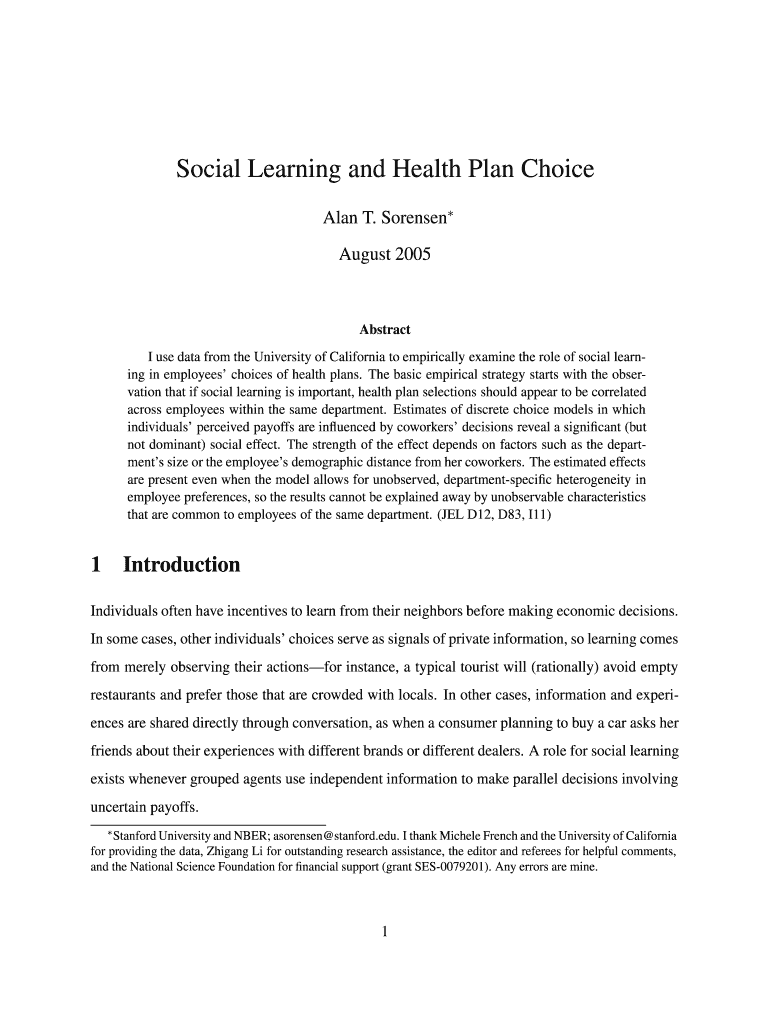
"Social Learning and Health Plan Choice Alan T - ssc wisc" is a research-driven document focused on understanding how social learning influences health plan selection among employees. Specifically, it examines these choices within the context of the University of California system. Social learning refers to the process by which individuals make decisions based on the behaviors and recommendations of their peers, particularly for complex products like health insurance.
Key Aspects Covered
- Social Influence: The document highlights the impact of social influence and coworker interactions on health plan decisions, suggesting that people tend to choose similar plans to those around them.
- Data Analysis: The analysis is based on data gathered from five university campuses, providing a comprehensive view of decision-making patterns across diverse environments.
Key Elements of the Social Learning and Health Plan Choice
The document outlines several critical factors that contribute to health plan choices influenced by social learning:
- Department Size and Dynamics: The study finds that larger department sizes amplify the influence of social learning, while smaller groups may have less pronounced effects.
- Demographic Considerations: Employees sharing similar demographic characteristics, such as age and income, tend to show stronger inclination towards similar health plans.
- Peer Recommendations: The importance of peer recommendations is accentuated, as it helps individuals make informed decisions in environments with numerous options.
Who Typically Uses the Social Learning and Health Plan Choice Alan T - ssc wisc
This form is primarily used by:
- University Researchers: Who want to study social dynamics and decision-making within institutional settings.
- Policy Makers: Interested in understanding how social factors impact health insurance choices to design better employee benefits.
- Human Resource Departments: At educational institutions looking to optimize their offerings and communication strategies based on departmental insights.


Steps to Complete the Social Learning and Health Plan Choice Alan T - ssc wisc
To complete this document effectively, users should:
- Collect Relevant Data: Gather needed data from various department members regarding their health plan choices.
- Analyze Social Networks: Study the interaction patterns and influence dynamics among coworkers.
- Summarize Findings: Provide a detailed report of how social learning affects health plan decisions within departments.
- Formulate Recommendations: Offer actionable insights and strategies for optimizing health plan offerings based on social dynamics.
Important Terms Related to Social Learning and Health Plan Choice
A few key terms commonly associated with this form include:
- Experience Goods: Products or services where the value is appreciated primarily after use, such as health insurance.
- Peer Effects: Influences from colleagues or friends affecting individual decision-making.
- Demographic Similarity: How shared characteristics like age, income, or role can impact similar decision-making patterns.
Examples of Using the Social Learning and Health Plan Choice Alan T - ssc wisc
The document may be employed in various scenarios, such as:
- Research Papers: Published analyses on the effects of social environments on decision-making in professional settings.
- Policy Reports: For governmental or institutional policy-making processes aimed at improving employee health plan choices.
- Training Materials: Used in workshops to illustrate principles of social learning in organizational contexts.
Legal Use of the Social Learning and Health Plan Choice Alan T - ssc wisc
The document should be used in compliance with applicable:
- Data Protection Laws: Ensuring that any use of personal data from employees is managed securely and ethically.
- Institutional Guidelines: Following university or organizational regulations regarding surveys and data collection.
State-Specific Rules for the Social Learning and Health Plan Choice
While the document focuses on the University of California system, its principles could be applied to other states, considering:
- State Healthcare Regulations: Ensuring that any recommendations comply with local healthcare laws and benefits structures.
- Institutional Autonomy: Adapting the findings to fit the unique governance structures and rules of different states and institutions.




