Definition & Meaning
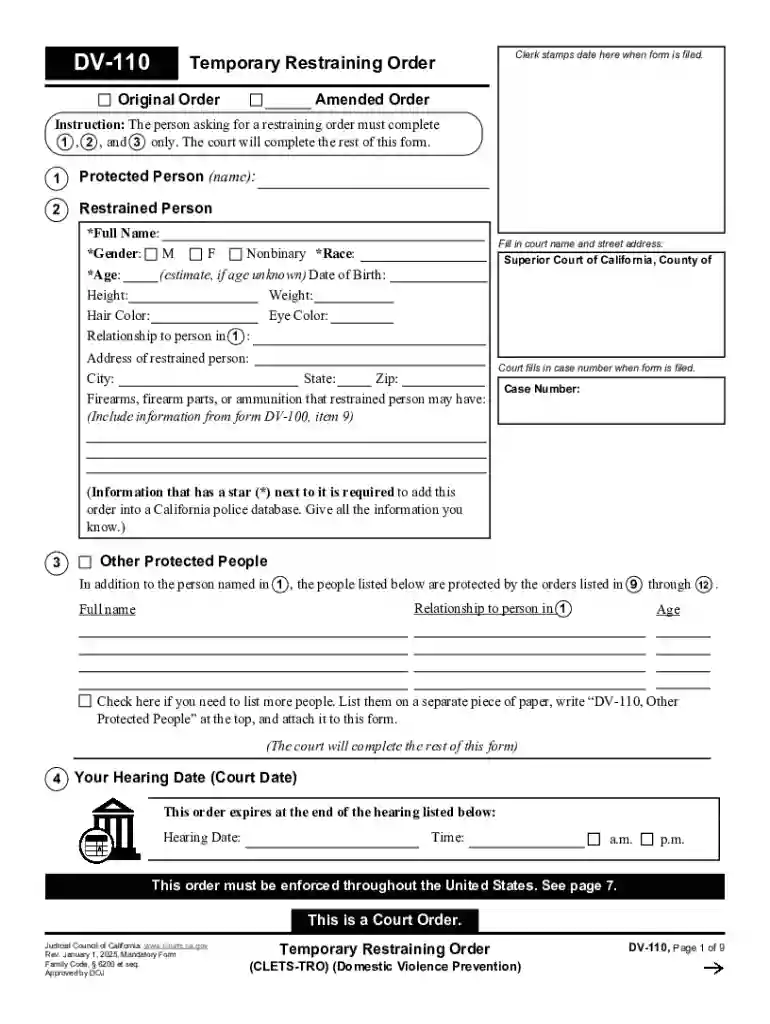
The "DV-110 Temporary Restraining Order (CLETS-TRO)" is a legal document issued by the Superior Court of California to protect individuals from acts of domestic violence. This form specifically caters to those who seek immediate protection from potential harm, detailing prohibitions and actions the restrained person must adhere to. The DV-110 is an integral part of the California Law Enforcement Telecommunications System (CLETS), which assists in maintaining communication between law enforcement and judicial systems to ensure the enforcement of restraining orders.
Key Features of DV-110
- Protection Scope: The order includes measures to prevent further harassment, physical harm, or other abusive actions.
- Temporary Nature: The order is designed to offer immediate short-term protection until a more permanent solution is determined by the court.
- Legal Enforcement: As part of CLETS, this form allows for swift enforcement by law enforcement agencies across California.
How to Use the DV-110 Temporary Restraining Order (CLETS-TRO)
Using the DV-110 involves several critical steps aimed at ensuring your safety and the legal enforceability of the order. This process is initiated by those who have experienced domestic violence or threats thereof.
- Filing the Form: The DV-110 form needs to be filled out accurately, providing all necessary details regarding the parties involved and the nature of the threat.
- Court Submission: Submit the completed form to the appropriate court, often with assistance from legal counsel to ensure all aspects are correctly addressed.
- Service of Process: Once issued, the order must be served to the restrained individual, typically through law enforcement personnel or a professional process server.
- Law Enforcement Notification: Ensure that local law enforcement agencies receive a copy of the order to facilitate immediate response if violations occur.
Steps to Complete the DV-110 Temporary Restraining Order (CLETS-TRO)
Completing the DV-110 form requires careful attention to detail to guarantee that all legal protections are accurately captured.
- Gather Necessary Information: Collect all personal identification for both the petitioner and the respondent, including any incidents of abuse or harassment.
- Describe the Abuse: Clearly articulate the nature, frequency, and extent of the domestic violence incidents in the designated sections.
- Specify Orders Needed: Indicate the type of protection being requested, such as no-contact provisions, custody arrangements, or firearm restrictions.
- Review and Sign: After filling out the form, a thorough review should be conducted to ensure accuracy before signing and submitting it to the court.
Common Mistakes to Avoid
- Incomplete Information: Failing to provide comprehensive details can delay the process.
- Vague Descriptions: Ensure that descriptions of incidents are clear and specific.
- Submission Errors: Verify all requested documents accompany the DV-110 upon submission.
Key Elements of the DV-110 Temporary Restraining Order (CLETS-TRO)
The DV-110 encapsulates several critical elements that define its purpose and application.
Protection Measures
- Personal Conduct Orders: Directives preventing harassment, contact, or disturbances by the respondent.
- Stay-Away Orders: Mandates that require the respondent to maintain a specified distance from the petitioner and related locations.
Compliance Requirements
- Firearms and Ammunition: Immediate surrender of any firearms or weapons by the restrained individual.
- Prohibited Actions: Explicitly outlines actions the respondent must refrain from, such as contacting the petitional by digital means.
Important Terms Related to DV-110 Temporary Restraining Order (CLETS-TRO)
Understanding the terminology used within the DV-110 helps in accurately interpreting the order and ensuring compliance.
- Petitioner: The individual seeking protection through the restraining order.
- Respondent: The person against whom the protection is sought.
- No-Contact Order: A directive prohibiting the respondent from initiating any contact with the petitioner.
- CLETS: An acronym for the California Law Enforcement Telecommunications System, which plays a key role in the tracking and enforcement of the order.
Legal Use of the DV-110 Temporary Restraining Order (CLETS-TRO)
The legality of the DV-110 ensures that it provides effective recourse under California law for those seeking protection from domestic violence.
- Judicial Authority: Issued by the Superior Court of California, granting it legal enforceability statewide.
- Law Enforcement Involvement: Enables authorities to act swiftly should the restrained party violate any part of the order.
- Temporary Relief: Provides interim safety measures, often preceding a hearing for a longer-term restraining order.
Targeted Users
- Domestic Violence Victims: The primary users are individuals who have experienced or are at risk of domestic violence.
- Family Law Professionals: Legal practitioners often utilize this form to advocate for their clients' safety.
- Advocacy Organizations: Groups that offer support to victims might also guide them in utilizing the DV-110 to secure their protection.
State-Specific Rules for the DV-110 Temporary Restraining Order (CLETS-TRO)
California law governs the issuance and enforcement of the DV-110, with strict adherence to specific rules and regulations to ensure comprehensive protection.
California Regulations
- Filing Procedures: Specific methods are outlined for how to file and process the form in California courts.
- Judicial Review: A hearing is typically set to review the circumstances and decide on extending or modifying the restraining order.
- Cross-State Enforcement: While the order is specific to California, many states offer full faith and credit to such orders, providing additional layers of protection.