Employer Employee Agreement to Select Ohio as the State of 2026

Get Form
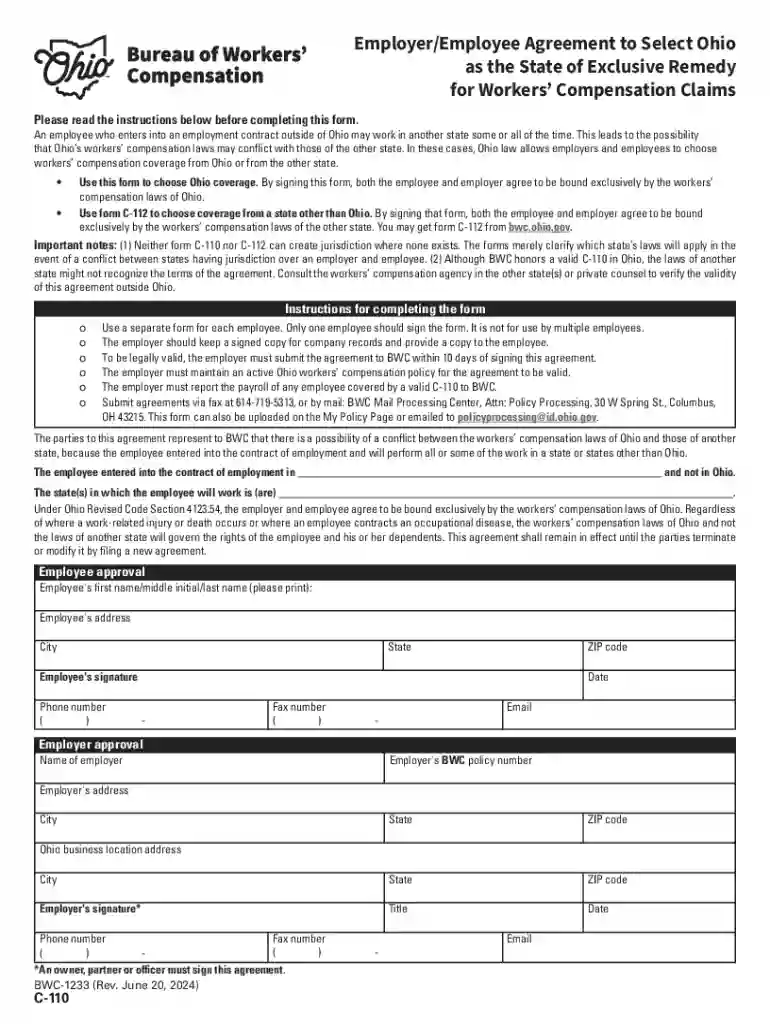
Employer Employee Agreement to Select Ohio as the State of Preview on Page 1

Here's how it works

01. Edit your form online
Type text, add images, blackout confidential details, add comments, highlights and more.

02. Sign it in a few clicks
Draw your signature, type it, upload its image, or use your mobile device as a signature pad.

03. Share your form with others
Send it via email, link, or fax. You can also download it, export it or print it out.

Definition and Meaning

The "Employer Employee Agreement to Select Ohio as the State of" serves as a formal document allowing both employers and employees to designate Ohio as the exclusive state of jurisdiction for workers' compensation claims. This agreement is especially important for businesses that have operations across multiple states but wish to leverage Ohio's specific legal framework for handling such claims. By executing this agreement, both parties commit to adhering solely to Ohio's workers' compensation laws, irrespective of where a work-related injury might occur geographically.

Key Components

  • Jurisdiction: Limits workers' compensation claims to being governed by Ohio laws.
  • Scope: Applies irrespective of the physical location where work activities occur or where an injury takes place.
  • Limitations: Does not establish a new jurisdiction where none previously exists.

How to Use the Employer Employee Agreement to Select Ohio as the State of

Pre-Agreement Considerations

Before signing the agreement, both parties should ensure they understand Ohio's workers' compensation laws thoroughly. It can be beneficial to consult with legal counsel to ascertain the implications of such an agreement, especially for businesses that operate in multiple jurisdictions.

Execution Steps

  1. Review Legal Obligations: Both parties must review their respective obligations under Ohio law.
  2. Agree on Terms: Ensure mutual understanding and acceptance of the agreement's terms.
  3. Sign the Document: The document needs to be signed by both parties, signifying their agreement.
  4. Store Officially: Maintain a properly executed copy in company records for compliance purposes.

Steps to Complete the Agreement

  1. Obtain the Form: Secure a copy of the "Employer Employee Agreement to Select Ohio as the State of" from a legitimate source.
  2. Input Information: Fill out all necessary fields, including parties' names, employments details, and agreement terms.
  3. Affix Signatures: Have both the employer and employee sign the document as consent.
  4. File and Record: Store copies with appropriate personnel records and potentially upload to a secure document management system like DocHub for easy retrieval.

Key Elements of the Agreement

Essential Clauses

  • Exclusive Jurisdiction Clause: Establishes the commitment to Ohio's laws.
  • Employment Scope: Details which types of employment activities are covered.
  • Legal Compliance: Ensures both parties understand compliance requirements under Ohio law.

Conditions and Exceptions

  • Conditional Exceptions: Outlines situations where exceptions may apply.
  • Limitations: Clarifies that this agreement does not replace other state or federal requirements.

Legal Use and Compliance

Legal Framework

The agreement is structured under the guidance of Ohio state legislation on workers' compensation. Employers are advised to verify that their current workers' compensation policies align with Ohio's legal framework before entering this agreement.

Compliance Measures

  • Policy Validation: Validate that an active Ohio workers' compensation policy is in place.
  • Continuous Review: Regularly reassess compliance post-signing, especially in cases of business structure alterations or jurisdictional changes.

State-Specific Rules and Requirements

Ohio's Legal Specifications

Ohio has specific rules that govern the validity and enforceability of such agreements, which include ensuring a valid workers' compensation policy specific to Ohio and maintaining adherence to any statutory changes over time.

Regulatory Updates

Stay informed about periodic legal or regulatory updates from Ohio to ensure ongoing compliance and avoid any legal ramifications for non-compliance.

Examples of Usage Scenarios

Multi-State Operations

Consider a manufacturing company that operates facilities in Ohio, Michigan, and Indiana. The employer might use this agreement to streamline legal proceedings by consolidating workers' compensation claims solely under Ohio jurisdiction, simplifying administrative procedures, and offering clearer legal interpretations.

Cross-Border Employment

For consultants working on projects in different states but based in Ohio, this agreement provides consistency in compensation claims processing, contributing to administrative efficiency and predictability in legal outcomes.

Important Terms Related to the Agreement

  • Workers’ Compensation Laws: Refers to the specific legal framework within which compensation claims are addressed.
  • Jurisdiction: The authority given to Ohio to preside over and determine workers' compensation cases.
  • Exclusive Agreement: A legally binding promise that limits claims to be governed exclusively by Ohio's laws.

Business Types That Benefit Most

Applicable Business Entities

  • Multi-State Corporations: Companies operating across state lines benefit from simplified claims processing.
  • Remote Work Organizations: Businesses with remote work policies can leverage this for consistent workers' compensation claims.

Industry Applications

  • Construction Firms: Often engage labor across various states, thus benefiting significantly from jurisdiction-specific agreements.
  • Technology Companies: With remote or mobile workforce dynamics, consistent jurisdiction regulations aid in simplifying compensation claims management.

This comprehensive guide on the "Employer Employee Agreement to Select Ohio as the State of" is designed to offer in-depth insights and practical frameworks for understanding and utilizing this legal document effectively.

be ready to get more

Complete this form in 5 minutes or less

Get form

Got questions?

We have answers to the most popular questions from our customers. If you can't find an answer to your question, please contact us.
Contact us
Temporary exposures: 90-Day Rule Ohios workers compensation laws now recognize the extraterritorial coverage of an out-of-state employer for 90 consecutive days. The 90-Day Rule is applicable to all industries, including the construction industry.
State Deadlines for Filing a Workers Compensation Claim AlabamaWithin 2 years from the date of injury or the date of the last compensation payment California Within 1 year from the date of injury Colorado Within 2 years from the date of injury or within 3 years with a compelling reason48 more rows
An Ohio employment contract is a legally binding agreement between an employer and a new employee hired to work for the employer. Employment contracts serve the important purpose of outlining each partys rights and obligations in the working relationship.
Ohio Revised Code 4123.90 provides protection. It says employers cannot fire, demote, or discipline someone for filing a workers comp claim or participating in a related proceeding. It is also unlawful to reduce pay, threaten termination, or cut hours because an employee filed a comp claim.
A letter of agreement between an employer and an employee defines the work arrangement t between the two parties. The employee letter of agreement explains all the terms and conditions of the employment and includes details like the contact information of the involved parties, the agreed-upon payments and the timeline.

Security and compliance

At DocHub, your data security is our priority. We follow HIPAA, SOC2, GDPR, and other standards, so you can work on your documents with confidence.
Learn more
ccpa2
pci-dss
gdpr-compliance
hipaa
soc-compliance
be ready to get more

Complete this form in 5 minutes or less

Get form

People also ask

In Ohio, any business with employees, even a single employee, is required to carry Workers Compensation coverage. However, a sole proprietor, sole proprietor operating as an LLC, or partner in a business is NOT required to participate in the Ohio Workers Compensation program.

Related links