




01. Edit your form online
Type text, add images, blackout confidential details, add comments, highlights and more.

Type text, add images, blackout confidential details, add comments, highlights and more.

Draw your signature, type it, upload its image, or use your mobile device as a signature pad.

Send it via email, link, or fax. You can also download it, export it or print it out.
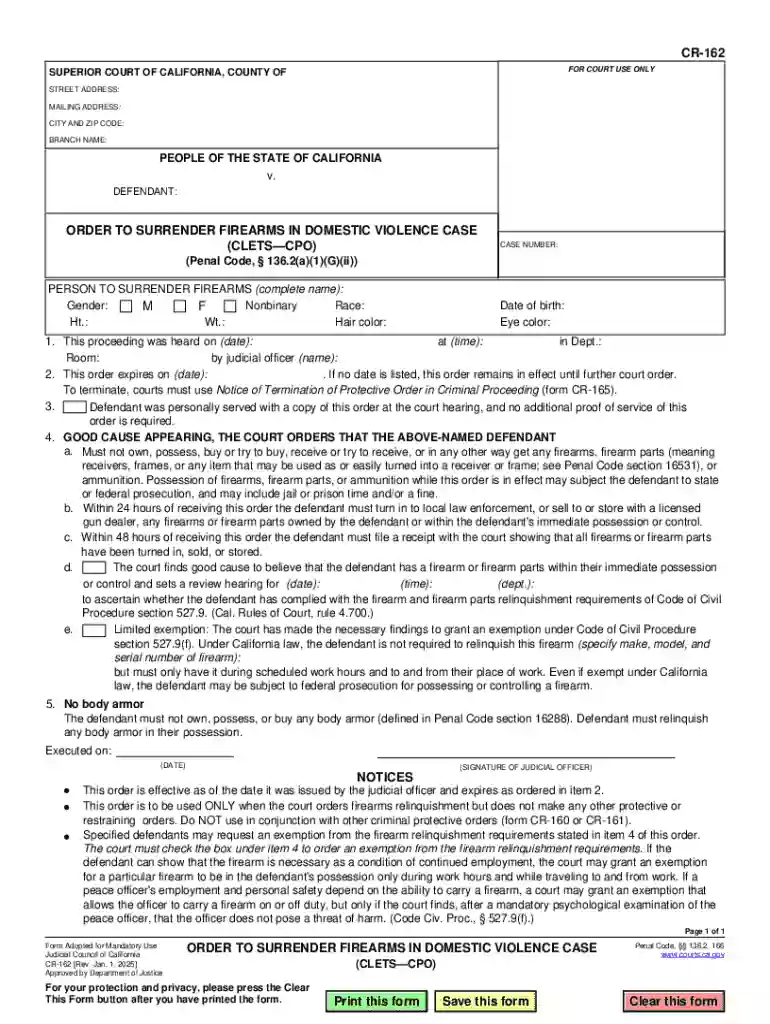
The CR-162 Order is a legal document issued by the Superior Court of California that mandates a defendant involved in a domestic violence case to surrender all firearms and body armor they possess. This court order outlines specific conditions under which the surrender must occur, including deadlines for compliance. These measures aim to ensure safety by removing weapons from individuals who might pose a threat. Non-compliance with this order can result in significant legal repercussions, highlighting its critical role in domestic violence proceedings.
To effectively use the CR-162 form, the defendant must understand all its stipulations and deadlines. Upon receiving the order, they should thoroughly review the document to comprehend the specific firearms and body armor surrender requirements. It's crucial to comply with the timeline for surrender as indicated in the order. Additionally, defendants should be aware of the process for requesting exemptions if certain firearms are necessary for employment. Legal counsel can provide valuable guidance to ensure compliance with these regulations, thereby avoiding potential legal consequences.
The CR-162 order is typically issued during court proceedings related to domestic violence cases. Judges may assign this order when determining the need for protective measures against the defendant. Defendant parties involved in such cases will receive this documentation directly from the court. Legal representatives of defendants or plaintiffs may also access this form through court filings or records offices to prepare for upcoming legal procedures. Understanding the context and purpose of obtaining such an order is critical for ensuring adherence to legal requirements.
Primarily, the CR-162 form is used by court officials, such as judges in domestic violence cases, to issue orders against defendants. It serves as a legal instrument to enforce the temporary surrender of firearms as part of protective measures within active domestic violence proceedings. Law enforcement agencies are also key stakeholders in this process, as they execute the surrender collection and maintain records of compliance. Legal professionals may use the order to advise clientele on compliance requirements and potential consequences for non-compliance.


The CR-162 order legally obligates individuals involved in domestic violence cases to surrender firearms to prevent potential harm. It's enforceable under California state law, highlighting its importance as a preventive measure in enhancing victim safety. Legal professionals often invoke this order to ensure compliance with domestic violence protective orders and mitigate risks of firearms-related incidents during legal proceedings.
Failure to comply with a CR-162 order can result in serious legal penalties, including contempt of court charges, fines, or incarceration. Additionally, non-compliance may lead to escalated legal actions, such as the enhancement of protective orders or additional restrictions on the defendant. Such penalties underline the critical nature of adhering to the order's requirements to avoid further legal entanglements. Legal representation is often essential in navigating the complexities associated with this order to avoid inadvertent non-compliance.
We've got more versions of the CR-162 ORDER TO SURRENDER FIREARMS IN DOMESTIC form. Select the right CR-162 ORDER TO SURRENDER FIREARMS IN DOMESTIC version from the list and start editing it straight away!
At DocHub, your data security is our priority. We follow HIPAA, SOC2, GDPR, and other standards, so you can work on your documents with confidence.
by K Roskam 2023 Cited by 16 a court issuing a final domestic violence protective order may order the respondent to surrender firearms if it finds that the respondent was in actual
Within 24 hours of receiving this order the defendant must turn in to local law enforcement, or sell to or store with a licensed gun dealer, any firearms,Read more


