




01. Edit your form online
Type text, add images, blackout confidential details, add comments, highlights and more.

Type text, add images, blackout confidential details, add comments, highlights and more.

Draw your signature, type it, upload its image, or use your mobile device as a signature pad.

Send it via email, link, or fax. You can also download it, export it or print it out.
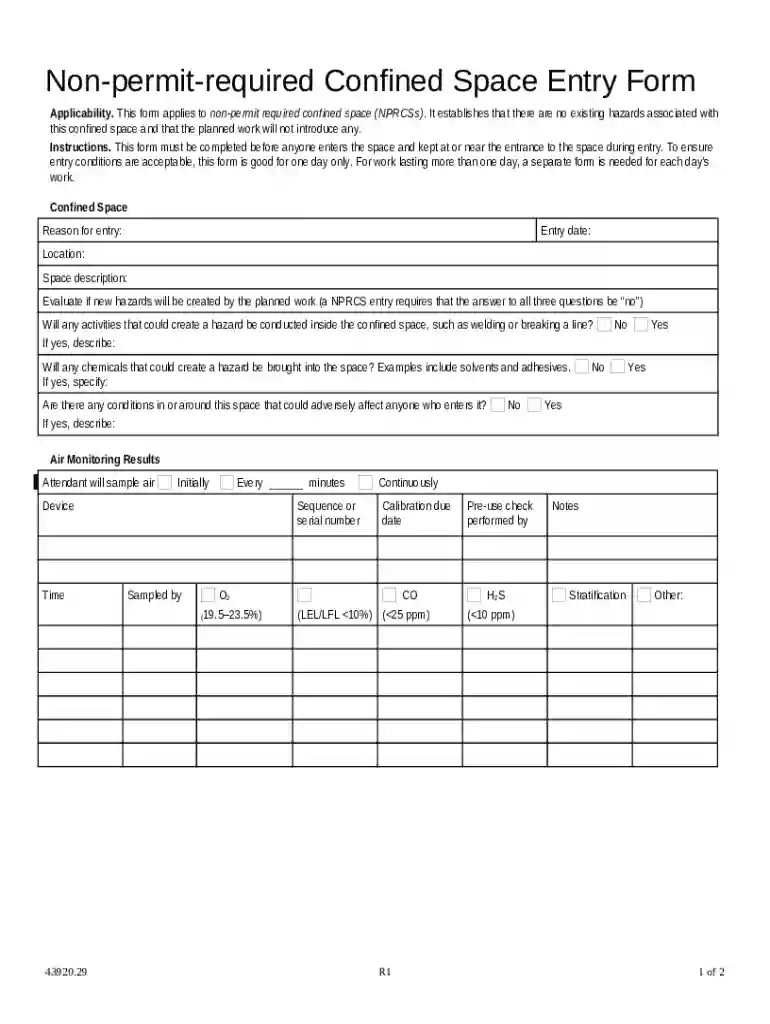
The "Confined Space Alternate Entry Form - Stanford University" is a specialized document intended for use in situations where personnel must enter confined spaces without existing hazards. This form is crucial in ensuring a safe and compliant work environment, outlining essential procedures for evaluating potential risks and documenting the entry and exit of individuals. It serves as an administrative tool to affirm that all safety measures are adhered to, complying with the safety regulations relevant to confined spaces.
Several critical components make up the Confined Space Alternate Entry Form, each designed to maintain safety and compliance:
Proper use of the Confined Space Alternate Entry Form involves a sequence of steps to ensure compliance and safety:
Completing the Confined Space Alternate Entry Form involves detailed attention to each section:
Understanding the terminology used in the form is essential for accurate completion:
The form is primarily used by:


Using the Confined Space Alternate Entry Form is a legal requirement when:
While the form follows federal guidelines, certain state-specific regulations may apply:
Consider these scenarios where the form would be used:
Each step must be followed and documented meticulously to achieve comprehensive coverage and compliance.
At DocHub, your data security is our priority. We follow HIPAA, SOC2, GDPR, and other standards, so you can work on your documents with confidence.

A detailed report from Stanford University, released in December 2008, reviewed and ranked major energy solutions to global warming and energy security. TheRead more
You are invited to voluntarily participate in a research study of BPM31510, an experimental (investigational) preparation of ubidecarenone (Coenzyme Q10,
Forms and Tools. Entry Permit Form [pdf]; Alternate Entry Form [pdf]; Non-permit Required Confined Space Entry Form [pdf]; Temporary Declassification Form [pdf]Read more


